Art Deco.
Art Deco is an early-20th-century design movement characterized by bold geometric forms, rich materials, and ornamental detail that celebrates modernity and machine-age aesthetics. In architecture, it produced distinctive buildings featuring sleek lines, zigzag patterns, sunburst motifs, and luxurious finishes that bridged decorative tradition with contemporary industrial design.
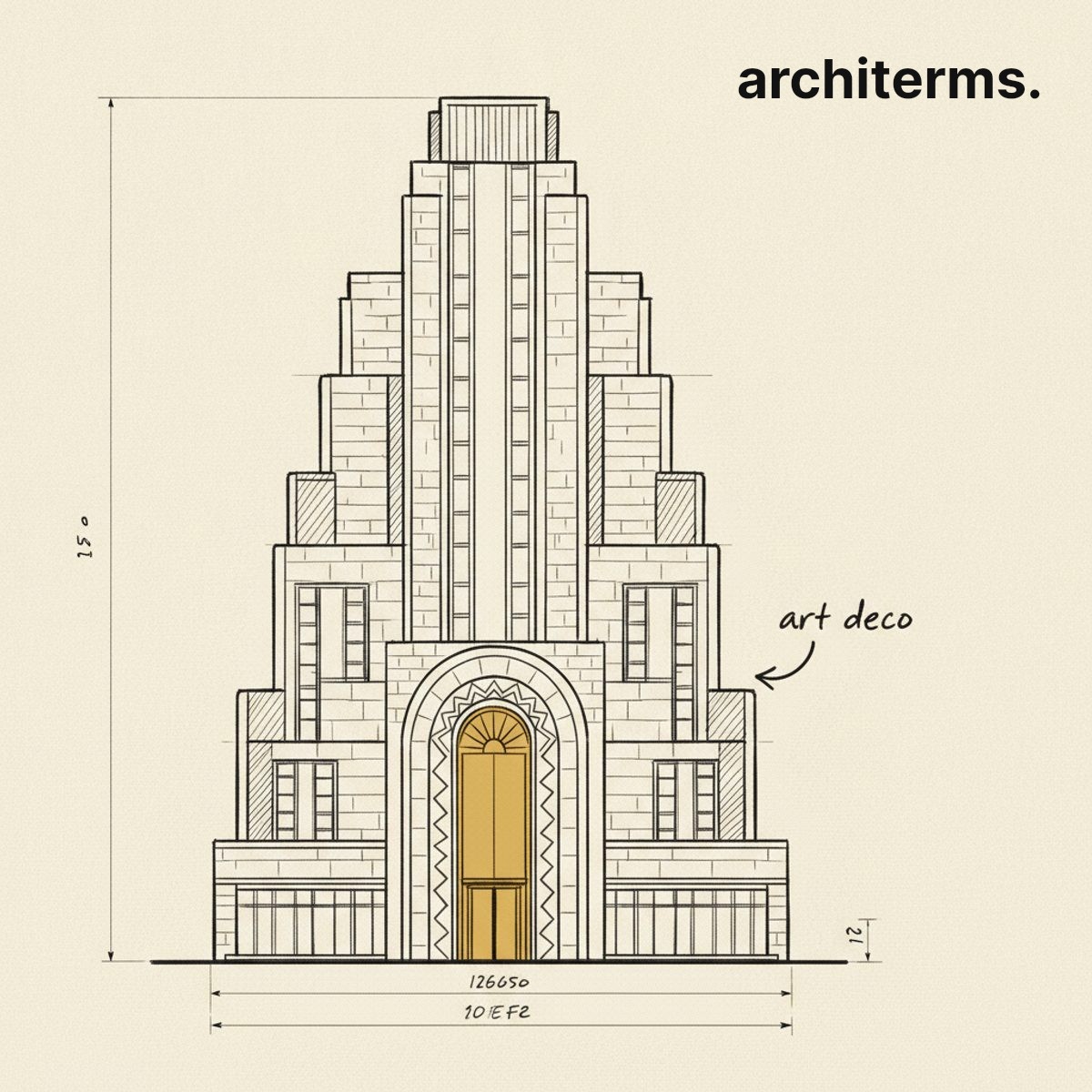
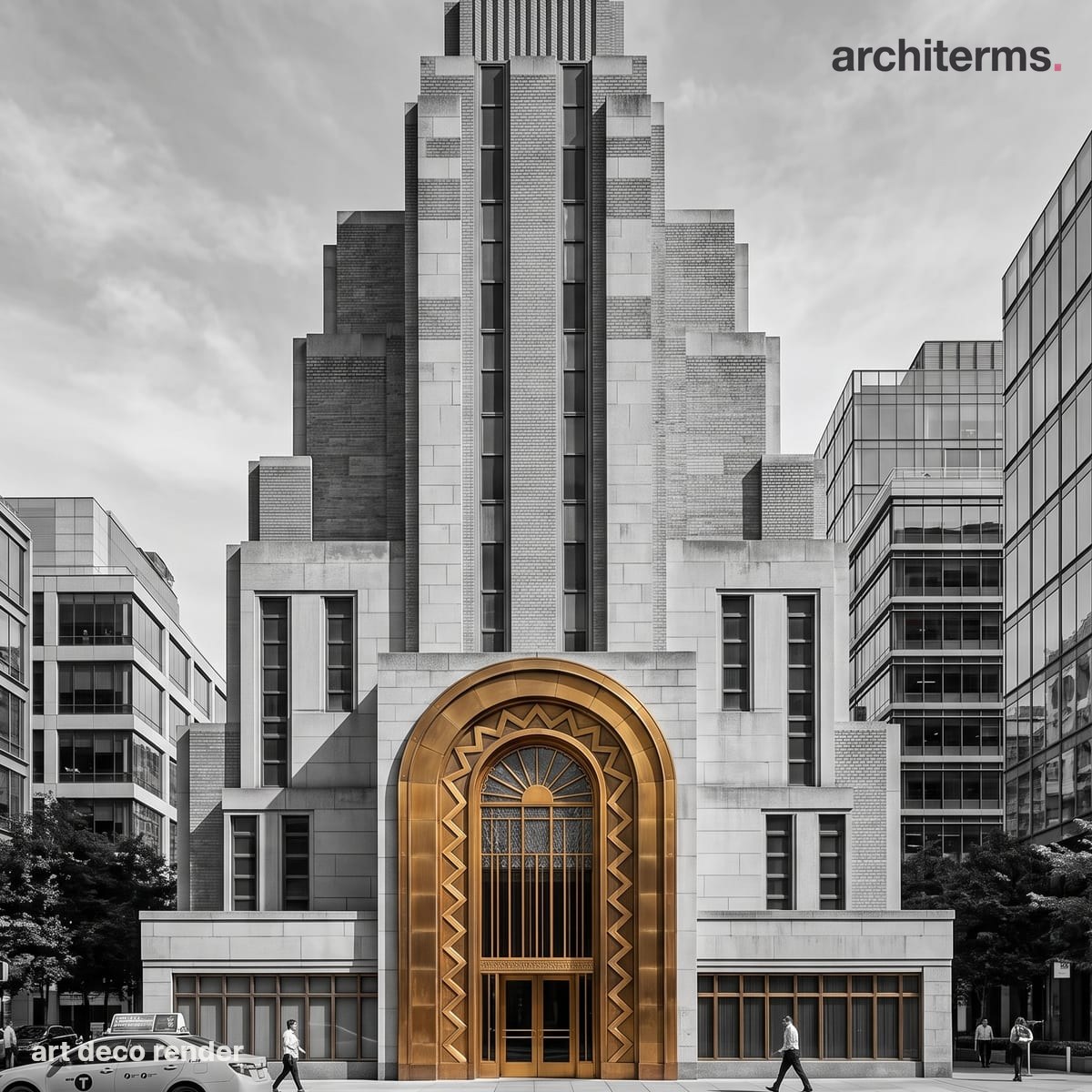
Art Deco stacks the building into stepped setbacks and dresses the vertical piers with zigzags, chevrons and sunburst motifs. Ornament here is geometric and machine-cut rather than carved from nature, celebrating industry while keeping a luxurious, decorative surface.
Made with Reviz.Design — AI visualization for architects and interior designers
Definition
Art Deco represents a pivotal moment in architectural history when ornament, geometry, and modernity converged into a cohesive aesthetic. Emerging in the 1920s and flourishing through the 1930s and early 1940s, Art Deco rejected the flowing, nature-inspired forms of Art Nouveau in favor of hard-edged geometry, streamlined profiles, and a machine-inspired vocabulary. It was an optimistic movement—one that celebrated speed, efficiency, luxury, and technological progress while still indulging in rich materials, bold color, and decorative play. Unlike the severity of International Style modernism that would follow, Art Deco allowed ornament, texture, and visual drama alongside functional form.
The term "Art Deco" derives from the 1925 Exposition Internationale des Arts Décoratifs et Industriels Modernes in Paris, where the style was officially christened and showcased. Architecturally, Art Deco is defined by several key characteristics: bold geometric and abstract forms (circles, triangles, zigzags, chevrons, and sunburst patterns); a preference for facade planes that are clean and orthogonal rather than curved; extensive use of chrome, glass, terra-cotta, and polished stone; vertical emphasis through setbacks and spires; and ornamental detail that reads as modern rather than historical. Art Deco buildings typically feature a strong vertical thrust, often achieved through setbacks, fins, or tower-like massing. Horizontally, they are articulated by banding of contrasting materials, stepped cornices, and boldly patterned molding. Windows are often grouped in long ribbon-like runs or arranged in geometric patterns. The overall impression is one of sleek confidence: a building that celebrates its own structure and materials while asserting forward momentum.
Art Deco History
Art Deco emerged in France during the 1920s as a reaction against the earlier Art Nouveau movement, which designers felt had become too organic and insufficiently modern. The 1925 Paris Exposition was a watershed moment, where designers, manufacturers, and architects from across Europe and America exhibited work that synthesized fine art, craftsmanship, and industrial production. The movement's philosophical roots lay in Cubism and Futurism—visual movements that had already fractured representation and celebrated dynamism and machine forms. Designers also drew inspiration from the geometric vocabularies of ancient Egyptian, Aztec, and Pacific cultures, which were being studied and exhibited in Western museums with growing fascination.
The 1920s saw Art Deco spread from Paris to the United States, where it found particularly fertile ground in New York, Chicago, Miami, and Los Angeles. American architects and developers embraced it because Art Deco could be applied at any scale—from a small storefront to a skyscraper—and it signaled progress, wealth, and cosmopolitan taste. In the United States, Art Deco merged with the emerging International Style and skyscraper tradition to create a distinctly American variant sometimes called Zigzag Moderne or Zig-Zag Deco.
The style peaked in the 1930s but began to fade in the late 1930s and 1940s as Modernism hardened into the purist, ornament-free dogma of the International Style. The Second World War also disrupted architectural commissions and cultural priorities. By 1945, Art Deco was considered dated by progressive architects, though it persisted in vernacular and commercial contexts, especially in Miami and in smaller towns. A revival of interest began in the 1960s and accelerated from the 1980s onward, as postmodern and contemporary architects reconsidered its humanistic, decorative qualities.
Art Deco in Architecture
Art Deco's architectural vocabulary is immediately recognizable and widely applied. In commercial and civic buildings, the style typically manifests as:
- —Setback towers: the massing steps back at various heights to create a pyramidal or wedding-cake profile, both responding to zoning regulations and creating visual drama. The Chrysler Building and Empire State Building exemplify this strategy.
- —Ornamental banding: horizontal courses of terra-cotta, glazed brick, or stone in contrasting colors or with geometric patterns (chevrons, zigzags, sunbursts) that mark floor plan levels or mark the transition between massing stages.
- —Facade articulation: the facade is rarely blank; it is composed of distinct zones—a rusticated or detailed base, a main shaft of offices or studios marked by regular fenestration, a decorative crown. Windows are grouped in arcade-like runs or separated by prominent mullions that create a grid. Some buildings use brick veneer in multiple colors to create patterns; others rely on limestone, granite, or polished granite facing.
- —Ornamental detail: spandrels between windows, friezes, cornices, and corner treatments are rich with geometric and stylized natural motifs. A sunburst, a stylized lightning bolt, a geometric flower, or an abstract cloud form might appear on a capital or as a cast-stone element. These ornaments are not naturalistic but abstracted, simplified, and mathematized.
- —Entrance porticos and lobbies: ground-floor entrances are often grandly detailed, with dark marble, polished metal, and brass fixtures. The lobby becomes a mini-gallery of Art Deco luxury—a vertical volume rising two or three stories with geometric light fixtures, marquee signage, and richly finished walls. This tradition of the luxurious lobby became an enduring feature of the American commercial building and influenced lobbies in hotels, apartments, and office buildings even after Art Deco's peak.
Materials in Art Deco architecture are deliberately luxurious and high-contrast. Terra-cotta in yellow, green, or cream; limestone, granite, and polished stone; chrome and nickel plating; glass block; and enameled metals are favored. The richness of materials signals quality and permanence. Many Art Deco buildings employed integrated ornamental terra-cotta, cast stone, or decorative brickwork in which the ornament was literally built into the facade rather than applied. This durability and craftsmanship, combined with bold geometry, gave Art Deco buildings a visual presence that has endured for nearly a century.
Notable Art Deco buildings include:
- —The Chrysler Building (New York, 1930): perhaps the most iconic Art Deco skyscraper, featuring a crown of triangular windows, stainless-steel cladding, sunburst reliefs, and a 77-meter spire. Its setback profile and ornamental crown established a template for the style.
- —The Empire State Building (New York, 1931): a more austere example, emphasizing verticality and geometric simplicity while still employing limestone facing, decorative molding, and a prominent setback profile.
- —Guardian Building (Detroit, 1929): a tour de force of polychromatic terra-cotta, with vertical striping in cream, orange, and green, and ornamental banding that celebrates color and material.
- —Eastern Columbia Building (Los Angeles, 1930): a smaller but exquisite example, with a turquoise and gold terra-cotta facade, a corner tower, and a rooftop sign. The fenestration is bold and rhythmic.
- —Miami Deco District: an entire neighborhood (roughly 1923–1943) of modest Art Deco hotels, apartments, and commercial buildings in pastel and vibrant colors, using simplified geometric forms and colorful relief ornament. This area, threatened by demolition in the 1970s, became a symbol of the style's historical importance.
- —Radiator Building (New York, 1924): an earlier example with a black brick facade and golden terra-cotta banding, creating a striking chromatic contrast. Its vertical emphasis and ornamental crown are quintessentially Art Deco.
- —Majestic Theatre (San Antonio, 1929): demonstrates Art Deco applied to a specialized building type, with ornamental plasterwork, geometric stage design, and a glamorous interior.
Beyond tall commercial buildings, Art Deco was applied to residential buildings, theaters, hotels, restaurants, libraries, and civic structures. The Hoover Factory near London, the Bullocks Wilshire Department Store in Los Angeles, and countless Art Deco theaters (often called "movie palaces") show the style's range. In Europe, Art Deco appeared in Scandinavia, Britain, and Eastern Europe, though often in more restrained form than American examples.
Types of Art Deco
Art Deco architecture is sometimes subdivided by regional or temporal variation:
- —French Art Deco: typically more refined, with emphasis on fine materials, subtle geometry, and craft. Examples include the Samaritaine department store and various Parisian apartment buildings.
- —American Zigzag Moderne or Zig-Zag Deco: emphasizes bold, emphatic geometric patterns (zigzags, chevrons, lightning bolts) and vertical thrust. Applied extensively to skyscrapers and commercial buildings in major American cities.
- —Streamline Moderne: a later phase (late 1930s–early 1940s) that borrowed from transportation design, emphasizing curves, chrome, and velocity-inspired forms. This variant is sometimes considered a distinct style but overlaps significantly with late Art Deco. The Greyhound bus stations and many gas stations adopted streamline forms.
- —Miami Deco: a vernacular regional variant using bright pastel colors, simplified geometric forms, and ornamental terra-cotta applied to modest apartment and hotel buildings. Often called Tropical Deco when it incorporated local materials or climate-responsive features.
Art Deco vs. International Style
A common point of confusion is the relationship between Art Deco and the International Style. Both emerged in the 1920s–1930s, and they coexisted and sometimes overlapped. However, they represent different philosophies. The International Style (associated with the Bauhaus, Le Corbusier, and Mies van der Rohe) rejected ornament entirely, calling for pure geometric form stripped of decoration and reduced to essential structure and material. It was utopian, rationalist, and purist. Art Deco, by contrast, celebrated ornament, color, and luxury alongside modernity. An Art Deco building will have decorative reliefs, patterned molding, colored materials, and visual drama. An International Style building will typically be austere, without applied ornament, favoring glass, steel, and concrete in their raw or neutral state. The two styles can appear similar in their embrace of geometric form and clean lines, but their intent is fundamentally different. The Chrysler Building (Art Deco) and the Lever House (International Style, 1952) represent these poles—one ornamental and exuberant, the other austere and rational.
Art Deco in Contemporary Architecture
Art Deco fell out of critical favor for decades but has been reassessed and celebrated since the 1970s, especially after the preservation of Miami Beach's Art Deco Historic District. Contemporary architects have occasionally referenced Art Deco motifs—geometric patterns, setbacks, ornamental detail—in postmodern and contextual projects. The 1980s Post-Modernist movement, in particular, found in Art Deco a precedent for the reintroduction of ornament and color. Today, Art Deco remains influential in commercial interior design, branding, and sometimes in residential architecture where a sophisticated, vintage-modern aesthetic is desired. Its legacy is visible in the design principles it exemplified: the marriage of ornament and function, the celebration of materials, and the conviction that modern buildings can be beautiful, not merely functional.
Frequently Asked Questions
What is Art Deco in architecture?
Art Deco is an early-20th-century design movement (1920s–1940s) characterized by bold geometric forms, sleek lines, rich materials, and decorative ornament. In architecture, it produced distinctive buildings with setback massing, vertical emphasis, geometric patterns (zigzags, sunbursts), polished stone or terra-cotta, and luxurious finishes. It celebrated modernity and machine-age aesthetics while maintaining a humanistic, decorative approach.
What is the difference between Art Deco and International Style architecture?
Both styles emerged in the 1920s–1930s but have opposite philosophies. Art Deco embraces ornament, color, and luxury alongside geometric form—buildings feature decorative reliefs, patterned details, and rich materials. The International Style rejects ornament entirely, calling for pure, austere form stripped to essential structure and neutral materials like glass and steel. Art Deco buildings (like the Chrysler Building) are visually dramatic; International Style buildings are austere and rationalist.
Where did Art Deco originate in architecture?
Art Deco emerged in France during the early 1920s and was formally christened at the 1925 Exposition Internationale des Arts Décoratifs et Industriels Modernes in Paris. It was a reaction against Art Nouveau and drew inspiration from Cubism, Futurism, and non-Western geometric traditions. From Paris, it spread rapidly to the United States, where it became especially prominent in skyscraper design in New York, Chicago, and Los Angeles.
What are common features of Art Deco buildings?
Common features include setback massing (stepped tower profiles), strong vertical emphasis through piers or fins, bold geometric ornament (zigzags, chevrons, sunbursts), contrasting bands of polished stone or terra-cotta, geometric fenestration patterns, and luxurious ground-floor lobbies. Colors, metallics, and decorative reliefs are integral. The overall effect celebrates modernity, progress, and luxury while maintaining visual drama and detailed craftsmanship.
What are examples of famous Art Deco buildings?
Famous examples include the Chrysler Building and Empire State Building in New York, the Guardian Building in Detroit with its polychromatic terra-cotta, the Eastern Columbia Building in Los Angeles, the entire Miami Beach Art Deco Historic District, and the Radiator Building in New York. These buildings showcase setback profiles, ornamental detail, rich materials, and the vertical emphasis that define the style.