Capital.
A capital is the topmost element of a column, serving as a transition between the column shaft and the load above (such as an architrave or arch). In plain terms: it's the 'crown' of the column that distributes weight and provides decorative detail.
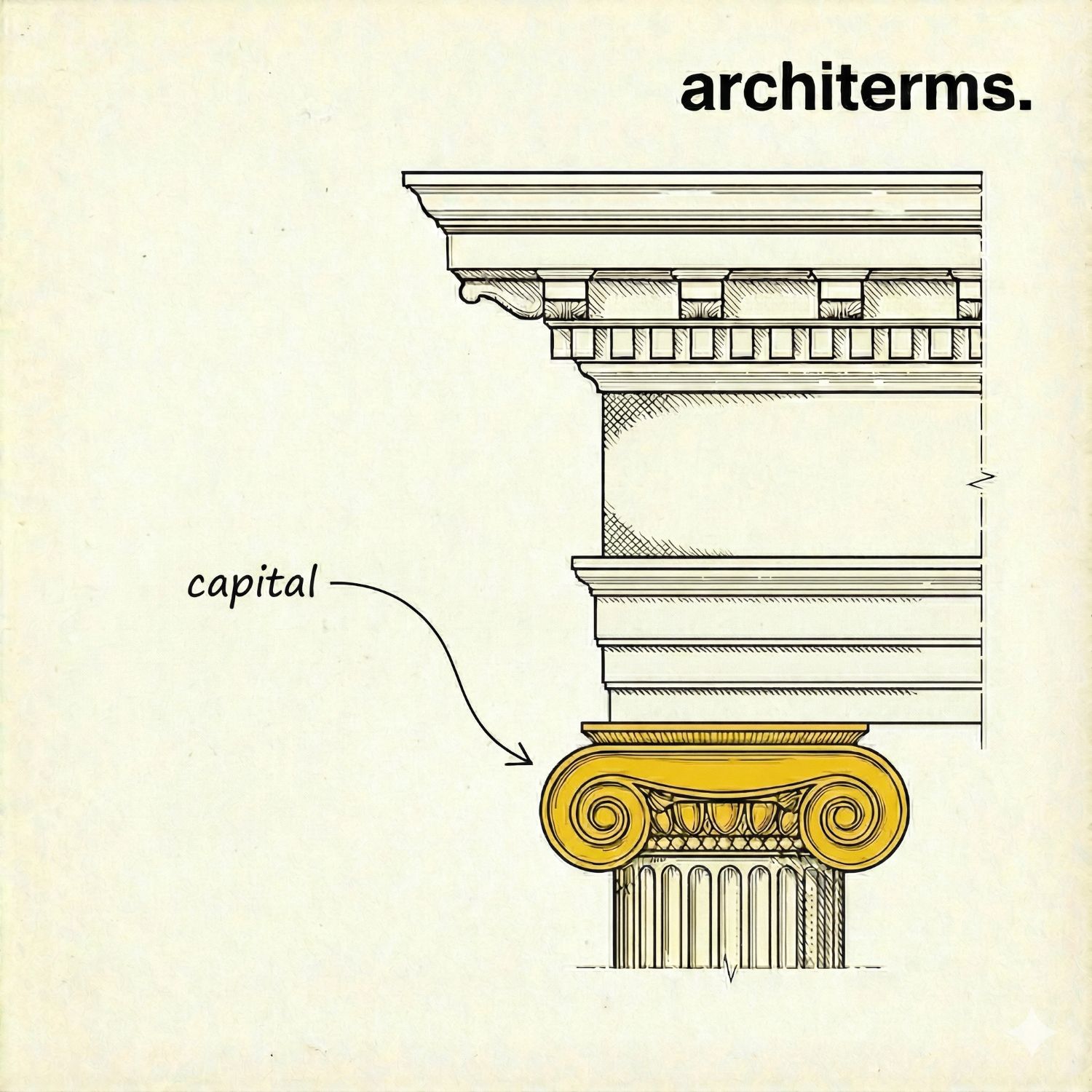
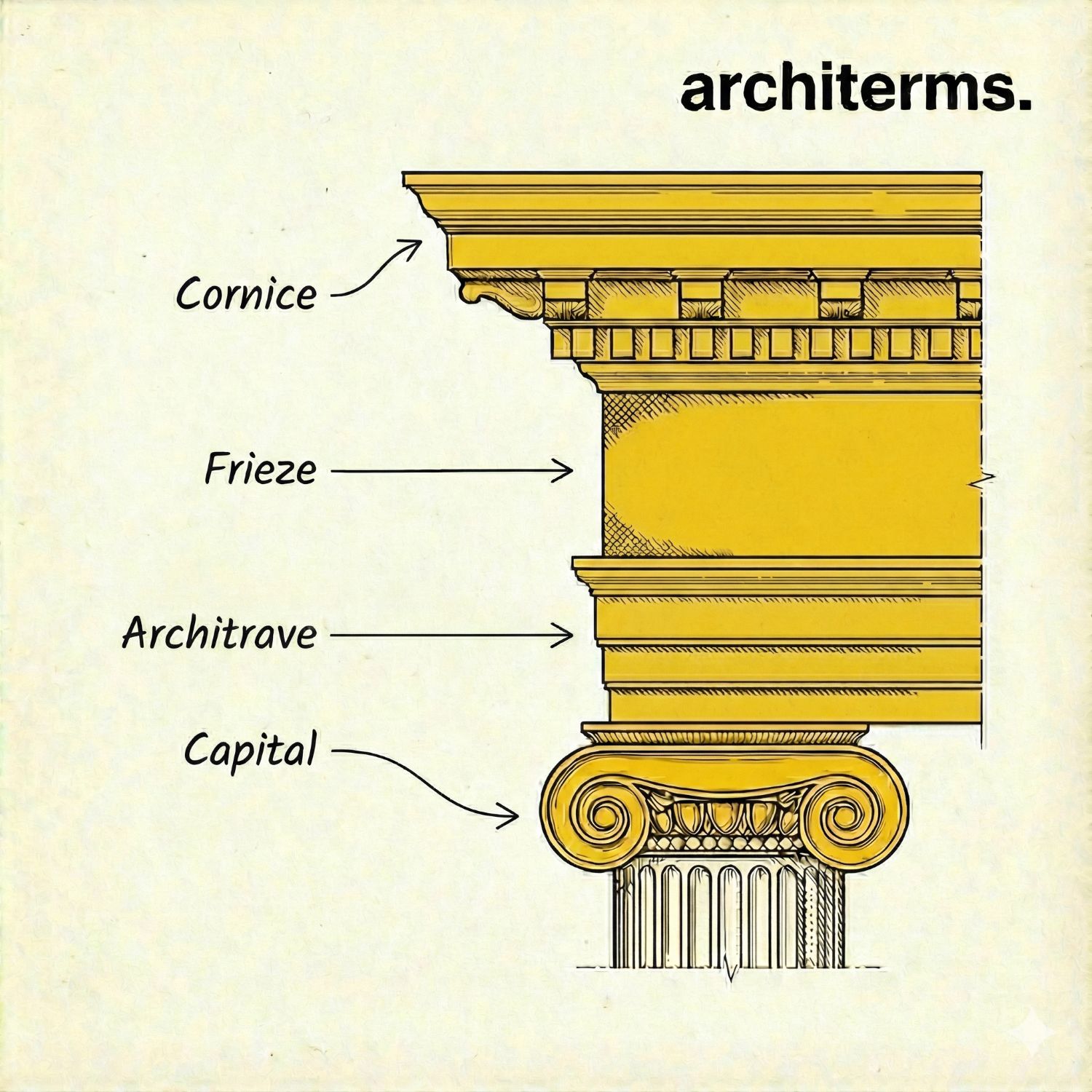
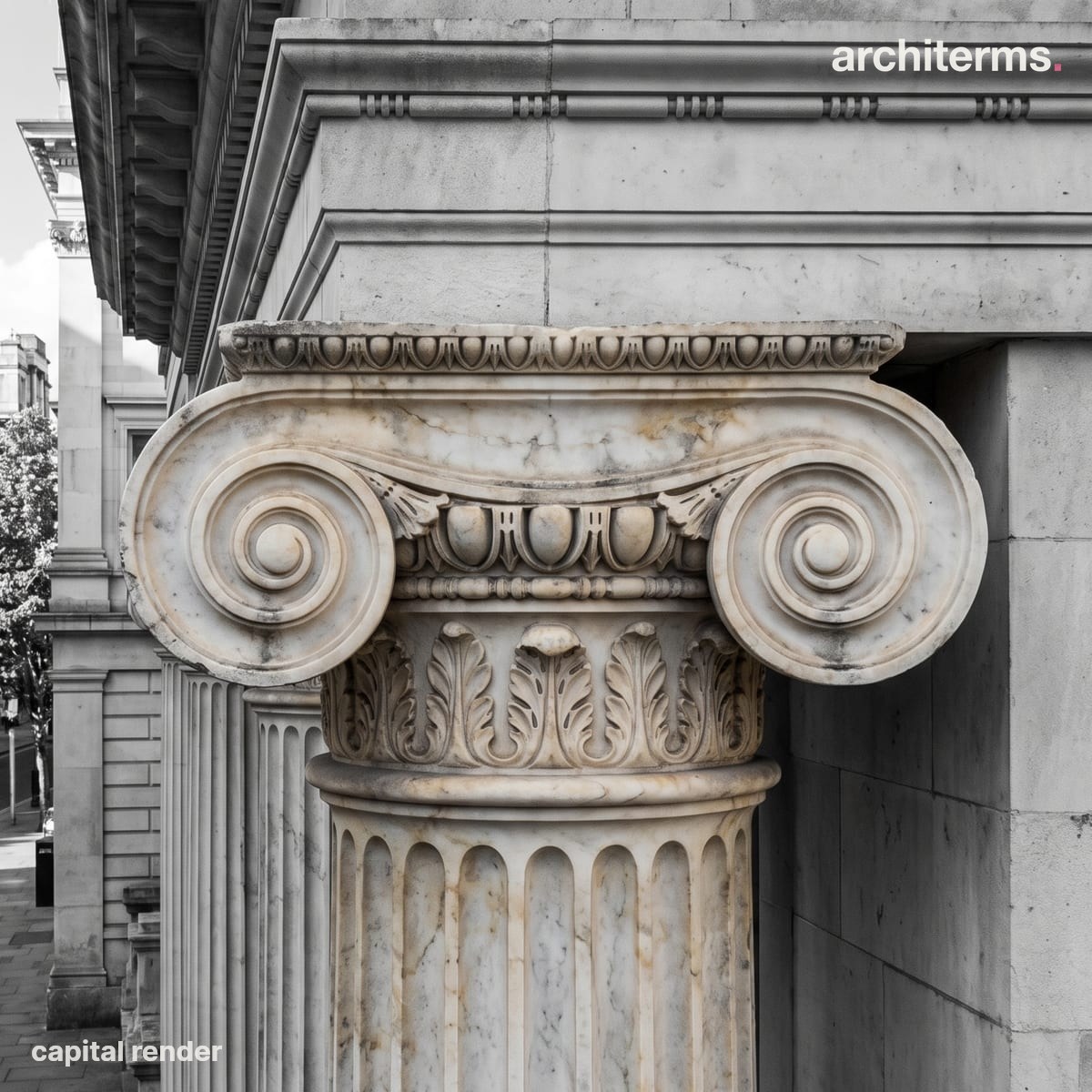
The capital caps the column shaft and widens toward the top, spreading the concentrated load of the architrave or arch above across the narrower shaft below. Its carved surface also marks the order to which the column belongs.
Rendered with Reviz.Design — AI visualization for architects and interior designers
Definition
A capital (from Latin "caput," meaning "head") is the topmost element of a column, positioned between the column shaft and the entablature or arch above. The capital serves both structural and aesthetic functions: it distributes the load from above across the column, and it provides a decorative transition that defines the architectural order.
In classical architecture, the capital is one of the three main parts of a column (base, shaft, capital). The capital's design is a key identifier of the architectural order—Doric, Ionic, Corinthian, and their variations each have distinct capital forms.
The capital acts as a visual and structural "crown" for the column, marking the transition from vertical support to horizontal load-bearing elements. Its design reflects both engineering considerations (distributing loads) and aesthetic choices (defining style and proportion).
Capital architecture
In capital architecture, the capital plays a critical role in classical design systems:
Structural function: The capital distributes loads from the entablature or arch above across the column shaft. This requires careful engineering to ensure the capital can handle compressive forces without failure.
Aesthetic function: The capital provides a decorative transition between the column shaft and the elements above. It is one of the most visible and recognizable elements of classical architecture.
Order identification: The capital's design is the primary identifier of the architectural order. Doric capitals are simple and geometric; Ionic capitals feature volutes (scrolls); Corinthian capitals are elaborate with acanthus leaves.
Proportional system: Capital proportions are carefully calculated as part of the classical orders. Each order has specific proportions for the capital relative to the column shaft and overall height.
Material expression: Capitals can be made from stone, marble, wood, or modern materials like concrete or composite materials. The material choice affects both appearance and structural capacity.
Historical significance: Capitals have been used in architecture for thousands of years, evolving from simple forms to elaborate decorative elements that define architectural styles.
Column Capital
In Column Capital design, the capital is integrated with the column system:
Integration with column: The capital sits directly on top of the column shaft, forming a seamless transition. The connection must be structurally sound and visually harmonious.
Load distribution: The column capital distributes loads from the entablature (architrave, frieze, cornice) or arch above. This requires the capital to be properly sized and proportioned for the loads it will carry.
Visual hierarchy: The capital creates a visual hierarchy, marking the transition from vertical (column) to horizontal (entablature) elements. This hierarchy is essential to classical composition.
Decorative detail: Column capitals are often the most decorative element of the column, featuring carvings, moldings, or sculptural elements that reflect the architectural order.
Proportional relationships: Column capital proportions are carefully calculated relative to the column shaft diameter and height. These proportions create the harmony characteristic of classical architecture.
Material continuity: The capital is typically made from the same material as the column shaft, creating visual and structural continuity. In some cases, capitals may use different materials for decorative effect.
Column Capital architecture
In Column Capital architecture, capitals are essential elements of classical design:
Doric capital: The Doric capital is the simplest form, consisting of a circular abacus (top plate) and an echinus (curved molding). It reflects the Doric order's emphasis on strength and simplicity.
Ionic capital: The Ionic capital features volutes (spiral scrolls) on the front and back, creating a more decorative form. The volutes are the defining characteristic of the Ionic order.
Corinthian capital: The Corinthian capital is the most elaborate, featuring acanthus leaves arranged in rows, with small volutes at the corners. It reflects the Corinthian order's emphasis on elegance and refinement.
Composite capital: The Composite capital combines elements of Ionic and Corinthian orders, featuring both volutes and acanthus leaves. It represents a synthesis of classical design elements.
Tuscan capital: The Tuscan capital is similar to Doric but simpler, with a plain abacus and minimal decoration. It reflects the Tuscan order's rustic character.
Modern capitals: Contemporary architecture may use simplified or abstracted capital forms, maintaining the concept of a transition element while adapting to modern design languages.
Column capital in flat slab
In Column capital in flat slab construction, capitals serve a specific structural function:
Flat slab system: In flat slab construction, the slab is supported directly by columns without beams. Column capitals (also called drop panels) are thickened areas of the slab around the column that help distribute loads.
Structural function: Column capitals in flat slabs increase the slab's capacity to resist punching shear (the tendency of the column to "punch through" the slab). The capital provides additional depth and reinforcement area.
Design requirements: Flat slab capitals must be properly sized and reinforced to handle the loads from the slab above. Building codes specify minimum dimensions and reinforcement requirements.
Form and appearance: In flat slab construction, capitals may be visible (forming a decorative element) or hidden within the slab thickness. Visible capitals can be designed to reference classical forms.
Reinforcement: Column capitals in flat slabs require additional reinforcement to handle the concentrated loads and prevent failure. This reinforcement is typically placed in the capital region.
Construction methods: Flat slab capitals can be formed using various methods, including cast-in-place concrete, precast elements, or composite systems. The method affects both structural performance and appearance.
Integration with slab: The capital must be properly integrated with the slab, ensuring smooth load transfer and preventing stress concentrations that could cause failure.
Column capital types
Column capital types vary by architectural order and historical period:
Doric capital: Simple geometric form with circular abacus and echinus. Characterized by strength and simplicity. Used in Greek and Roman Doric orders.
Ionic capital: Features volutes (spiral scrolls) on front and back. More decorative than Doric. Characteristic of Ionic order in Greek and Roman architecture.
Corinthian capital: Most elaborate form with acanthus leaves arranged in rows. Features small volutes at corners. Represents the height of classical decorative refinement.
Composite capital: Combines Ionic volutes with Corinthian acanthus leaves. Represents synthesis of classical orders. Developed in Roman architecture.
Tuscan capital: Simplest form, similar to Doric but even more plain. Characteristic of Tuscan order, a Roman variation of Doric.
Byzantine capital: Developed in Byzantine architecture, featuring abstracted classical forms and Christian symbolism. Often includes basket-like forms with decorative carving.
Gothic capital: In Gothic architecture, capitals feature naturalistic foliage and decorative elements. Reflects the period's emphasis on verticality and organic forms.
Renaissance capital: Renaissance architects revived classical capital forms, studying ancient examples and applying them to new buildings. Often more refined than original classical examples.
Modern capital: Contemporary architecture may use simplified, abstracted, or completely new capital forms. Some modern buildings omit capitals entirely, while others reinterpret classical forms.
Regional variations: Different regions and cultures have developed their own capital types, adapting classical forms to local materials, techniques, and aesthetic preferences.
History
The capital has a long history in architecture, evolving from simple functional elements to elaborate decorative forms:
Ancient origins: Early capitals were simple functional elements, providing a transition between column and load above. Examples from ancient Egypt and Mesopotamia show basic capital forms.
Greek architecture: Greek architects developed the classical orders with distinct capital types. Doric, Ionic, and Corinthian capitals became the foundation of Western architectural tradition.
Roman architecture: Roman architects adopted and refined Greek capital forms, adding the Composite order and developing regional variations. Roman capitals were often more elaborate than Greek examples.
Byzantine architecture: Byzantine capitals evolved from classical forms, incorporating Christian symbolism and abstracted decorative elements. Basket capitals became characteristic of Byzantine architecture.
Medieval architecture: Medieval capitals featured naturalistic carving and regional variations. Romanesque capitals were often narrative, while Gothic capitals emphasized verticality and organic forms.
Renaissance revival: Renaissance architects studied classical capitals and applied them to new buildings. This period saw a revival of classical proportions and decorative elements.
Neoclassical period: Neoclassical architecture emphasized faithful reproduction of classical capital forms, studying ancient examples and applying them to contemporary buildings.
Modern era: Modern architecture simplified or eliminated capitals, focusing on structural expression rather than decorative elements. Some modern buildings reinterpret classical forms in new materials.
Contemporary architecture: Today, capitals are used in both traditional and modern contexts, from classical revival buildings to contemporary designs that reference classical concepts.
Application
Classical architecture: In classical and neoclassical buildings, capitals are essential elements that define the architectural order. They are used in columns, pilasters, and other vertical elements.
Temple architecture: Classical temples use capitals as part of the peristyle (colonnade) that surrounds the cella (inner chamber). Capital design reflects the temple's order and style.
Civic buildings: Government buildings, courthouses, and civic structures use capitals to convey authority and reference classical tradition. Capital design contributes to the building's symbolic meaning.
Residential architecture: High-style residential buildings may use capitals in porches, porticos, or interior columns. Capital design reflects the building's style and level of formality.
Modern buildings: Contemporary buildings may use simplified or abstracted capital forms, maintaining the concept of a transition element while adapting to modern design languages.
Historic preservation: In historic preservation projects, capitals are carefully restored or replicated to match original designs. This may involve custom fabrication or specialized materials.
Interior design: Capitals are used in interior design to create classical references, define spaces, and provide decorative transitions between vertical and horizontal elements.
Common confusion
Capital vs column: The capital is the topmost element of the column, not the column itself. The column consists of base, shaft, and capital.
Capital vs abacus: The abacus is the topmost part of the capital (the flat plate), not the entire capital. The capital includes the abacus and the decorative elements below it.
Capital vs entablature: The capital is part of the column, while the entablature sits on top of the capital. They are adjacent but distinct elements.
Capital vs base: The capital is at the top of the column, while the base is at the bottom. They serve different functions and have different designs.
Doric vs Ionic capital: Doric capitals are simple with circular abacus and echinus. Ionic capitals feature volutes (scrolls) and are more decorative.
Corinthian vs Composite capital: Corinthian capitals feature acanthus leaves. Composite capitals combine Ionic volutes with Corinthian acanthus leaves.
Capital vs drop panel: In flat slab construction, the term "capital" may refer to a drop panel (thickened slab area). This is different from the classical architectural capital, though the concept of load distribution is similar.
Classical vs modern capital: Classical capitals are decorative elements that define architectural orders. Modern capitals may be simplified, abstracted, or serve primarily structural functions.