Caryatid.
A caryatid is a sculptured female figure that serves as a supporting column or pilaster in classical architecture. Instead of a plain cylindrical column, the figure itself—carved in the round or in relief—bears the structural load of the entablature or architectural element above.
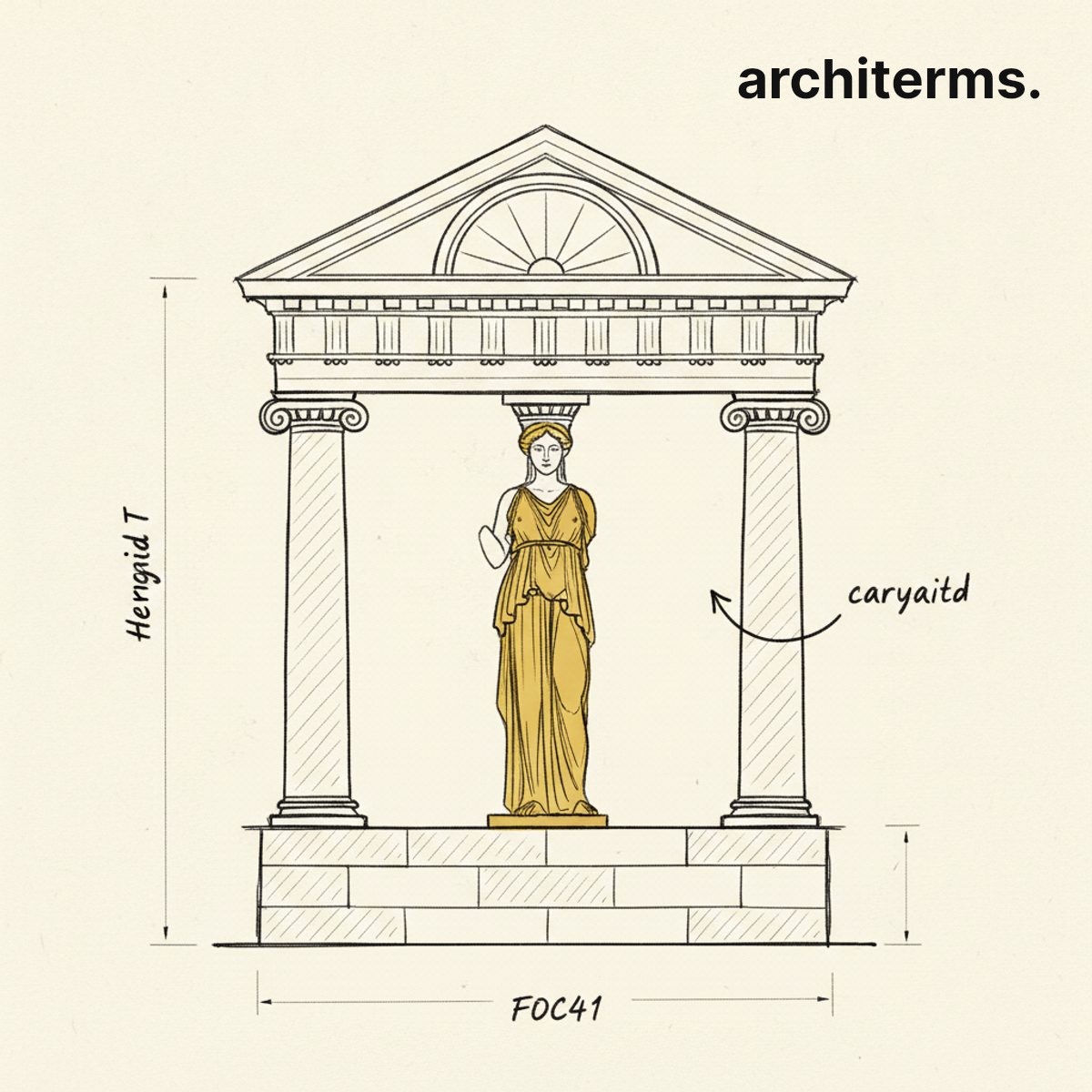
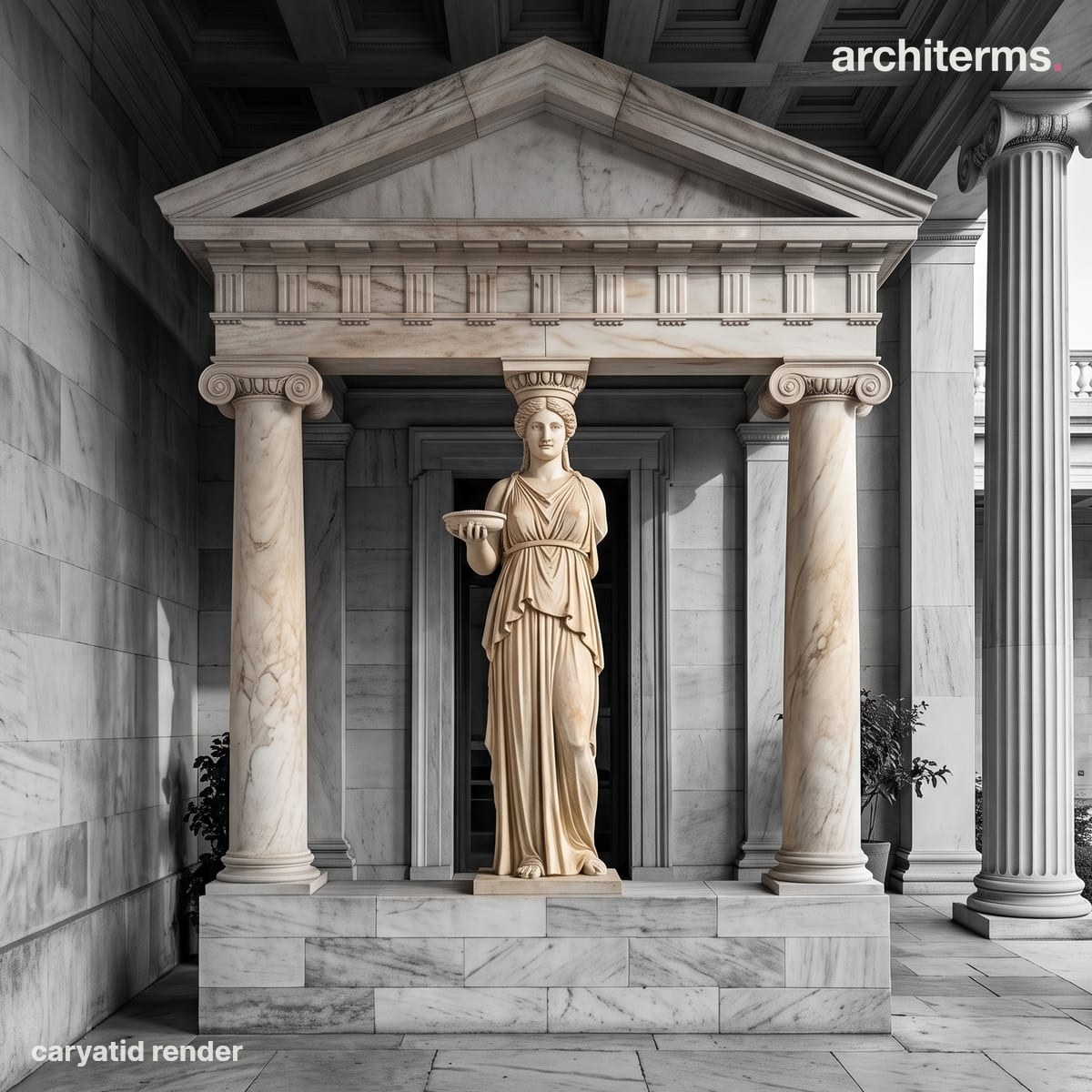
A caryatid takes the place of a column: the standing figure bears the entablature on her head, the load passing down through the neck and rigid stance into the base. The drapery falls in straight vertical folds that echo the fluting of a shaft.
Made with Reviz.Design — AI visualization for architects and interior designers
Definition
A caryatid is one of the most distinctive and visually arresting structural elements in classical architecture, combining utility and sculptural beauty into a single form. Rather than relying on an abstract geometric column, a caryatid substitutes a full-length human figure—nearly always a draped woman—to carry the weight of beams, lintels, or entablatures. The figure stands erect, often with idealized proportions and classical dress, and the load transfers through her head or shoulders into the foundation below. This approach transforms a purely functional support into an anthropomorphic monument, creating a conversation between human scale, strength, and ornament.
The term "caryatid" derives from the ancient Greek "karyatides," meaning "maidens of Karyai" (a town in Sparta, though the etymology remains debated). Architecturally, a caryatid is defined as a capital or upper portion of a column replaced by a sculpted human (typically female) figure that performs the load-bearing function of a column or pier. Unlike a pilaster (a flat, attached column), a caryatid is three-dimensional and often free-standing or partially detached. The opposite male figure—less common but equally valid—is called an atlas or atlantid. Caryatids are typically monolithic or carved from a single block, though they may also be assembled from multiple pieces. The sculptural detail may be highly refined, with drapery folds, facial features, and ornament added through carving or paint.
Caryatid History
Caryatids emerged in ancient Greece during the Archaic and Classical periods (6th to 4th centuries BCE), though their exact origins and symbolic meaning remain subjects of scholarly debate. The earliest prominent example is the Erechtheion on the Acropolis in Athens (circa 421–406 BCE), where four draped female figures form the south porch, collectively known as the Porch of the Maidens. These figures are carved from marble in the Ionic order style, with elaborate drapery and idealized features characteristic of late Classical Greek sculpture. Their precision and refinement established a template for the form that would persist for two millennia.
The Romans adopted and adapted the caryatid, incorporating them into both public monuments and domestic architecture. Examples appear in private residences in Pompeii and Herculaneum, where they were often smaller, more decorative features rather than primary structural supports. During the Renaissance (14th to 17th centuries), the rediscovery of Greco-Roman antiquity sparked renewed interest in caryatids as learned architects and patrons sought to emulate and reinterpret classical forms. Renaissance caryatids often appeared in churches, palaces, and civic buildings, sometimes paired with atlases to create compositional balance.
The Baroque and Neoclassical eras saw intensive use of caryatids, particularly as ornamental supports for cornices, balconies, and entablature elements. The 18th and 19th centuries witnessed a scholarly revival of Greco-Roman architecture, and caryatids became fashionable in European academic and eclectic styles. By the 20th century, modernism's rejection of ornament diminished the use of caryatids, though they persisted in historicizing, postmodern, and classical revival architecture. Contemporary classical and contextualist architects continue to employ caryatids where historical continuity or human-scaled ornament is desired.
Caryatid in Architecture
Caryatids serve several simultaneous functions. Structurally, they transfer loads as efficiently as any column—the compressive forces from above travel through the sculpted figure and into the base or footing below. Visually, they humanize the building by introducing the human figure at a monumental scale, creating an intimate connection between building users and the architecture itself. Symbolically, they can represent female virtue, support, servitude, or divine presence, depending on the context and period.
Caryatids are found in specific architectural contexts:
- —Balconies and cantilevers: Renaissance and Baroque buildings frequently placed caryatids beneath cantilever balconies, where their sculptural presence adds visual support and enrichment to the projecting element.
- —Interior chambers and courts: Caryatids appear in courtyards, halls, and atriums where their sculptural quality enhances the spatial experience. Interior caryatids are often more elaborate and finely detailed because they face closer viewing distances.
- —Decorative frieze and relief panels: Sometimes caryatids are rendered in relief rather than in the round, appearing as part of a frieze or decorative band along a wall. These are typically non-structural and purely ornamental.
Notable examples include the Erechtheion's Porch of the Maidens (Athens, circa 421–406 BCE), one of the most copied models in architectural history; the Tower of the Winds (Athens, Hellenistic period), which incorporates male atlases representing wind gods; Renaissance palaces in Italy, such as the Palazzo Ducale in Urbino and various buildings in Florence and Rome, where caryatids frame windows and support lintels; the Hermitage museum in Saint Petersburg, where caryatids and atlases support upper-floor cornices; and neoclassical civic buildings across Europe and the Americas, where caryatids signal classical learning and permanence.
From a design perspective, caryatids create several effects. They establish a clear, legible rhythm along a façade—each figure marks a bay or structural interval, much as a colonnade would. They introduce scale through anthropomorphic proportion: viewers can measure the building against their own bodies. They also soften the severity of structural geometry by infusing it with human imagery, a strategy particularly valued in classical and revival architecture. The drapery of a caryatid's robe often echoes the fluting of a column or the lines of the entablature, creating visual continuity between the figure and the structural system.
Caryatids also interact with other classical elements. They typically rest on a base or plinth (a plain or molded platform), and they are often crowned by a capital (though the caryatid itself may be carved to suggest a capital-like transition at the top). They frequently appear in conjunction with other Classical orders—an Ionic or Corinthian cornice overhead, for example—creating a layered, hierarchical composition.
Types of Caryatids
Caryatids vary by gender, style, and function:
- —Female caryatids: The standard form, representing idealized feminine beauty and virtue. The Erechtheion Maidens are the quintessential example.
- —Male figures (atlases or atlantids): Less common but equally valid. Often represent strength, heroism, or divine male figures. Examples include wind gods in the Tower of the Winds and Hercules figures in Renaissance buildings.
- —Draped caryatids: Fully clothed in classical dress (chiton, peplos, or drapery), emphasizing modesty and formality. Most canonical examples are draped.
- —Partially draped or nude caryatids: Rarer, appearing in contexts where sensuousness or divine nakedness was permissible. Some Renaissance and Baroque examples tend toward greater undress.
- —High relief caryatids: Carved in profile or semi-three-dimensional form, often as part of a larger façade panel or cornice. Less structurally ambitious than free-standing figures.
- —Monumental caryatids: Large-scale figures (often over life-size) serving as primary structural supports in important public buildings.
- —Miniature caryatids: Small-scale figures used as decorative supports for furniture, vessels, or interior furnishings.
Caryatid vs. Atlases
Caryatids are female figures; atlases (or atlantids) are male equivalents. Both perform the same structural and ornamental function. Atlases are named after Atlas, the Titan who carried the heavens, and they often embody themes of masculine strength and burden. In architectural ensembles, caryatids and atlases are sometimes paired—caryatids on one side, atlases on the other—to create compositional balance and to suggest complementary gender roles (a practice more common in Renaissance and Baroque design than in ancient Greek architecture).
Caryatid vs. Pilaster
Both caryatids and pilasters are vertical supports that engage with walls rather than projecting fully into space like columns. However, a pilaster is typically a flat, rectangular column-like element with a capital, shaft, and base, while a caryatid is a fully sculptural, three-dimensional human figure. Pilasters are usually non-load-bearing (or less obviously load-bearing) and serve mainly to articulate a wall's surface; caryatids are explicitly anthropomorphic and visually emphasize their structural function through human form.
Caryatid vs. Column
Both columns and caryatids transfer loads vertically and organize façade rhythm. A column is a geometric abstraction—a cylinder or fluted shaft with a capital and base; a caryatid substitutes a human figure for the shaft, transforming the support into figurative sculpture. Columns are more efficient at concentrating load and are easier to produce at scale; caryatids are slower to carve, more site-specific, and require skilled sculptors, making them more expensive and rare.
Common confusion
Caryatid vs. telamones: "Telamones" is simply the Greek term for male figure supports (equivalent to atlases in Latin); a caryatid is female. Both are valid in architecture, and the choice is usually thematic or compositional rather than technical.
Caryatid vs. sculpture: While a caryatid is indeed a work of sculpture, it is functional sculpture—it genuinely supports weight and is integral to the building's structural logic. A purely decorative relief or statue on a wall is ornamental but does not bear load. This distinction makes a caryatid unique: it is simultaneously fine art and structural engineering.
Caryatid vs. canephora: A canephora (plural canephorae) is a female figure carrying a basket, often appearing in ancient Greek art and architecture. A caryatid is a female figure acting as a column or support but does not necessarily carry a basket (though some examples may depict a basket on the head). The terms are related but not identical.
Caryatid vs. herma or herm: A herma is a squared pillar topped by a head (often Hermes), common in Greek gardens and sanctuaries. A caryatid is a full-length figure, not a head mounted on a block. Hermae are decorative markers; caryatids are structural and typically full figures.
Frequently Asked Questions
What is a caryatid in architecture?
A caryatid is a sculptured female figure that serves as a structural support or column in classical architecture. Instead of a plain column, the figure itself—carved from stone and typically dressed in classical robes—bears the weight of the structure above, such as an entablature or lintel. Caryatids combine functional engineering with figurative sculpture, creating a distinctive and visually striking architectural element that humanizes the building.
What is the difference between a caryatid and an atlas?
A caryatid is a female figure serving as a structural support, while an atlas (or atlantid) is the male equivalent. Both perform the same load-bearing function and are found in classical and revival architecture. Atlases are named after Atlas, the Titan, and often represent masculine strength, whereas caryatids typically embody idealized feminine beauty and virtue. Architects sometimes pair caryatids and atlases in the same building for compositional and thematic balance.
Where did caryatids originate and which is the most famous example?
Caryatids originated in ancient Greece during the Classical period (6th to 4th centuries BCE). The most famous and iconic example is the Porch of the Maidens at the Erechtheion temple on the Acropolis in Athens (circa 421–406 BCE), where four draped marble female figures support the roof structure. This porch became the canonical model that architects and designers copied and reinterpreted throughout the Renaissance, Baroque, and Neoclassical eras.
How do caryatids differ from regular columns?
Both caryatids and columns transfer vertical loads and organize façade rhythm, but columns are geometric abstractions—cylindrical or fluted shafts with simple capitals and bases—while caryatids substitute a full-length sculpted human figure for the shaft. Caryatids are slower and more expensive to produce because they require skilled sculptors, and they create a more intimate, human-scaled connection to the building. Columns are more efficient structurally and easier to reproduce at large scale.
Are caryatids still used in modern architecture?
Caryatids are less common in contemporary mainstream architecture because modernism and minimalism rejected ornamental figuration. However, they persist in classical revival, contextualist, and historicizing buildings where architects seek continuity with the past or wish to introduce human-scaled ornamentation. Some contemporary architects working in postmodern or traditionalist modes continue to use caryatids to humanize buildings and establish dialogue with classical architectural heritage.