Entablature.
An entablature is the horizontal assembly that sits above columns in Classical architecture, typically made of three parts: architrave, frieze, and cornice. In plain terms: it’s the “stacked horizontal band” that crowns a colonnade.
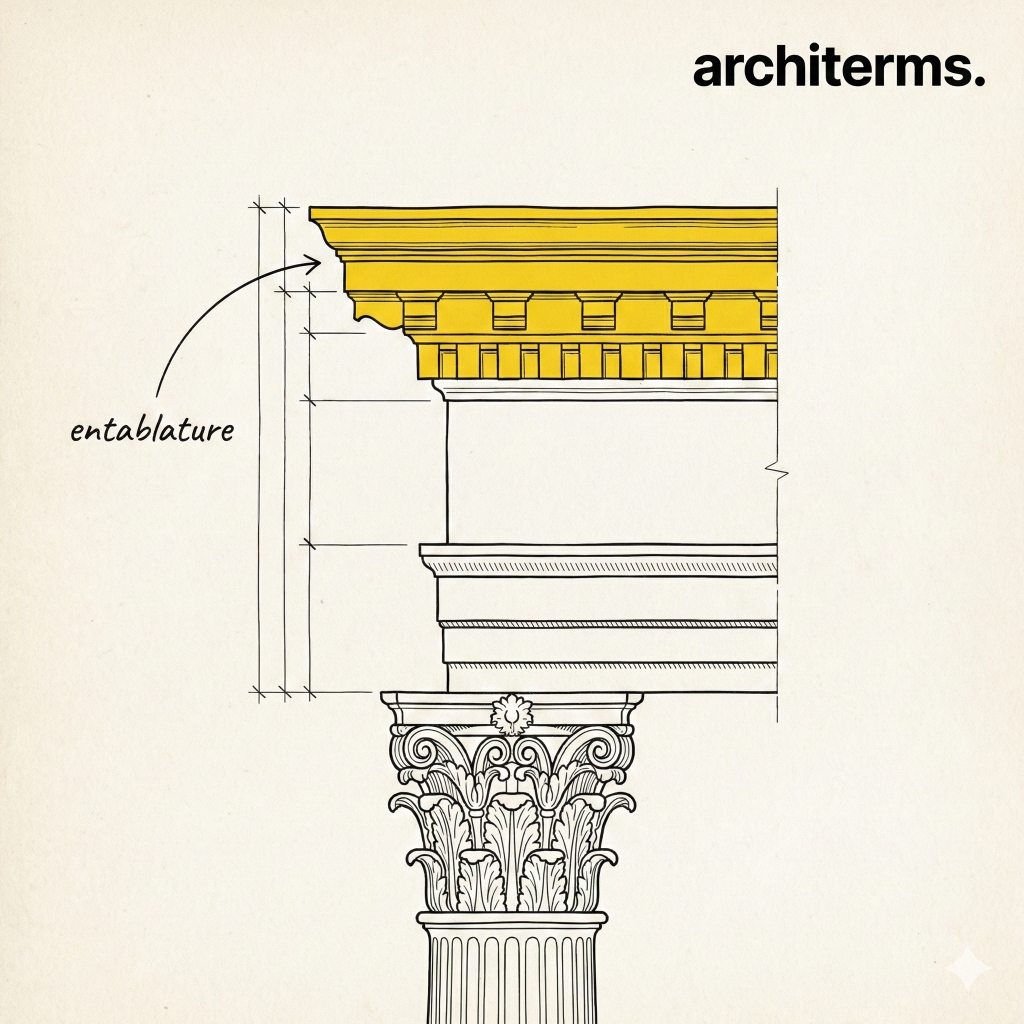
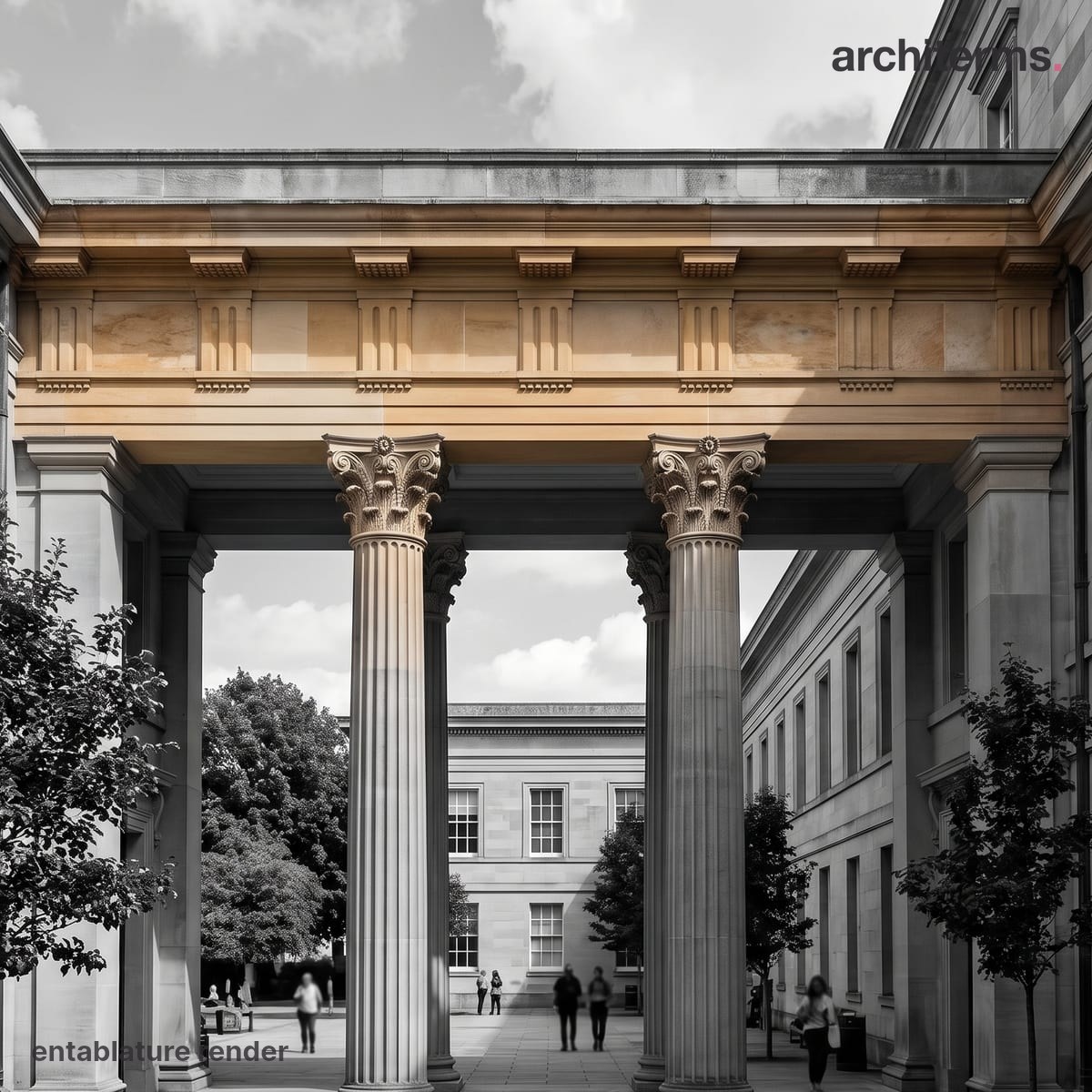
The entablature is the horizontal assembly a colonnade carries: the architrave spans column to column, the frieze runs as a decorated band above it, and the cornice projects at the top to shed water and cast a shadow line.
Created with Reviz.Design — AI rendering for architects and interior designers
Definition
An entablature is the horizontal superstructure that rests on top of columns in Classical architecture, built from three stacked bands: the architrave, the frieze, and the cornice. It is the element that turns a simple row of columns into a complete, proportioned composition.
An entablature is the horizontal “cap” that sits on top of columns, turning vertical supports into a complete Classical composition. In traditional Greek and Roman design, the entablature is usually organized as a clear three-part stack:
architrave → frieze → cornice
The architrave is the lowest band (closest to the column capitals), the frieze is the middle band (often decorative), and the cornice is the projecting top edge that casts the shadow and finishes the profile. Together, these bands make the building readable at street distance: you can “see” where the vertical order ends and the horizontal order begins.
Entablature construction (is it structural?)
Historically, entablature construction could be genuinely structural—especially in stone temples where large blocks spanned between columns and carried roof loads. But many entablatures you see today are not doing heavy structural work; they’re often a façade assembly or decorative build-up that preserves Classical proportion and shadow without needing massive stone members.
What matters either way is the idea: the entablature is a horizontal system, designed to express proportion, hierarchy, and termination.
History (Entablature architecture history)
In Greek temple architecture, the entablature became one of the clearest “signatures” of the Classical orders. It is central to iconic compositions like the Parthenon, where the proportions of the Column, Capital, Architrave, Frieze, and Cornice work together as a unified language.
Roman architecture carried the concept forward, often increasing richness and layering. Over time—through Renaissance, Neoclassical, and Beaux-Arts traditions—the entablature remained a key tool for making facades legible, formal, and monument-like.
Application (Modern entablature architecture)
You still see entablatures in:
- —Porticos and colonnades: where the entablature helps an entry read as ceremonial and “complete.”
- —Institutional facades: museums, courthouses, libraries, and civic buildings that borrow Classical authority.
- —Contemporary reinterpretations: modern buildings sometimes use a simplified entablature as a strong horizontal band—less ornament, same role: scale, shadow, and a clear top edge.
Entablature and frieze (why the middle band matters)
People often search entablature and frieze together because the frieze is where architecture historically told stories—relief sculpture, inscriptions, repeated motifs. Even when ornament disappears, a frieze-like band still helps organize a Facade: it can become signage, a material transition, or a ventilated strip while keeping the elevation readable.
Common confusion
- —Entablature vs. cornice: the cornice is only the top part; the entablature includes architrave + frieze + cornice.
- —Entablature vs. architrave: the architrave is the lowest band; it’s part of the entablature, not the whole thing.
- —Entablature vs. pediment: a pediment is the triangular gable form above an entablature (often at a temple front). The entablature is the horizontal layer below it.
- —Entablature vs. parapet: a Parapet is a protective wall at an edge; an entablature is a proportional/architectural horizontal assembly tied to columns and Classical composition.
FAQ
What are the parts of an entablature?
In Classical architecture, the main parts are Architrave, Frieze, and Cornice.
Is an entablature always structural?
No. Historically it could be load-bearing, but in many modern facades it’s a lightweight assembly that preserves the Classical profile and shadow without carrying major loads.