Spire.
A spire is a tall, slender, pointed structure that rises from a tower or roof, tapering to a point as it ascends. In plain terms: it is the sharp, soaring peak that crowns a church tower, steeple, or skyscraper.
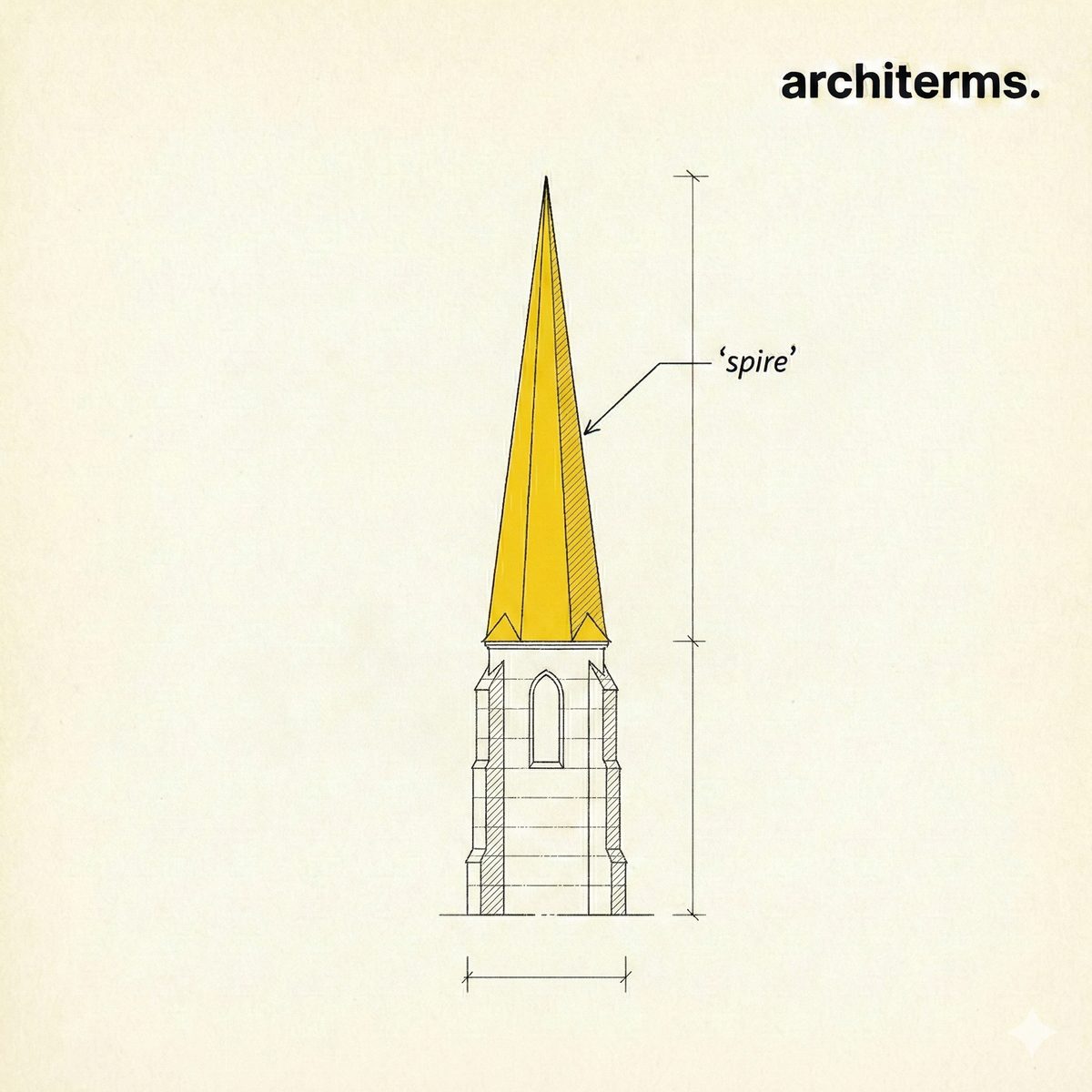
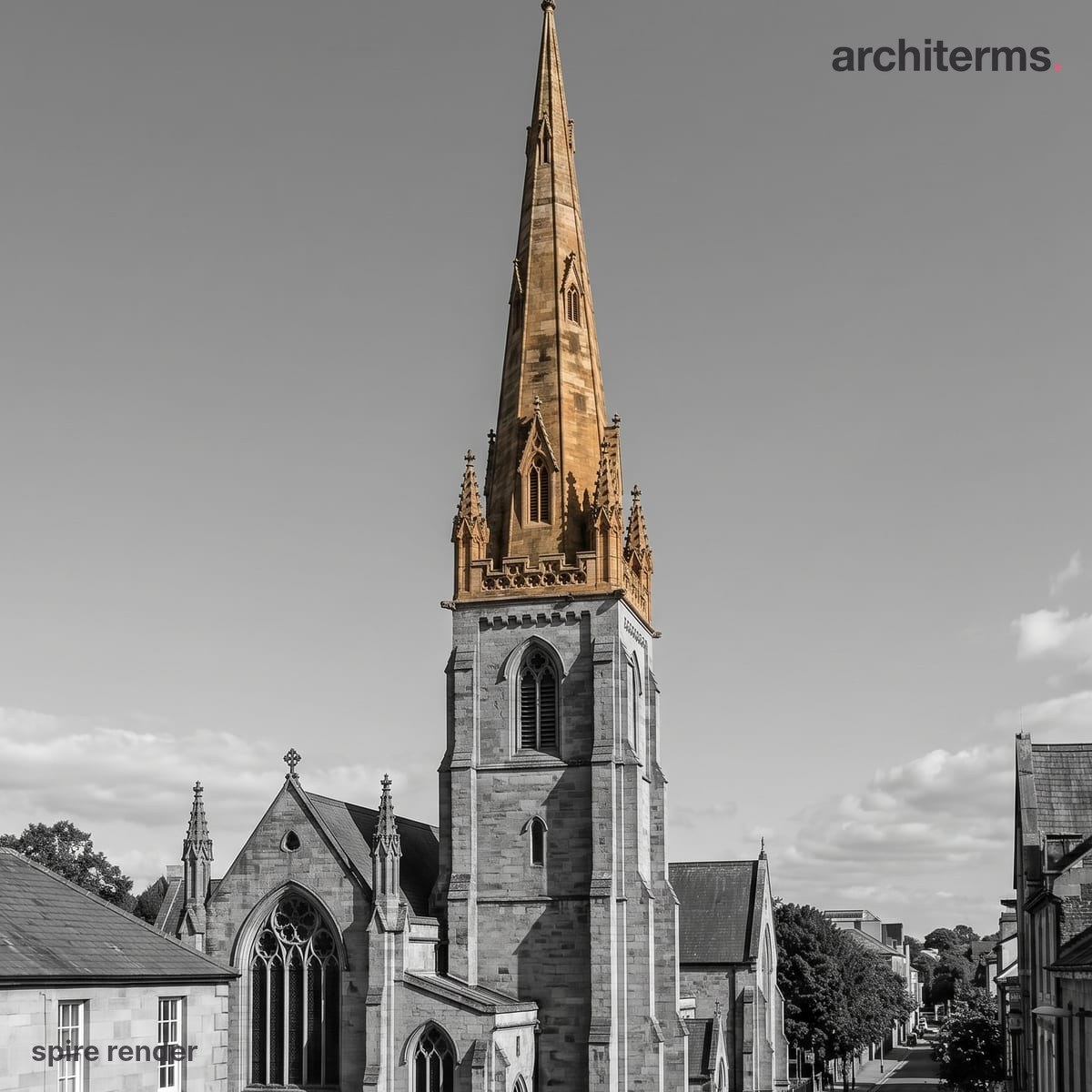
A spire crowns the square tower, its steeply tapering faces drawing together to a single point. The taper carries the eye upward and sheds rain and wind, while corner pinnacles ease the transition from the broad tower below to the slender peak above.
Created with Reviz.Design — AI rendering for architects and interior designers
Definition
A spire is a tall, slender structure that tapers to a point as it rises, crowning a tower, turret, or roof. Most often associated with churches and cathedrals, the spire carries the eye—and historically the spirit—upward, ending the mass of a building in a sharp vertical accent that can be seen for miles. It is at once a structural feat, a landmark, and a symbol of aspiration.
Building a spire is a problem of height, wind, and weight. A spire is essentially a very tall, hollow cone or pyramid raised high above the ground, exposed to wind on every side and bearing down on the tower beneath it. The art of the spire lies in making it soar while keeping it light enough and braced enough to stand against the wind and to transfer its load safely down into the tower and its supports.
A spire is a tapering, pointed structure that rises from the top of a tower or roof, narrowing as it ascends until it terminates in a point or finial. It may be built of masonry, of timber clad in lead, copper, or slate, or of metal, and it is typically conical or pyramidal in form. A spire concentrates the silhouette of a building into a single vertical line, drawing the eye skyward; structurally it transfers its own weight and the wind loads acting on it down into the tower or supports below. When a spire sits on top of a tower, the tower and spire together are often called a steeple.
Spire History
The spire grew out of the medieval desire to build ever taller and to point churches symbolically toward heaven. Early spires were simple timber pyramids over towers, but during the Gothic period the spire became a major architectural ambition. Masons built soaring stone spires—often pierced and decorated with crockets, pinnacles, and tracery—on cathedrals and parish churches across Europe; the spire of Salisbury Cathedral and the openwork spires of German Gothic are famous examples. Reaching such heights demanded great skill, and some spires collapsed or had to be rebuilt. After the Middle Ages the spire remained central to church design, from the lead-covered timber spires of countless parish churches to the slender steeples of Renaissance and Georgian architecture. In the modern era the same vertical impulse reappears in the tapering crowns and antennae of skyscrapers.
Spire in Architecture
The spire works on a building in several ways:
- —Vertical termination: It ends a tower or roof with a strong upward point, completing the composition and giving it a clear summit.
- —Landmark and orientation: Rising above the surrounding roofs, a spire makes a building visible across a town or landscape and serves as a point of reference.
- —Symbolism: On churches the spire has long expressed aspiration and the reach toward the divine; its height and prominence signalled the importance of the building below.
- —Silhouette and skyline: Clusters of spires give historic cities their distinctive skylines, and a single spire can define the identity of a building.
Spires are frequently surrounded or accompanied by smaller pinnacles, which both decorate the base of the spire and add weight that helps steady the structure against the outward thrust and the wind.
Common confusion
Spire vs. steeple: A steeple is the whole tower-and-spire assembly on a church—the tower plus the spire that rises from it. The spire is specifically the tapering, pointed part at the top. Every spire may form part of a steeple, but the steeple includes the tower beneath.
Spire vs. pinnacle: A pinnacle is a small, subordinate spire-like ornament, often placed on buttresses, parapets, or the corners of a tower. A spire is the large, dominant pointed structure crowning the building; pinnacles are the smaller accents around it.
Spire vs. tower: A tower is a tall structure with roughly vertical sides and usually a flat or low top; a spire is the slender, sharply tapering point that may rise from a tower. A tower can exist without a spire, and the spire is the part that comes to a point.
Spire vs. cupola: A cupola is a small domed or rounded structure on a roof or tower, while a spire is tall, slender, and pointed. One ends in a curve, the other in a point.
Frequently Asked Questions
What is a spire in architecture?
A spire is a tall, slender structure that tapers to a point as it rises from a tower or roof. Most often seen on churches and cathedrals, it ends a building in a sharp vertical accent, drawing the eye upward and acting as a landmark visible from a distance.
What is the difference between a spire and a steeple?
A steeple is the whole assembly of a tower together with the spire that rises from it, as seen on many churches. The spire is specifically the tapering, pointed part at the very top. In other words, the steeple includes the tower, while the spire is just the pointed crown.
What is the difference between a spire and a pinnacle?
A spire is the large, dominant pointed structure that crowns a tower or roof, while a pinnacle is a small, subordinate spire-like ornament placed on buttresses, parapets, or tower corners. Pinnacles often surround the base of a spire, both decorating it and adding steadying weight.
What are spires made of?
Spires are built of masonry (cut stone), or of a timber frame clad in lead, copper, or slate, and sometimes of metal. Stone spires can be richly carved, while lead-covered timber spires are lighter and were common on parish churches. The choice affects the spire's weight, height, and how it is braced against the wind.
Why do churches have spires?
Churches have spires partly for symbolism—the tapering point reaches upward, expressing aspiration and the direction of the heavens—and partly for prominence, making the church visible across its town and marking it as an important building. The spire also gives the building a strong, memorable silhouette on the skyline.