Soffit.
A soffit is the horizontal or angled underside of an architectural element, such as an eave, arch, or beam. In plain terms: it's the 'ceiling' you see when you look up under a roof overhang or the underside of an arch.
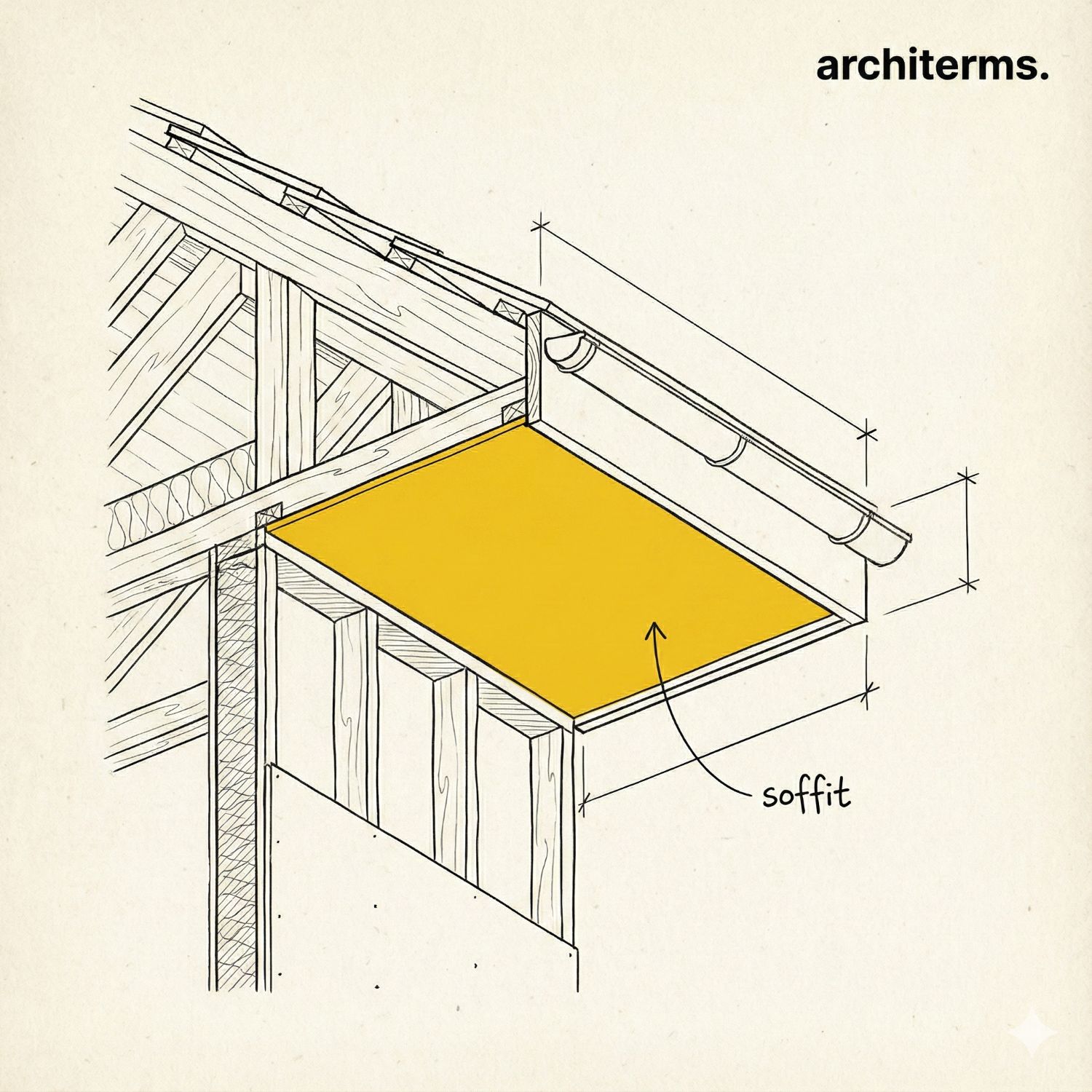
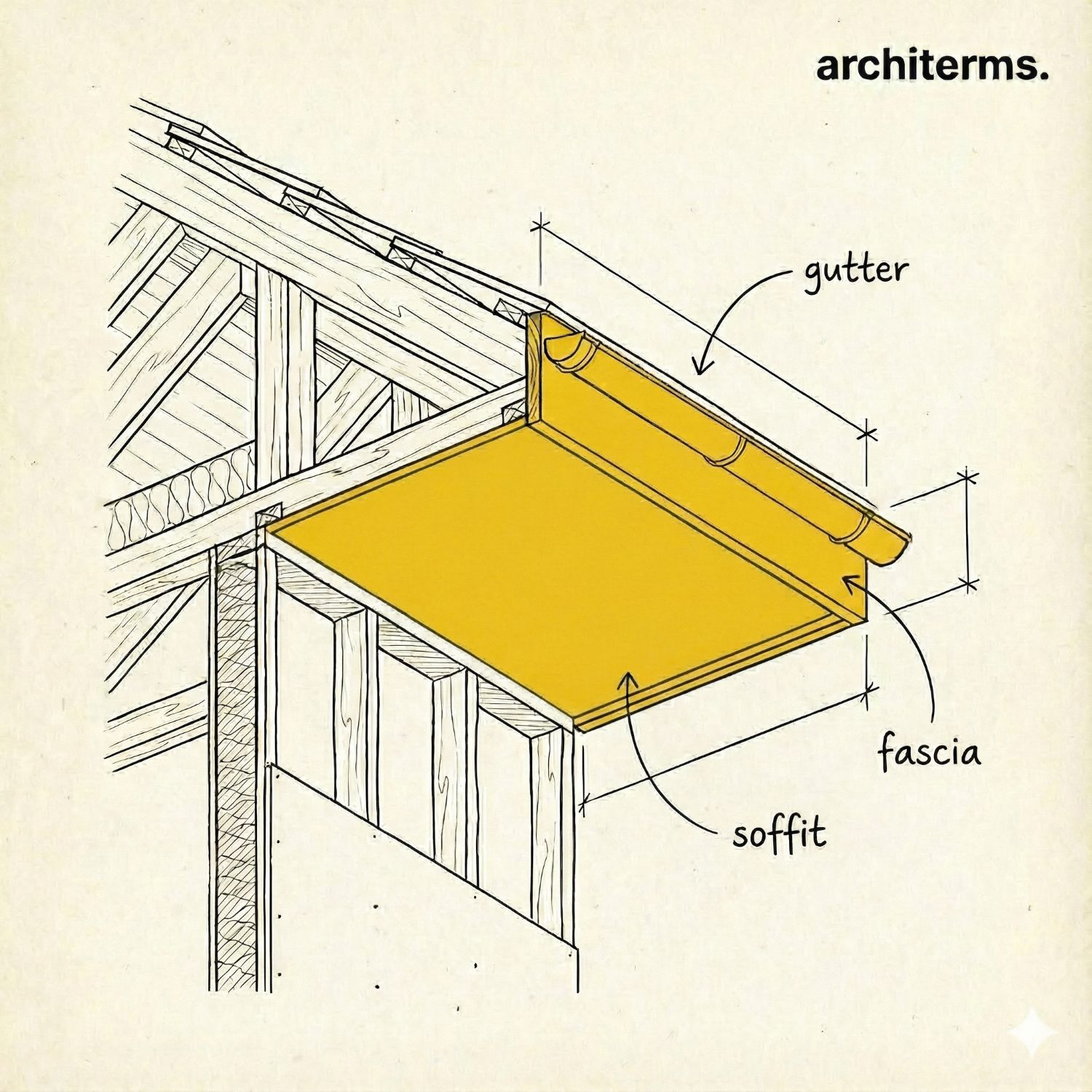
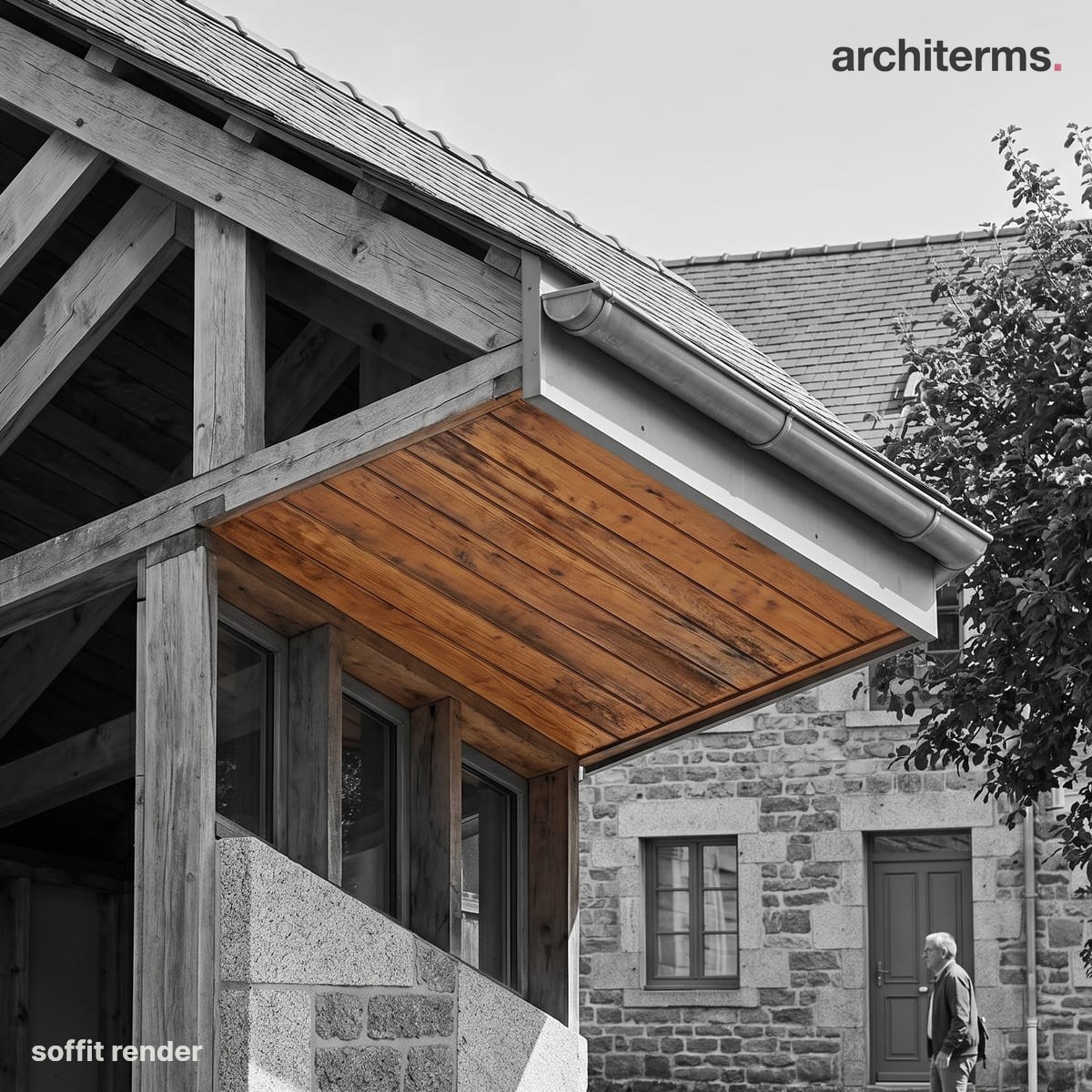
The soffit is the finished underside you see looking up beneath an overhang: here it closes off the gap under the projecting eave, hiding the rafter tails while still allowing ventilation into the roof space above.
Rendered with Reviz.Design — AI visualization for architects and interior designers
Definition
A soffit (pronounced SOF-it) is the horizontal or angled underside of an architectural element, such as an eave, arch, beam, or slab. The soffit is the visible surface that faces downward, creating a finished appearance and often serving functional purposes like ventilation or protection.
The word "soffit" comes from the Italian word "soffitto," meaning "ceiling" or "underside." In architecture, soffits are used to finish and protect the undersides of various building elements, creating clean, professional appearances while serving practical functions.
Soffits are found in many parts of a building, from the roofline (eave soffits) to interior spaces (ceiling soffits, beam soffits) to structural elements (arch soffits, slab soffits). Each type serves specific functional and aesthetic purposes.
Soffit architecture
In soffit architecture, soffits play important roles in both building performance and appearance:
Visual finishing: Soffits provide a finished appearance to the undersides of building elements, hiding structural components, wiring, and other elements that would otherwise be visible. This creates a clean, professional look.
Ventilation: Eave soffits often include vents or perforations that allow air to circulate in attics or roof spaces. This passive ventilation helps regulate temperature and prevent moisture buildup, which is critical for building durability.
Protection: Soffits protect building elements from weather, insects, and other environmental factors. They create a barrier that prevents water, debris, and pests from entering the building structure.
Material expression: Soffit materials contribute to the building's overall material expression. Common materials include wood, metal, composite materials, and PVC, each offering different aesthetic and performance characteristics.
Integration with other elements: Soffits integrate with other building elements like fascia, gutters, and walls, creating a cohesive building envelope. Proper integration requires careful attention to flashing, sealing, and material transitions.
Architectural detail: In some architectural styles, soffits are treated as architectural details with decorative elements, moldings, or finishes that reference traditional or modern design languages.
What is a soffit in Concrete Construction
In concrete construction, a soffit refers to the underside of a concrete slab, beam, or other structural element:
Slab soffit: The underside of a concrete slab, which is the surface visible from below. This is a critical surface that must be properly finished, as it is often exposed in finished spaces.
Beam soffit: The underside of a concrete beam, which may be exposed or concealed depending on the design. Beam soffits must be properly formed and finished to meet architectural and structural requirements.
Formwork and finishing: Concrete soffits are created using formwork (molds) that shape the concrete during pouring. The formwork's surface quality directly affects the soffit's appearance, so smooth, clean formwork is essential.
Finishing requirements: Soffit finishing requirements vary depending on whether the soffit will be exposed or concealed. Exposed soffits may require special finishing techniques like troweling, texturing, or painting.
Structural considerations: Soffits must be designed to support their own weight and any loads from above. In concrete construction, this involves proper reinforcement and structural design.
Architectural expression: Exposed concrete soffits can be used as architectural features, with the concrete's texture and form becoming part of the design. This is common in modern and Brutalist architecture.
Maintenance: Concrete soffits may require maintenance over time, including cleaning, sealing, or repair. Proper initial construction and finishing can minimize maintenance needs.
Soffit ceiling
A soffit ceiling refers to a dropped or lowered portion of a ceiling, creating a recessed area:
Dropped ceiling element: A soffit ceiling is a section of ceiling that is lower than the surrounding ceiling, creating a recessed or stepped effect. This is commonly used to define spaces, hide mechanical systems, or create visual interest.
Space definition: Soffit ceilings are used to define different areas within a room, such as separating a dining area from a living area or creating a visual boundary around a kitchen island.
Mechanical integration: Soffit ceilings often conceal mechanical systems like HVAC ducts, electrical wiring, or plumbing. This allows these systems to be hidden while maintaining ceiling height in most of the space.
Lighting integration: Soffit ceilings are ideal for integrating lighting, with recessed lights, cove lighting, or linear lights often installed in the soffit. This creates indirect lighting that adds ambiance and visual interest.
Architectural detail: Soffit ceilings can be architectural details that add visual interest and sophistication to interior spaces. They may feature decorative moldings, materials, or finishes.
Residential applications: In residential construction, soffit ceilings are common in kitchens (around cabinets), bathrooms (around vanities), and living spaces (to define areas or hide systems).
Commercial applications: In commercial buildings, soffit ceilings are used extensively to define spaces, integrate lighting, and conceal mechanical systems while maintaining flexibility.
Soffit of slab
The soffit of slab refers to the underside of a concrete slab:
Structural surface: The soffit is the bottom surface of the slab, which may be exposed or concealed depending on the design. In many cases, the soffit becomes the ceiling of the space below.
Formwork quality: The quality of the formwork (the mold used to shape the concrete) directly affects the soffit's appearance. Smooth, clean formwork creates a smooth soffit surface.
Finishing requirements: Soffit finishing requirements depend on whether it will be exposed. Exposed soffits may require special finishing, texturing, or treatment to meet architectural requirements.
Reinforcement visibility: In some designs, the soffit may reveal the slab's reinforcement pattern, creating a visual texture. This is sometimes used as an architectural feature.
Architectural expression: Exposed slab soffits can be architectural features, with the concrete's texture, form, and reinforcement pattern becoming part of the design. This is common in modern, industrial, and Brutalist architecture.
Maintenance and durability: Slab soffits must be durable and able to withstand the conditions of the space below. This may require special treatments, sealers, or finishes.
Integration with building systems: Slab soffits often integrate with building systems like lighting, HVAC, and fire protection. Proper integration requires careful coordination during design and construction.
Soffit interior
Soffit interior refers to soffits used in interior spaces:
Ceiling soffits: Interior soffits are often dropped ceiling elements that create recessed areas, define spaces, or conceal mechanical systems. These are common in residential and commercial interiors.
Beam soffits: The undersides of exposed beams create soffit surfaces that may be finished, painted, or left natural depending on the design. Beam soffits are common in traditional and modern architecture.
Arch soffits: The undersides of arches create curved soffit surfaces that are often decorative and may feature moldings, paintings, or other treatments. Arch soffits are common in classical and traditional architecture.
Cabinet soffits: In kitchens and bathrooms, soffits are often built above cabinets to fill the space between the top of the cabinets and the ceiling. These may be functional (concealing systems) or purely aesthetic.
Lighting integration: Interior soffits are ideal for integrating lighting, with recessed lights, cove lighting, or linear lights often installed. This creates indirect lighting that adds ambiance.
Material options: Interior soffits can be made from various materials including drywall, wood, metal, or composite materials. The choice depends on the design, budget, and performance requirements.
Aesthetic integration: Interior soffits must integrate with the overall interior design, matching or complementing the space's color scheme, materials, and style.
What is a soffit in kitchen
A soffit in kitchen refers to the built-in structure above kitchen cabinets:
Cabinet soffit: The most common kitchen soffit is the built-in structure that fills the space between the top of wall cabinets and the ceiling. This creates a finished appearance and may conceal mechanical systems.
Functional purposes:
- —Concealing systems: Kitchen soffits often hide HVAC ducts, electrical wiring, plumbing, or other mechanical systems that run above the cabinets.
- —Filling gaps: Soffits fill the space between cabinets and ceiling, creating a finished appearance and preventing dust and debris from accumulating.
- —Storage: Some kitchen soffits include storage space, though this is less common in modern designs.
Aesthetic purposes:
- —Finished appearance: Soffits create a clean, finished look by eliminating the gap between cabinets and ceiling.
- —Visual continuity: Soffits create visual continuity, making the kitchen appear more cohesive and designed.
- —Architectural detail: Soffits can be architectural details with moldings, materials, or finishes that add visual interest.
Design considerations:
- —Height: Soffit height should be proportional to the cabinets and ceiling height. Standard soffits are typically 12 to 18 inches tall.
- —Material: Soffits are typically made from drywall, wood, or composite materials that match or complement the cabinets.
- —Lighting: Soffits can integrate lighting, with recessed lights or under-cabinet lighting often installed.
- —Removability: Some modern designs use removable soffits for easier access to systems above.
Soffit and fascia
Soffit and fascia work together as a system at the roofline:
Fascia: The vertical board at the roof edge that faces outward. The fascia covers the rafter ends and provides a surface for gutter attachment.
Soffit: The horizontal board under the eave that faces downward. The soffit covers the underside of the eave and often includes vents for ventilation.
Working together: Soffit and fascia work together to create a finished, protected roofline. The fascia faces outward and handles water management, while the soffit faces downward and handles ventilation.
Material coordination: Soffit and fascia are often made from matching or coordinating materials and colors, creating a cohesive appearance. Common combinations include:
- —Wood soffit and fascia (painted or stained)
- —Composite soffit and fascia (matching colors)
- —Metal soffit and fascia (aluminum or steel)
- —PVC soffit and fascia (maintenance-free)
Design integration: Soffit and fascia must integrate with the overall building design, matching or complementing the building's color scheme, materials, and style.
History
Soffits have been used in architecture for centuries, evolving from simple functional elements to sophisticated architectural details:
Ancient architecture: Early soffits were simple undersides of structural elements like beams and arches. In ancient Greek and Roman architecture, soffits were often decorated with paintings, carvings, or moldings.
Medieval architecture: In medieval architecture, soffits were often highly decorative, featuring elaborate carvings, paintings, or moldings that reflected the building's importance and style.
Renaissance and Baroque: During the Renaissance and Baroque periods, soffits became more sophisticated, with elaborate decorations, moldings, and treatments that referenced classical architecture.
Industrial Revolution: The Industrial Revolution brought new materials and construction methods, expanding soffit options. Metal soffits became common in industrial and commercial buildings.
Modern architecture: Modern architecture simplified soffits, emphasizing clean lines and functional design. New materials like composite and PVC expanded options.
Contemporary architecture: Today, soffits are used in both traditional and modern architecture, with materials and designs that reflect current building practices and aesthetic preferences.
Application
Residential construction: Soffits are essential in residential construction, providing finished appearances to rooflines and interior spaces. They are used in all types of homes, from traditional to modern.
Commercial buildings: Commercial buildings use soffits extensively for both functional and aesthetic purposes. Metal and composite soffits are common in commercial construction.
Interior design: Interior soffits are used to define spaces, integrate lighting, and conceal mechanical systems. They are common in kitchens, bathrooms, and living spaces.
Historic preservation: In historic preservation projects, soffits are carefully restored or replaced to match original designs. This may involve custom millwork or specialized materials.
Modern architecture: Contemporary architecture uses soffits to create clean, minimal appearances while serving functional purposes like ventilation and system concealment.
Industrial buildings: Industrial buildings use soffits for weather protection and to create finished appearances. Metal soffits are common in industrial construction.
Common confusion
Soffit vs fascia: A soffit is the horizontal board under the eave that faces downward. A fascia is the vertical board at the roof edge that faces outward. They work together but serve different functions.
Soffit vs ceiling: A soffit is the underside of an architectural element. A ceiling is the overhead surface of a room. A soffit can be part of a ceiling, but not all ceilings are soffits.
Soffit vs eave: The eave is the overhanging edge of the roof. The soffit is the horizontal board that covers the underside of the eave. The soffit is part of the eave system.
Soffit vs architrave: A soffit is the underside of an architectural element. An architrave is a horizontal beam in classical architecture that sits on top of columns. They are different elements with different locations and functions.
Soffit vs coffer: A soffit is the underside of an element. A coffer is a recessed panel in a ceiling or soffit. Coffers are decorative elements that can be part of a soffit.