Flashing.
Flashing is thin, impervious material—usually metal—installed at joints and openings in a building's envelope to direct water away and prevent leaks. In plain terms: it is the protective strip fitted around chimneys, valleys, and edges that channels rain out instead of letting it seep inside.
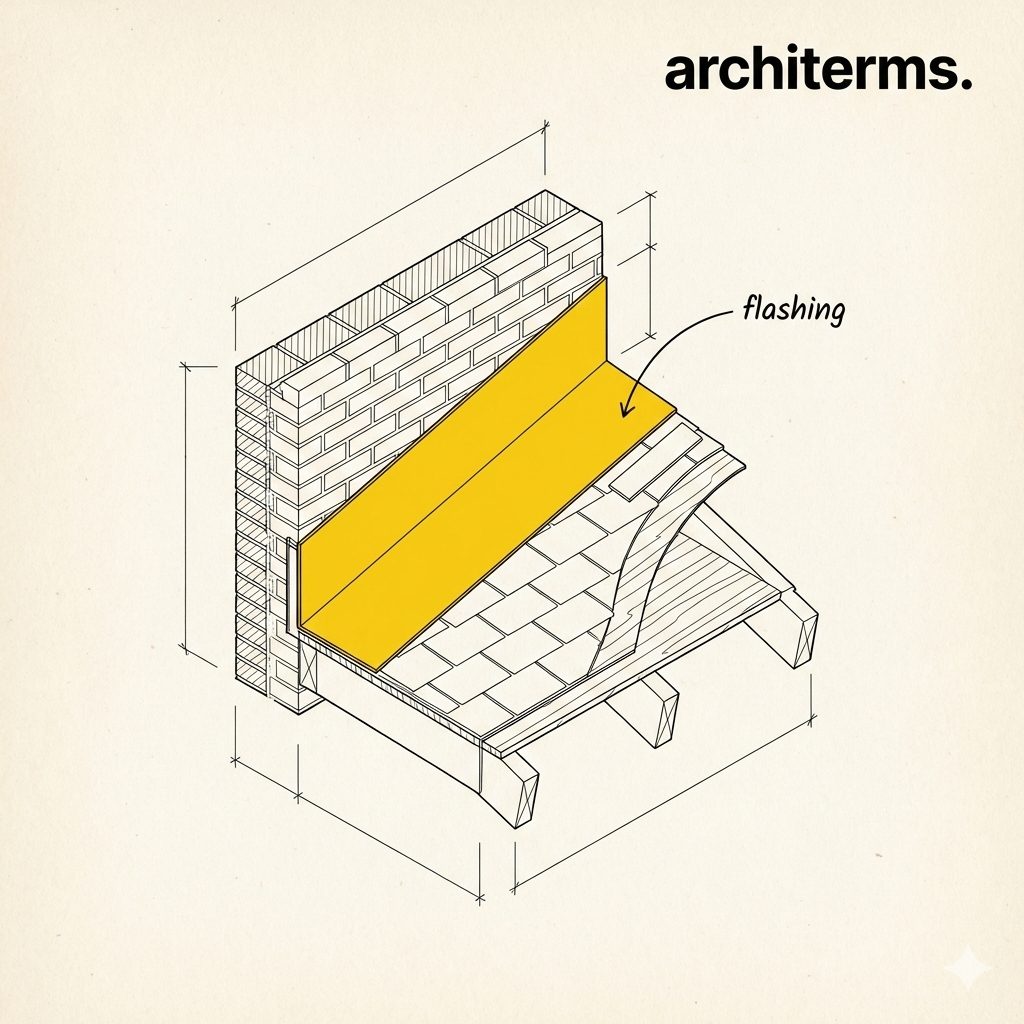
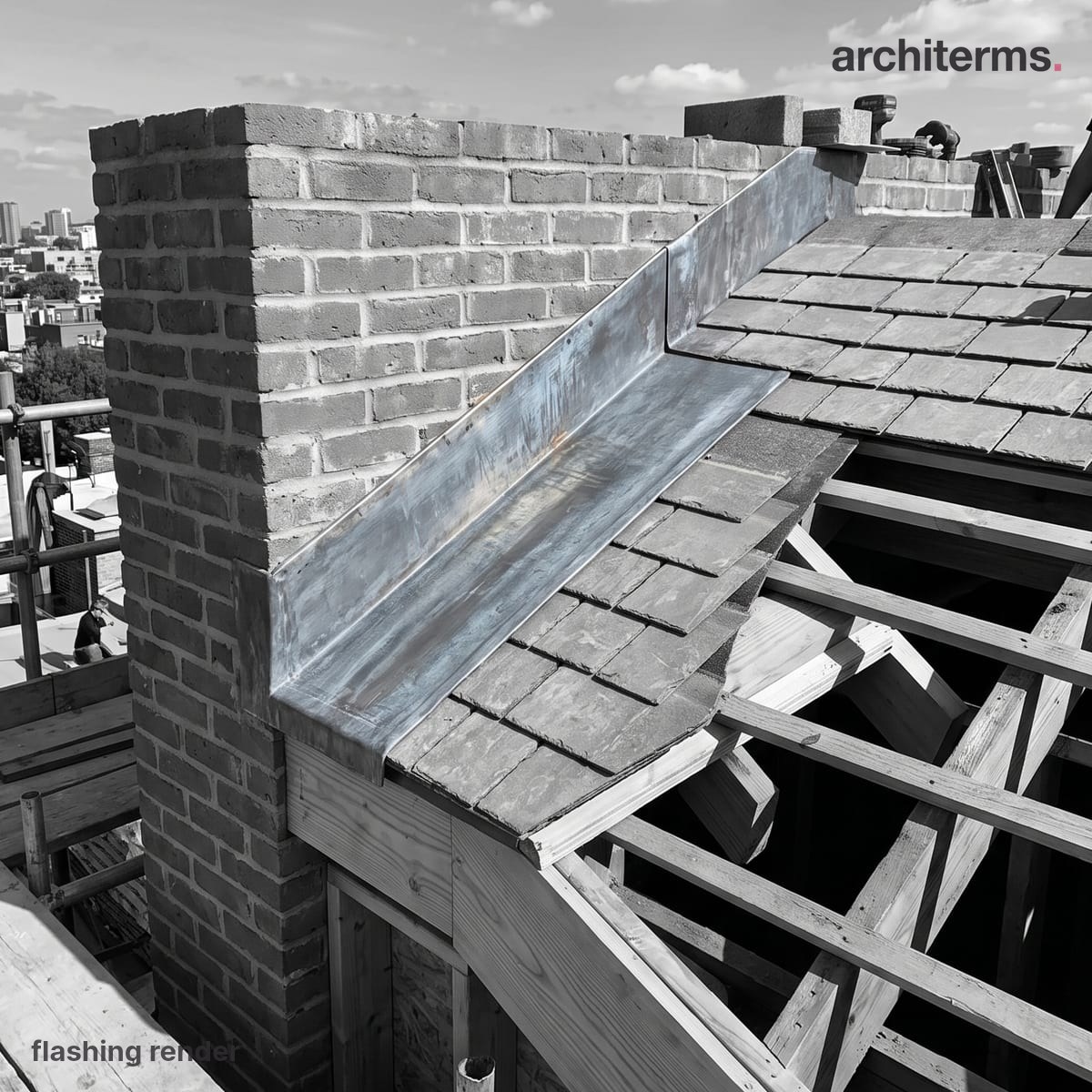
Flashing seals the vulnerable joint where a roof slope meets a wall. The bent metal strip stands up against the brickwork and laps out over the slates below, so water running down the wall is shed onto the roof surface instead of soaking into the joint.
Visualized with Reviz.Design — AI rendering for architects and interior designers
Definition
Flashing is the building's first line of defense at its most vulnerable points: the joints, edges, and penetrations where different surfaces meet and water could find a way in. A roof plane on its own sheds rain easily, but wherever it meets a wall, a chimney, a vent pipe, or a valley, the continuous surface is interrupted—and that is exactly where leaks begin. Flashing bridges those interruptions with a waterproof layer that guides water back onto the drainage surface and out of the building.
Usually made of sheet metal such as aluminum, galvanized steel, copper, or lead—and sometimes of flexible membranes—flashing is shaped and lapped so that water always runs over, not under, each piece. Though often hidden, well-designed flashing is one of the most important details determining whether a building stays dry.
Flashing is a thin, water-resistant material installed at the joints, transitions, and openings of a building envelope to prevent water penetration by directing it away from vulnerable points and back to the exterior or to a drainage path. It is fitted wherever surfaces meet or are pierced—roof-to-wall junctions, valleys, ridges, chimneys, parapets, and around windows and doors—and is always lapped so that upper pieces overlap lower ones, ensuring water sheds outward. Flashing works together with the surrounding cladding, roofing, and damp-proofing as part of the building's overall weatherproofing.
Flashing History
Protecting joints from water is an old necessity. Traditional builders used lead, which is soft and easily dressed into complex shapes, to weatherproof roofs, chimneys, and parapets—lead flashing on historic buildings can last for centuries. As sheet metals became widely available, zinc, copper, galvanized steel, and aluminum joined or replaced lead in much construction. The 20th century added flexible self-adhesive membranes and proprietary flashing systems, especially around windows and within walls, where concealed flashing and cavity trays manage water inside modern wall assemblies. The principle, however, has never changed: lap each layer so water always runs over the one below.
Flashing in Architecture
Flashing protects the building wherever its skin is interrupted:
- —Roof junctions: Step and apron flashings seal where a roof meets a wall or chimney; valley flashing lines the trough where two roof slopes meet.
- —Openings: Head, sill, and jamb flashings around windows and doors keep water out of the wall and drain any that gets in.
- —Parapets and copings: Flashing under copings and at the base of parapets stops water entering the top of the wall.
- —Lapping and drainage: The golden rule is shingling—each layer overlaps the one below so gravity carries water outward and downward, never behind the flashing.
Because it is often concealed and only tested by heavy weather, flashing that is poorly lapped or omitted is a leading cause of building leaks and water damage.
Common confusion
Flashing vs. gutter: Flashing is the waterproof strip that seals joints and directs water away from them; a gutter is the channel along the roof edge that collects the runoff and carries it to downpipes. Flashing protects junctions, gutters collect and convey water.
Flashing vs. coping: A coping is the protective capping on top of a wall or parapet; flashing is often installed beneath or behind the coping to direct any water that gets past it. They work together but are different elements.
Step flashing vs. counter-flashing: Step flashing is the series of small pieces woven into the roofing where it meets a wall; counter-flashing (or cap flashing) is set into the wall above and overlaps the step flashing, so water cannot get behind it.
Flashing vs. membrane: A waterproofing membrane is a continuous sheet covering a whole surface; flashing is the detailing at edges, joints, and penetrations that terminates and protects the membrane or roofing at those critical points.
Frequently Asked Questions
What is flashing in construction?
Flashing is thin, water-resistant material, usually sheet metal, installed at the joints, edges, and openings of a building to prevent leaks. It bridges vulnerable points—such as where a roof meets a wall or chimney—and directs rainwater away from them and back onto the drainage surface.
What is the purpose of flashing?
Its purpose is to stop water entering at the points where a building's surface is interrupted, such as roof junctions, valleys, chimneys, parapets, and around windows and doors. By covering these joints with a waterproof, lapped layer, flashing channels water outward instead of letting it seep inside.
Where is flashing installed?
Flashing is installed wherever surfaces meet or are penetrated: at roof-to-wall junctions, in roof valleys and at ridges, around chimneys and vent pipes, under copings and at parapets, and around window and door openings. These transitions are the points most likely to leak without it.
What is the difference between flashing and a gutter?
Flashing is the waterproof strip that seals joints and directs water away from vulnerable junctions, while a gutter is the channel along the roof edge that collects the runoff and carries it to the downpipes. Flashing protects the joints; the gutter conveys the water that flashing helps shed.
What is flashing made of?
Flashing is most often made of sheet metal such as aluminum, galvanized steel, copper, or lead, chosen for durability and the ability to be shaped around complex junctions. Flexible self-adhesive membranes are also widely used, especially around windows and inside modern wall assemblies.