Valley.
A valley is the internal angle where two sloping roof planes meet and run downward, forming a channel that collects and carries rainwater off the roof. In plain terms: it's the inward 'V' line where two roof slopes join and drain.
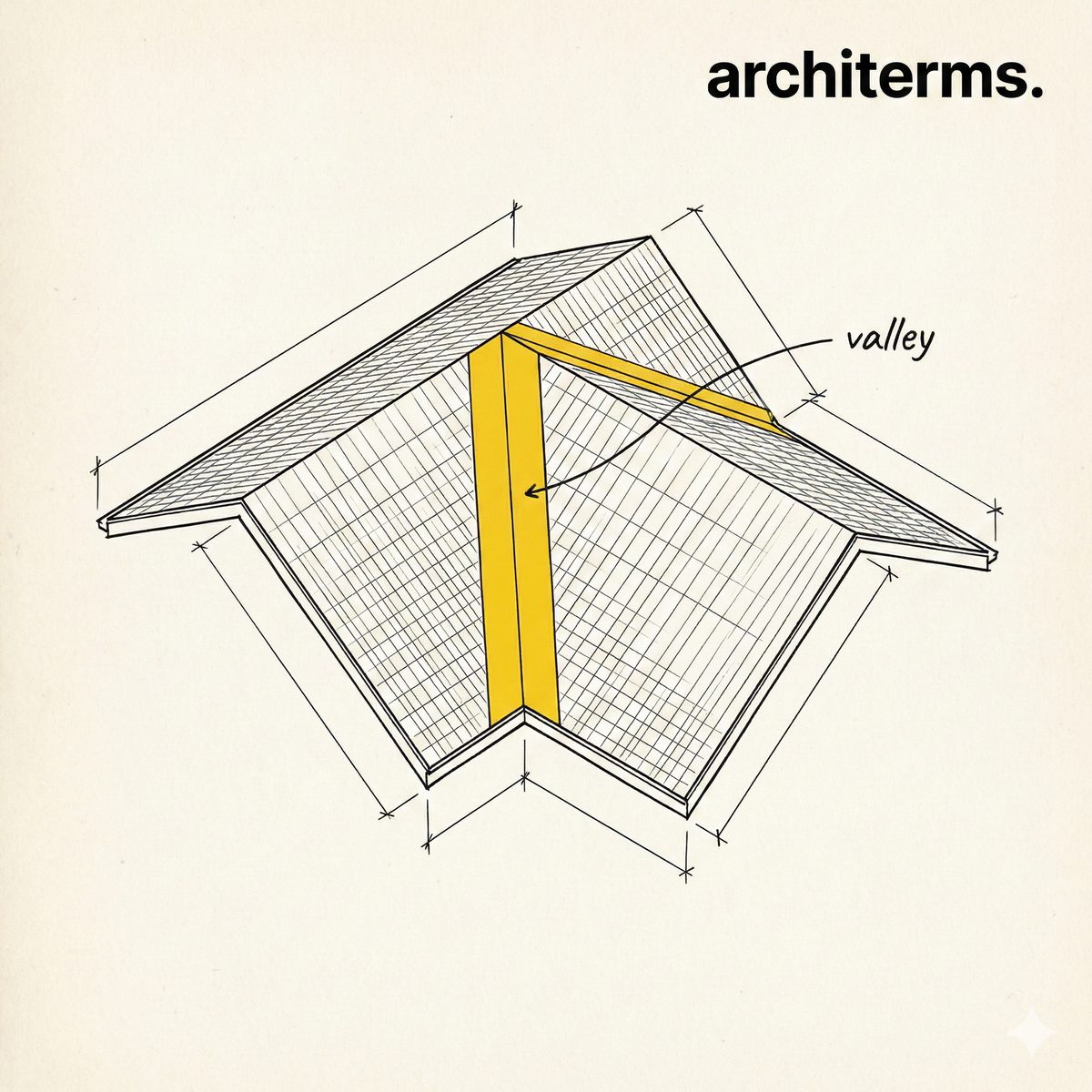
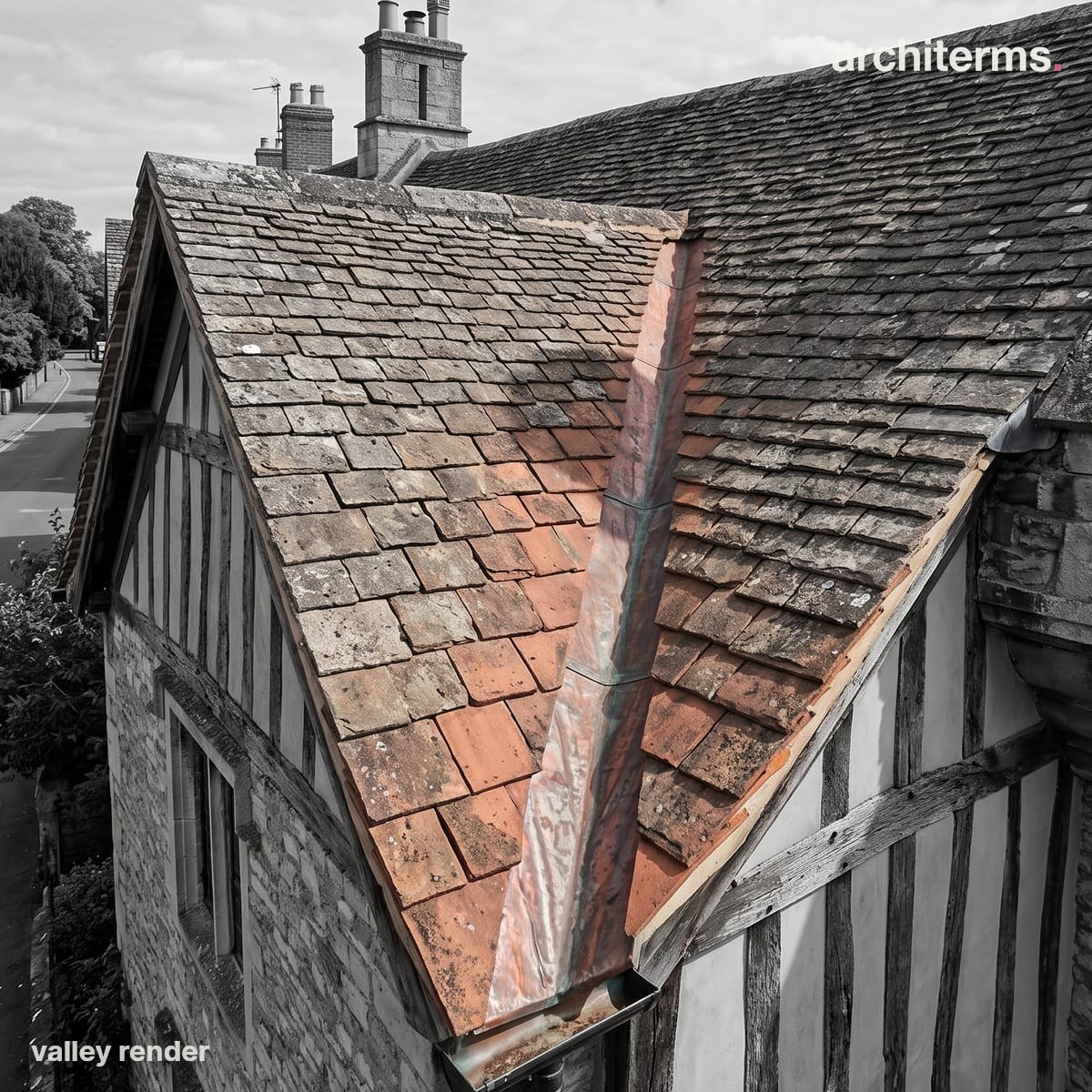
A valley is the internal angle where two roof slopes meet and fall together. The lined channel down the join gathers rainwater from both planes and carries it down to the eaves, so the seam sheds water instead of leaking at it.
Rendered with Reviz.Design — AI visualization for architects and interior designers
Definition
A valley is the inward-sloping junction where two roof planes meet at an internal angle and run down toward the eaves. Where a ridge sheds water away from a high line, a valley does the opposite — it gathers the runoff from both adjoining slopes and funnels it down to the gutter. Because so much water concentrates here, the valley is one of the most leak-prone lines on any roof, so it always gets special waterproofing.
Valleys appear wherever a roof changes direction: at an L-shaped plan, where a dormer meets the main roof, or where two wings of a building join. They are framed with valley rafters and lined with metal or membrane flashing, and the way they are detailed is a big part of whether a complex roof stays dry for decades. Sound valley design is a standard concern in domestic roof construction.
A valley is the internal, downward-sloping angle formed where two roof surfaces intersect. It works as a channel that collects rainwater and snowmelt from the two slopes and directs it toward the gutter at the eave. The structural line is carried by a valley rafter, and the waterproof line is formed by valley flashing — either exposed metal (an open valley) or shingles woven across the joint (a closed valley).
Valley History
For as long as builders have joined roofs at an angle, the valley has been the line they worried about most. Traditional roofs lined the valley with sheet lead or copper, laboriously dressed into the channel so water could not find a seam. The cut and complexity of valleys grew with ambitious Gothic and vernacular roofs, where many gables and wings met, and skilled plumbers and slaters were prized for keeping them watertight. Modern self-adhesive membranes and pre-formed metal valley sections now do the same job faster, but the principle is unchanged: give the concentrated water a smooth, sealed path out.
Valley in Architecture
The valley earns its place by solving a specific problem:
- —Manages concentrated water: it collects runoff from two slopes, so it must be sized and sealed for far more flow than a single roof plane.
- —Enables complex plans: valleys are what let roofs turn corners — cross-gable, L-shaped, and T-shaped layouts all rely on them, as do the junctions where a dormer breaks through.
- —Pairs with the rafter system: the line is framed by a valley rafter with shorter jack rafters running into it from each slope.
- —Demands careful flashing: an open valley shows a metal channel; a closed valley hides it under woven shingles — each is a different waterproofing strategy.
- —Relates to roof types: valleys are common on hip roof and multi-gable roof forms and feed the gutter at the eave.
Common confusion
- —Valley vs. ridge: a valley is the low internal angle that collects water; a ridge is the high horizontal line that sheds it. They are opposites.
- —Valley vs. hip: both are sloping lines between two planes, but a hip is a raised external angle (water runs off it) while a valley is a recessed internal angle (water runs into it).
- —Open valley vs. closed valley: an open valley leaves the metal lining exposed as a visible channel; a closed (woven) valley covers it with shingles for a more uniform look.
- —Valley vs. gutter: the valley channels water down the roof surface; the gutter catches it at the eave and carries it to the downspout.
Frequently Asked Questions
What is a valley on a roof?
A valley is the internal angle where two sloping roof planes meet and run downward. It acts as a channel that collects rainwater and snowmelt from both slopes and directs it down to the gutter, which is why it is carefully flashed to prevent leaks.
Why do roof valleys leak?
Valleys carry the combined runoff from two roof slopes, so far more water passes through them than over a normal roof surface. If the valley flashing is undersized, poorly lapped, or has corroded, that concentrated flow can back up under the shingles and leak. Good flashing and regular clearing of debris are the main defenses.
What is the difference between an open and a closed valley?
An open valley leaves the metal valley lining exposed, creating a visible channel down the joint. A closed (or woven) valley covers the lining with shingles that overlap across the joint for a more uniform appearance. Open valleys shed debris and heavy water well; closed valleys look cleaner.
What is the difference between a valley and a hip?
A hip is a raised external angle where two roof planes meet and slope down to a corner, so water runs off it. A valley is a recessed internal angle where two planes meet, so water runs into it and is channeled away. Hips shed; valleys collect.
What is a valley rafter?
A valley rafter is the structural member that runs along the valley line from the eave up to the ridge, supporting the shorter jack rafters that frame into it from each slope. It carries the framing of the valley while the flashing above it carries the water.