Hip Roof.
A hip roof is a roof design where all four sides slope downward toward the walls, with no vertical ends or gables. In plain terms: it's a roof that slopes on all sides, creating a more enclosed, stable form than a gable roof.
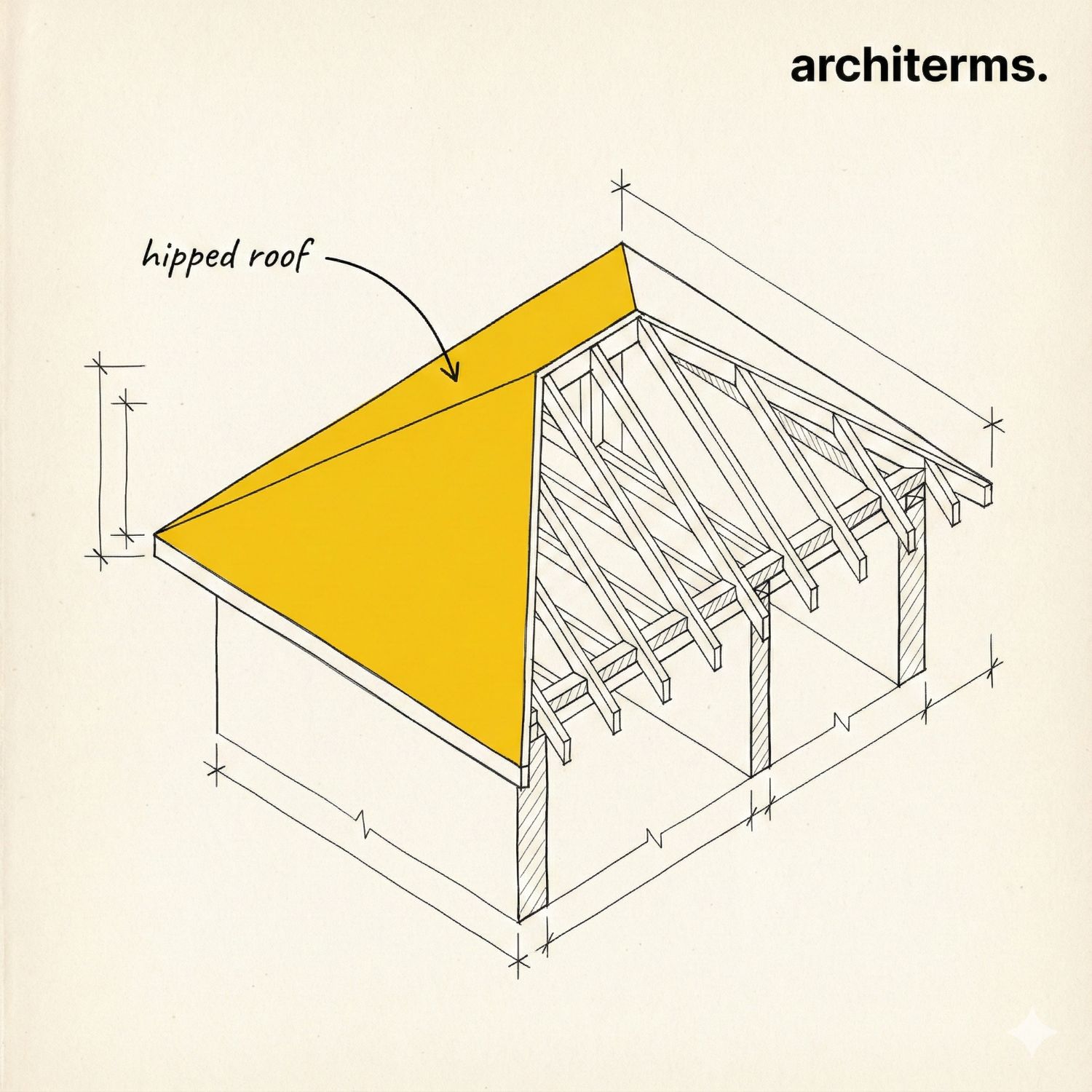
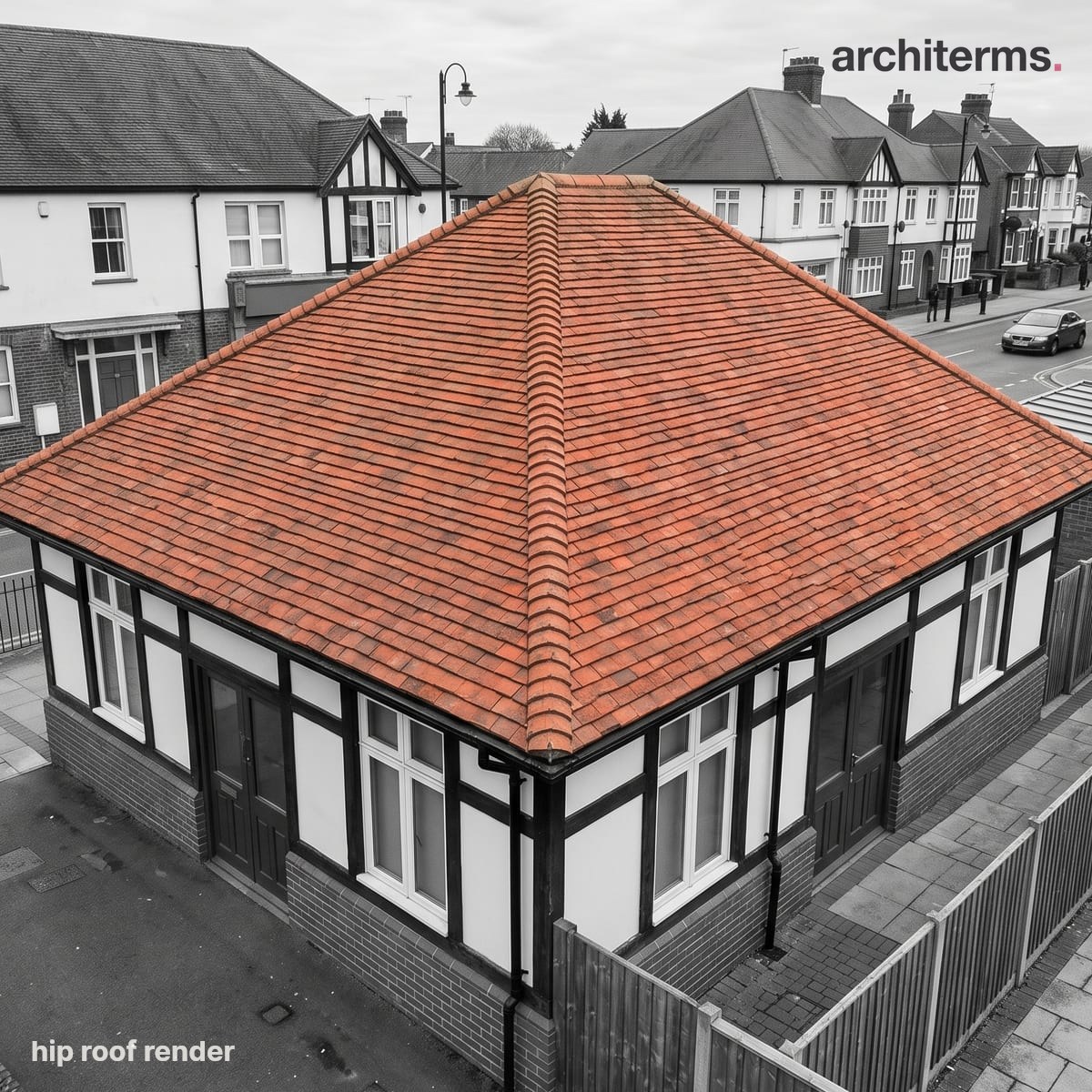
A hip roof slopes on all four sides, meeting the walls with an eave right around the building and rising along hips at each corner to a short ridge. With no vertical gable ends, the form is compact and braces itself against wind from every direction.
Visualize your own Hip Roof project with Reviz.Design
Definition
A hip roof (also called a hipped roof) is a roof type where all sides slope downward from a central ridge or peak. Unlike a gable roof, which has two sloping sides and two vertical ends, a hip roof has four sloping sides that meet at the top. This creates a more uniform, enclosed appearance and generally better structural stability against wind and weather.
The key characteristic of hip roof architecture is that every side of the roof is sloped—there are no vertical gable ends. The roof typically has a ridge at the top where the main slopes meet, and the sides (hips) slope down to the eaves. In a simple rectangular building, a hip roof will have two triangular sides (the hips) and two trapezoidal sides.
Hip roof design
In hip roof design, architects and builders consider several factors:
Slope and pitch: The angle of the roof slopes affects drainage, snow load capacity, and the building's visual appearance. Common pitches range from 4:12 to 8:12 (meaning the roof rises 4 to 8 inches for every 12 inches of horizontal run).
Hip length and ridge: The length of the ridge (the horizontal line at the top where slopes meet) determines how much of the roof is hipped versus how much is gabled. A shorter ridge means more hip area; a longer ridge creates more of a gable-like appearance.
Eave overhang: The horizontal projection of the roof beyond the walls affects water management, shading, and the building's proportions.
Structural framing: Hip roofs require more complex framing than gable roofs because all four sides need to be supported. This typically involves hip rafters, jack rafters, and sometimes valley rafters where hips meet.
Hip roof detail
When examining hip roof detail, the critical junctions are:
Hip rafter: The diagonal beam that runs from the corner of the building up to the ridge. This is the structural element that defines the hip.
Jack rafters: The shorter rafters that run from the wall plate to the hip rafter, creating the sloping sides.
Ridge board: The horizontal beam at the top where the main slopes meet.
Eave detail: Where the roof overhangs the walls, including fascia, soffit, and gutter systems.
Valley detail: Where two hip roofs meet at an angle (in L-shaped or more complex buildings), creating an internal corner that needs careful waterproofing.
These details matter because hip roofs have more complex geometry than gable roofs, requiring precise cutting and joining of rafters at various angles.
Hip roof vs gable roof
The main differences in hip roof vs gable roof:
Hip roof advantages:
- —Better wind resistance—the sloping sides reduce uplift forces compared to vertical gable ends
- —More stable in high winds and hurricanes
- —More enclosed appearance—no exposed gable ends
- —Better for areas with heavy snow—the slopes on all sides help distribute weight
- —Can provide more uniform overhangs for shading and protection
Gable roof advantages:
- —Simpler construction—fewer complex angles and cuts
- —More attic space—the vertical ends create more usable space
- —Lower cost—less material and simpler framing
- —Easier to ventilate—gable ends can have vents or windows
- —More traditional in some architectural styles
When to choose each:
- —Choose a hip roof for: high-wind areas, modern or contemporary designs, buildings needing uniform appearance, areas with heavy snow loads
- —Choose a gable roof for: traditional styles, maximizing attic space, simpler construction budgets, areas with moderate weather
Types of hip roofs
Simple hip roof: Four sides all slope to a central ridge. This is the most common type.
Cross hip roof: Two hip roofs intersect at right angles, creating an L-shaped or T-shaped plan. The intersection creates valleys that need careful detailing.
Half hip roof: A combination where part of the roof is hipped and part is gabled. This creates visual interest while maintaining some of the benefits of both types.
Pavilion hip roof: All sides meet at a single point at the top (no ridge). This creates a pyramid-like shape, common in smaller structures or decorative elements.
Dutch hip roof: A gable roof with small hip sections at the ends. This combines the simplicity of a gable with some of the stability of a hip.
History
Hip roofs have been used across many architectural traditions because they offer practical advantages. In Ancient China and Japan, hip roofs were common in traditional architecture, providing stability and a distinctive appearance. In European architecture, hip roofs became popular in the Renaissance and Baroque periods, especially for formal buildings and country houses. In American architecture, hip roofs are common in many regional styles, from Colonial to Craftsman to modern designs.
Today, hip roofs remain popular in both residential and commercial architecture, especially in areas prone to high winds or where a more enclosed, modern appearance is desired.
Application
Residential construction: Hip roofs are common in suburban homes, providing good weather protection and a clean appearance.
Commercial buildings: Many modern commercial buildings use hip roofs for their uniform appearance and structural benefits.
High-wind regions: Hip roofs are often required or recommended in hurricane-prone areas because of their superior wind resistance.
Contemporary architecture: Many modern designs use hip roofs for their clean lines and ability to create interesting geometric forms.
Mixed-use buildings: Hip roofs can help unify buildings with complex floor plans by providing a consistent roof form.
Common confusion
Hip roof vs gable roof: The key difference is that hip roofs slope on all four sides, while gable roofs have two sloping sides and two vertical ends.
Hip roof vs mansard roof: A mansard roof has two slopes on each side—a steeper lower slope and a flatter upper slope. A hip roof has a single slope on each side.
Hip roof vs gambrel roof: A gambrel roof (like a barn roof) has two slopes on each side, but only on two sides (like a gable). A hip roof has slopes on all four sides.