Joist.
A joist is one of a series of horizontal members, set in parallel rows, that support a floor or ceiling and carry its load to the walls or beams beneath.
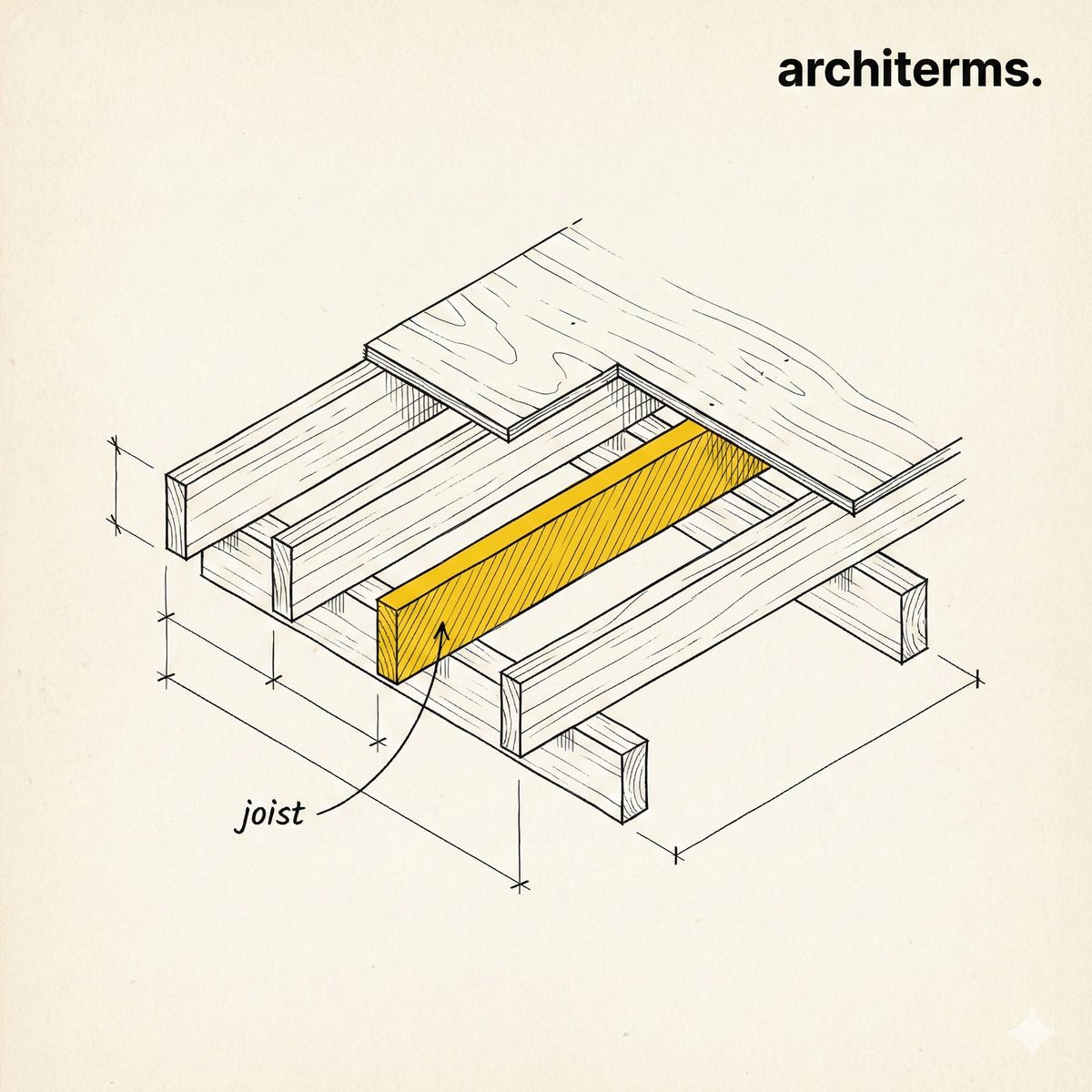
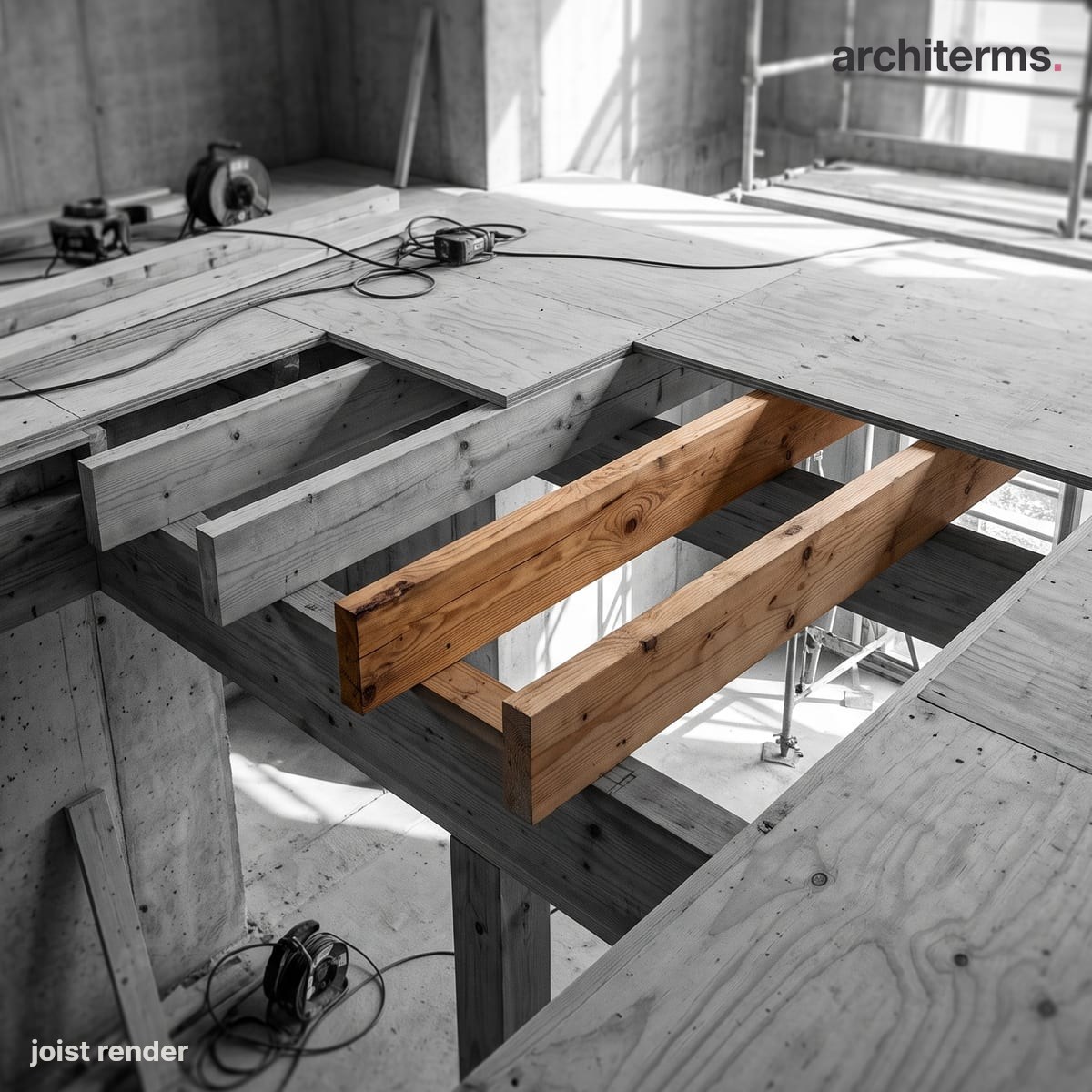
Joists are the repeating horizontal members that carry a floor. Set in parallel rows across an opening, they span from wall to wall or beam to beam and hand the load of the sheathing above down to their supports.
Created with Reviz.Design — AI rendering for architects and interior designers
Definition
A joist is the workhorse of floor and ceiling construction. Laid in closely spaced parallel rows, joists form the level platform that becomes a floor above and a ceiling below. Almost every flat surface you walk on in a timber or steel-framed building is carried by a grid of joists hidden just beneath the floorboards.
What makes the joist so useful is repetition. Rather than spanning a room with one massive beam, builders share the load across many smaller, evenly spaced members, each carrying its own narrow strip of floor. This keeps individual members shallow and economical while still producing a stiff, level surface able to support people, furniture, and partitions.
A joist is a horizontal structural member, typically of timber, engineered wood, or steel, that is repeated at regular spacing to support the boards of a floor or the finish of a ceiling. Each joist carries the load of the strip of floor on either side of it and transfers that load to the supports at its ends—usually the load-bearing walls, a beam, or a girder. The depth and spacing of joists are chosen so that the floor neither sags nor feels bouncy under normal use.
Joist History
Timber joists have framed floors for as long as people have built more than one storey. In traditional construction, heavy timber joists were cut from solid logs and notched into beams or pockets in masonry walls, their size judged by rule of thumb and long carpentry experience. The spacing of joists became standardized over time so that floorboards and, later, sheet materials could be fixed efficiently across them.
The modern era introduced engineered alternatives that let joists span farther while using less timber. I-joists, with a tall thin web between top and bottom flanges, and open-web or metal-web joists, which look like small trusses, now allow long, clear floor spans and provide convenient voids for running services such as pipes and ducts. Steel joists serve the same purpose in larger and commercial buildings, but the underlying principle—many parallel members sharing the floor load—has never changed.
Joist in Architecture
Joists do several jobs at once in a building:
- —Supporting floors: Joists carry the floor deck and everything that rests on it—people, furniture, and partitions—down to the walls or beams below.
- —Forming ceilings: The underside of a floor joist, or a dedicated ceiling joist, provides the framework to which a ceiling is fixed.
- —Routing services: Engineered and open-web joists leave room for pipes, wiring, and ducts to pass through the floor zone without notching the structure.
The spacing, depth, and span of joists directly shape how a floor performs: too shallow or too widely spaced and the floor feels springy, while a well-designed joist layout produces a floor that feels solid and quiet. In exposed-beam interiors, the joists themselves can be left visible as a rhythmic ceiling feature.
Common confusion
Joist vs. beam: A joist is one of many small, repeated members carrying a floor or ceiling, while a beam is a larger single member that often supports the ends of several joists. Joists usually rest on beams.
Joist vs. rafter: A joist is horizontal and supports a floor or flat ceiling; a rafter is sloping and frames a pitched roof. At the top of a wall, ceiling joists frequently tie the feet of the rafters together.
Joist vs. girder: A girder is a heavy primary beam that carries other members, including joists; a joist is one of the lighter secondary members it supports.
Joist vs. truss: A floor truss or open-web joist is a triangulated frame used like a deep joist for long spans, whereas a traditional joist is a single solid or engineered member. The terms overlap, but "truss" implies internal triangulation.
Frequently Asked Questions
What is a joist in architecture?
A joist is a horizontal structural member, repeated in parallel rows at regular spacing, that supports a floor or ceiling. Each joist carries the load of the strip of floor beside it and transfers that load to the walls or beams at its ends.
What is the difference between a joist and a beam?
A joist is one of many small, evenly spaced members that carry a floor or ceiling directly, while a beam is a larger single member that often supports the ends of several joists. In most floors, the joists rest on the beams.
What is the difference between a joist and a rafter?
A joist is horizontal and supports a floor or a flat ceiling, whereas a rafter is sloping and frames a pitched roof. At the top of a wall, ceiling joists often also act as ties that hold the feet of the rafters together.
What are joists made of?
Joists are made of solid timber, engineered wood such as I-joists, open-web or metal-web sections, or steel. Engineered and open-web joists can span farther and leave space for pipes and ducts, which is why they are common in modern floors.
How does joist spacing affect a floor?
The depth, span, and spacing of joists determine how stiff a floor feels. Joists that are too shallow or spaced too far apart produce a floor that sags or feels bouncy, while correctly sized and spaced joists create a floor that feels solid and quiet underfoot.