Truss.
A truss is a rigid framework of straight members arranged in connected triangles, engineered to span long distances and carry loads efficiently by resolving them into pure tension and compression.
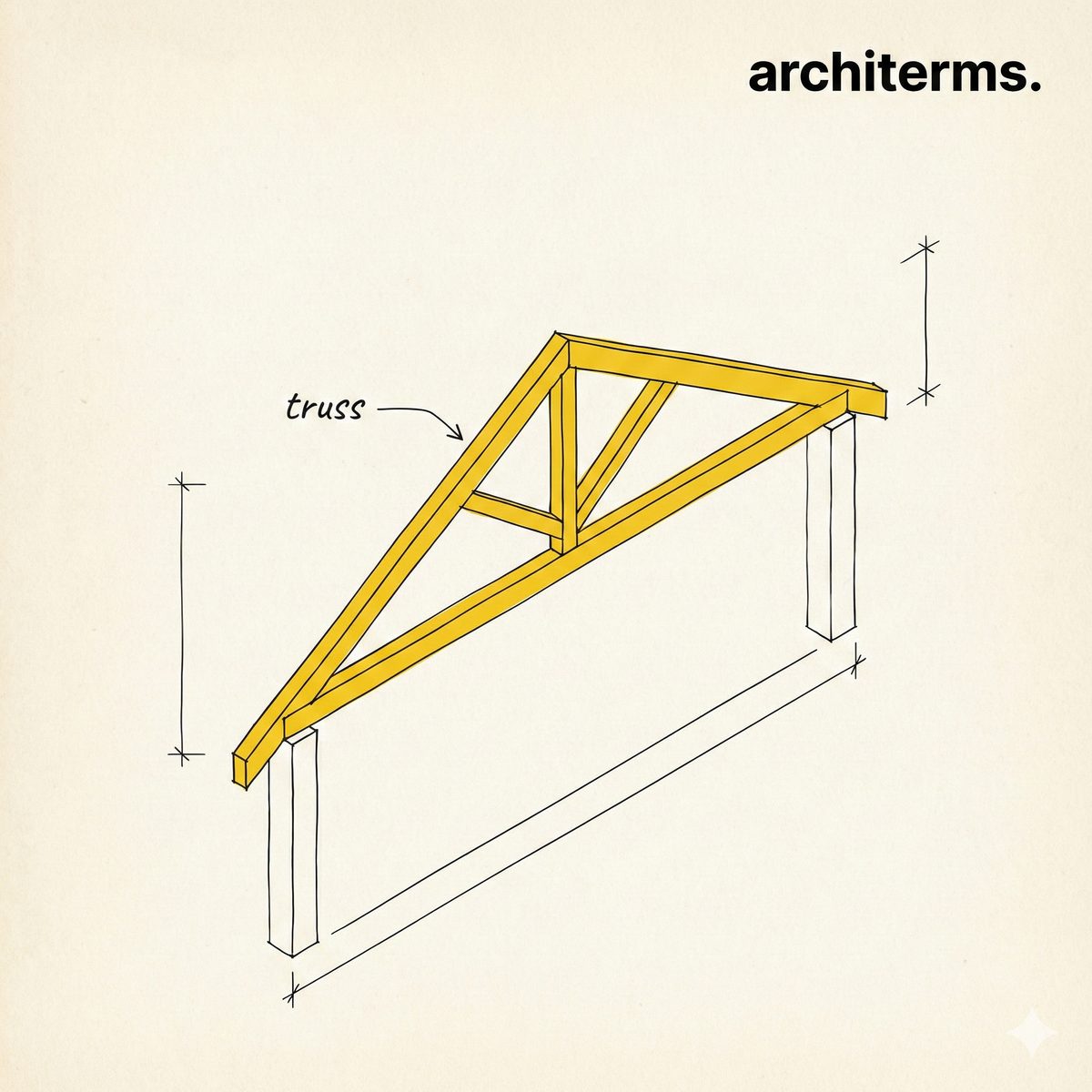
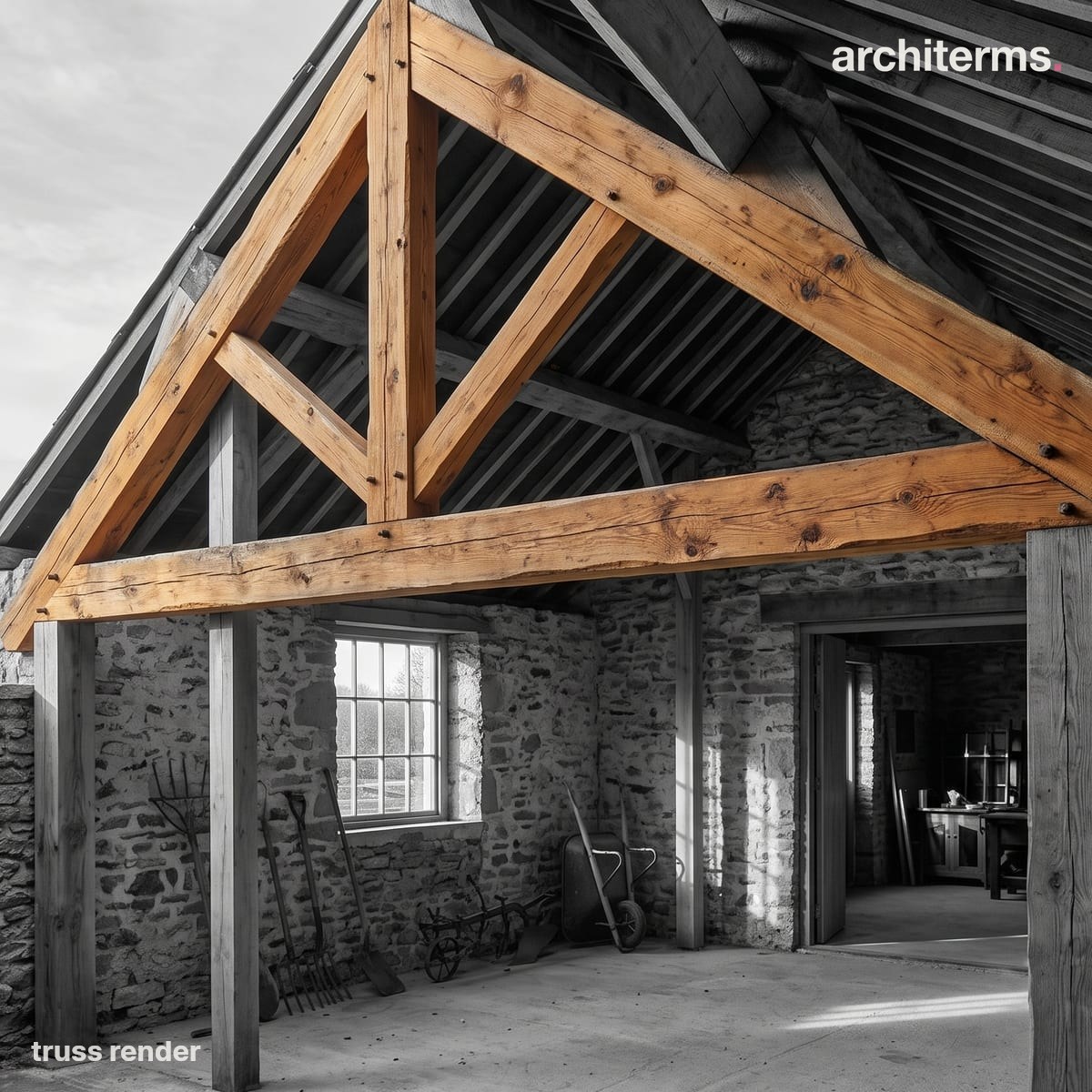
A truss resolves a roof's load into rigid triangles: the sloping rafters press down and outward at their feet, the tie beam across the base holds that spread in, and the king post hangs the middle of the long tie from the apex so it cannot sag.
Made with Reviz.Design — AI visualization for architects and interior designers
Definition
A truss is one of the most efficient ways ever devised to span a large distance with a small amount of material. Instead of relying on a single deep beam, a truss breaks the structure into a network of straight members joined into triangles. Because a triangle cannot change shape without changing the length of its sides, this arrangement is exceptionally rigid, allowing a relatively light framework to carry heavy loads across roofs, bridges, and wide-open interiors.
The genius of the truss lies in how it handles force. Every member in an ideal truss carries load only along its length—either pulling apart in tension or pushing together in compression—rather than bending. This makes the most of each piece of timber or steel, which is why trusses appear wherever architects and engineers need to roof a sports hall, a railway station, or a barn without a forest of internal columns.
A truss is a structural framework composed of straight members connected at joints (nodes) to form a series of triangles, designed so that loads are carried primarily as axial tension and compression rather than bending. The members above are typically called the top chord, those below the bottom chord, and the diagonal and vertical pieces between them the web members. Trusses are most often made of timber or steel and are used to span roofs, floors, and bridges where a solid beam would be heavier, deeper, and less economical.
Truss History
Triangulated timber frameworks appear in Roman construction and were refined throughout the medieval period, when great roof trusses spanned the naves of churches and the halls of castles without intermediate supports. Carpenters developed sophisticated joints to lock timber members together, and the king-post and queen-post trusses of this era remain in use today. These early trusses were shaped as much by craft and intuition as by calculation.
The 19th century transformed the truss into a precisely engineered element. The expansion of railways demanded long-span bridges, and engineers such as those behind the Pratt, Howe, and Warren trusses developed standardized configurations whose forces could be calculated member by member. The arrival of iron and steel let trusses grow to enormous spans, roofing the great train sheds and exhibition halls of the industrial age. Today, computer analysis and prefabricated metal-plate connectors make the timber roof truss a routine, mass-produced component of ordinary houses.
Truss in Architecture
Trusses are valued in architecture for several reasons:
- —Long spans: A truss can bridge distances far greater than a single beam, creating column-free interiors for halls, gymnasiums, and warehouses.
- —Material efficiency: By carrying load in tension and compression rather than bending, a truss uses much less material than a solid beam of the same span.
- —Roof shaping: Roof trusses establish the pitch and profile of a roof, supporting the rafters or roof deck above and the ceiling below in a single prefabricated unit.
- —Expressed structure: When left exposed, a truss becomes a powerful architectural feature, revealing the logic of the structure overhead in spaces from rustic barns to high-tech atriums.
Because a truss concentrates its forces at the joints, the design of those connections—whether traditional carpentry joints, bolted steel gusset plates, or pressed metal connector plates—is critical to its performance. The visible rhythm of a truss's diagonals and verticals also gives many buildings their character, turning a structural necessity into a defining visual element.
Common confusion
Truss vs. beam: A beam is a single solid member that carries load by bending, while a truss is an open framework of triangulated members that carries the same load in tension and compression, using far less material for a long span.
Truss vs. rafter: A rafter is an individual sloping member that supports a roof; a truss is a complete triangulated frame that often incorporates the rafters (as its top chord) together with the ceiling tie and internal web members in one engineered unit.
Truss vs. frame: A rigid frame resists load partly through bending and stiff joints, whereas a truss is specifically triangulated so that its members are loaded along their length and its joints can be treated as pins.
Truss vs. girder: A girder is a large primary beam that carries other beams; a truss may do the same job but achieves it through triangulation rather than a single deep solid section.
Frequently Asked Questions
What is a truss in architecture?
A truss is a rigid framework of straight members connected into triangles to span a distance and carry loads efficiently. Because triangles cannot deform without changing the length of their sides, the framework is very stiff, letting a light structure support heavy roofs, floors, or bridges with little material.
How does a truss work?
A truss works by resolving applied loads into pure axial forces in its members—tension in some, compression in others—rather than bending. The triangulated geometry directs forces along the straight members to the joints, which is why a truss can span far more efficiently than a solid beam of similar weight.
What is the difference between a truss and a beam?
A beam is a single solid member that carries load by bending across its depth. A truss is an open framework of triangulated members that carries the same load as tension and compression, using much less material to achieve a long span.
What are the main parts of a truss?
A truss has a top chord and a bottom chord—the main upper and lower members—and a set of web members (the diagonals and verticals) connecting them. Loads travel through these members to the joints, or nodes, where they meet.
What is a roof truss used for?
A roof truss supports the roof covering and ceiling while spanning between the outer walls, removing the need for internal load-bearing walls or columns. Prefabricated timber roof trusses are now a standard, economical way to frame the roofs of houses and light commercial buildings.