Rafter.
A rafter is one of a series of sloping structural members that run from the ridge of a roof down to the wall plate, forming the frame that supports the roof covering.
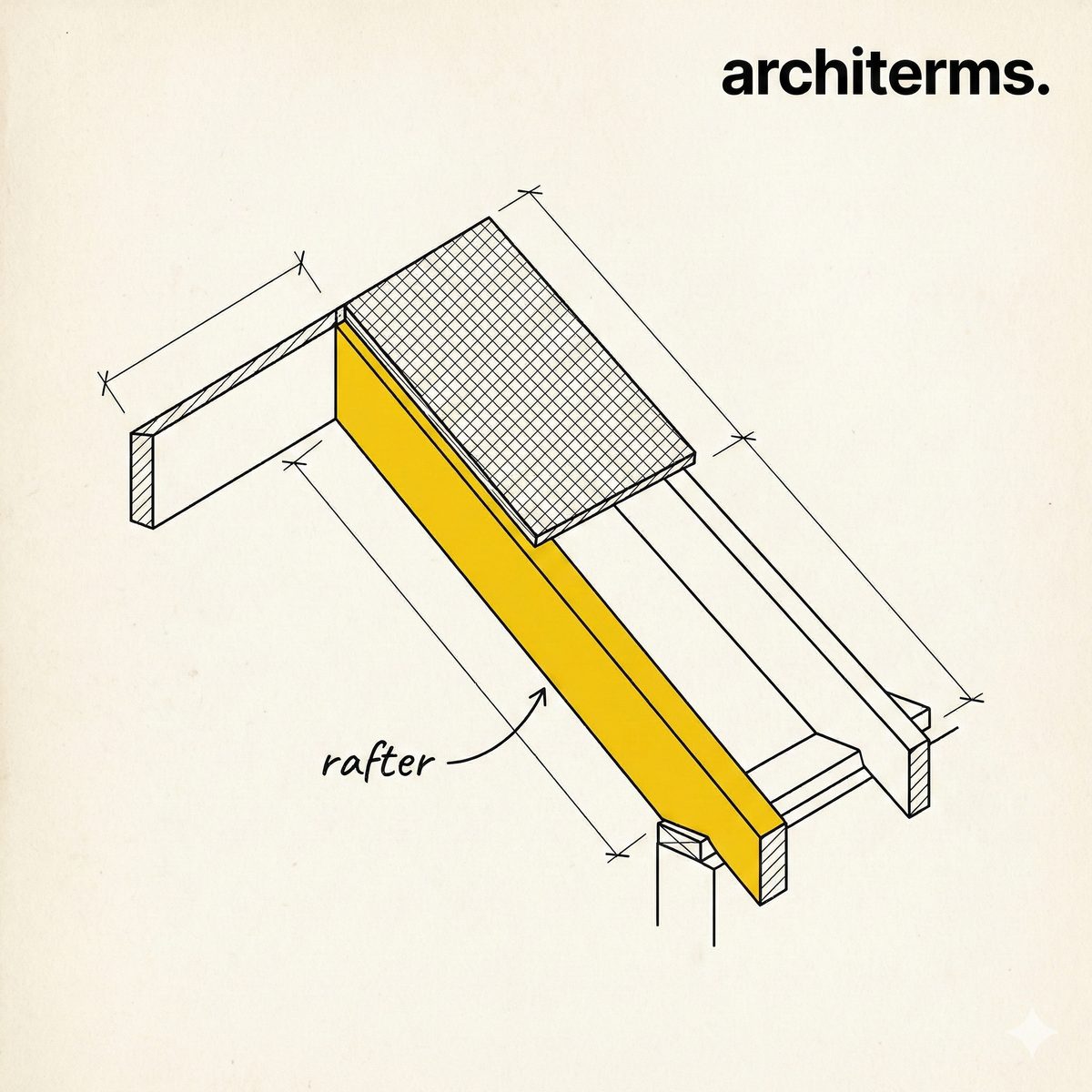
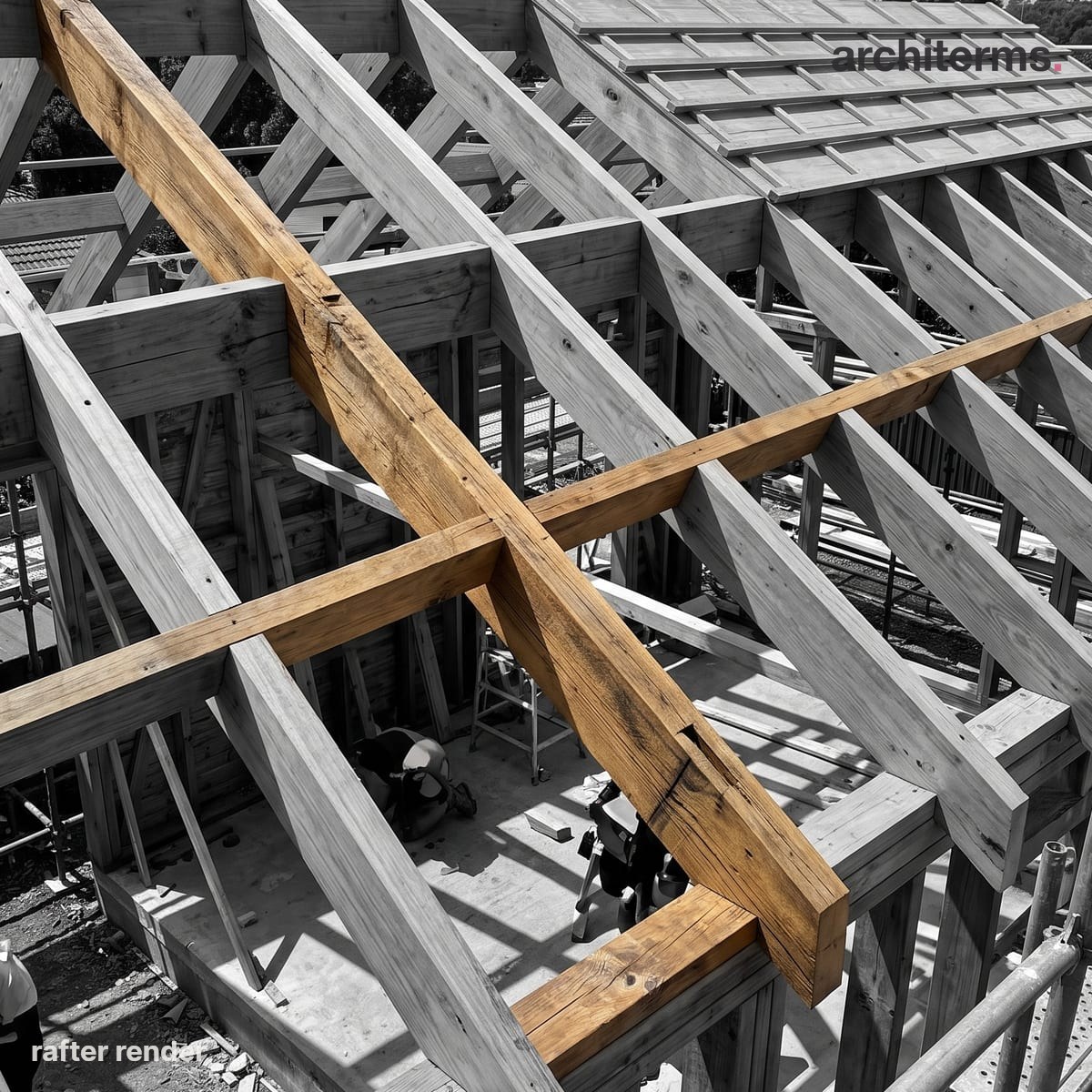
Rafters are the sloping members that run from the ridge down to the wall plate, setting the pitch of the roof. Here the longer hip rafters carry the line where two roof planes meet, giving the shorter common rafters something to land against.
Made with Reviz.Design — AI visualization for architects and interior designers
Definition
A rafter is the basic building block of a pitched roof. Set in repeating parallel rows, rafters create the sloping planes that shed rain and snow and give a roof its characteristic shape. Each rafter runs from the high point of the roof down to the top of the wall, and together they form the skeleton onto which battens, sheathing, and the final roof covering are fixed.
Rafters are deceptively simple but structurally demanding members. They must resist the bending caused by the weight of the roof and the loads of wind and snow, while also tending to push outward on the walls at their feet—a thrust that the rest of the roof frame must be designed to control. Understanding rafters is the key to understanding how almost every traditional roof stands up.
A rafter is an inclined structural member, usually of timber, that extends from the ridge or hip at the top of a roof down to the eaves, where it bears on the wall plate. Rafters are spaced at regular intervals and carry the roof deck, battens, and covering above them, transferring those loads down to the walls. Because a sloping rafter tends to spread outward at its base under load, rafters are usually tied together across the building—by ceiling joists or a collar—to stop the walls from being pushed apart.
Rafter History
The rafter is as old as the pitched roof itself, appearing in timber building traditions across the world wherever rain and snow had to be shed. Early builders quickly learned that a pair of opposing rafters leaning against each other formed a stable triangle only if their feet were prevented from spreading, and the history of roof carpentry is largely the history of solving that single problem with ties, collars, and braces.
Medieval carpenters raised rafter construction to an art, framing vast church and hall roofs with paired "common" rafters stiffened by purlins and elaborate trusses. As building science matured, the simple rafter was increasingly combined into the engineered roof truss, where rafters become the top chords of a triangulated frame. Even so, traditional rafter-and-purlin roofs and modern "cut" roofs framed on site rafter by rafter remain in widespread use today.
Rafter in Architecture
Rafters perform several essential roles in a roof:
- —Defining the slope: The angle at which rafters are set fixes the pitch of the roof, which in turn affects how it drains, how it looks, and how it performs in different climates.
- —Supporting the covering: Rafters carry the sheathing, underlay, and tiles or sheets that make up the weatherproof surface of the roof.
- —Spanning to the walls: Rafters transfer the roof loads down to the wall plate and the load-bearing walls below.
- —Working with purlins and ties: Long rafters are often supported partway by purlins and restrained at the base by ceiling joists or collars that absorb their outward thrust.
Where rafters are left exposed beneath an open ceiling, their repeating rhythm becomes a strong architectural feature, expressing the geometry of the roof inside the room. In many modern houses, however, the individual rafter has been absorbed into the prefabricated roof truss, where it survives as the sloping top chord.
Common confusion
Rafter vs. joist: A rafter is a sloping member that frames a pitched roof, while a joist is a horizontal member that supports a floor or flat ceiling. The two often meet at the wall plate, where ceiling joists tie the feet of the rafters together.
Rafter vs. truss: A rafter is a single sloping member; a truss is a complete triangulated frame that may contain rafters as its top chords along with internal web members and a bottom tie. A "cut" roof is framed from individual rafters, while a "trussed" roof uses prefabricated trusses.
Rafter vs. purlin: A rafter runs up the slope of the roof, whereas a purlin runs horizontally along the roof to support the rafters partway along their length and reduce how far they have to span.
Rafter vs. beam: A beam is a general horizontal load-carrying member; a rafter is the specific sloping member used to frame a pitched roof.
Frequently Asked Questions
What is a rafter in architecture?
A rafter is one of the sloping structural members that frame a pitched roof. Rafters run from the ridge at the top of the roof down to the wall plate at the eaves, and set in parallel rows they support the roof covering and carry its loads down to the walls.
What is the difference between a rafter and a joist?
A rafter is a sloping member that frames a pitched roof, while a joist is a horizontal member that supports a floor or a flat ceiling. They frequently meet at the top of the wall, where ceiling joists also tie the feet of the rafters together to stop them spreading.
What is the difference between a rafter and a truss?
A rafter is a single sloping member, whereas a truss is a complete triangulated frame. A truss often includes the rafters as its top chords, combined with web members and a bottom tie. Roofs built from individual rafters are called cut roofs; those using factory-made frames are trussed roofs.
Why do rafters push the walls outward?
Because a rafter is set at a slope, the roof load it carries has a horizontal component that tries to push the foot of the rafter—and the wall it sits on—outward. This is why rafters are tied together across the building with ceiling joists or collars that resist the spreading thrust.
What is the difference between a rafter and a purlin?
A rafter runs up the slope of the roof from eaves to ridge, while a purlin runs horizontally across the rafters. The purlin supports the rafters partway along their length, reducing the distance each rafter must span on its own.