Nave.
The nave is the long central hall of a church, running from the main entrance to the chancel, where the congregation gathers and faces the altar. In plain terms: it is the tall, open middle space you walk into and move down toward the front of the church.
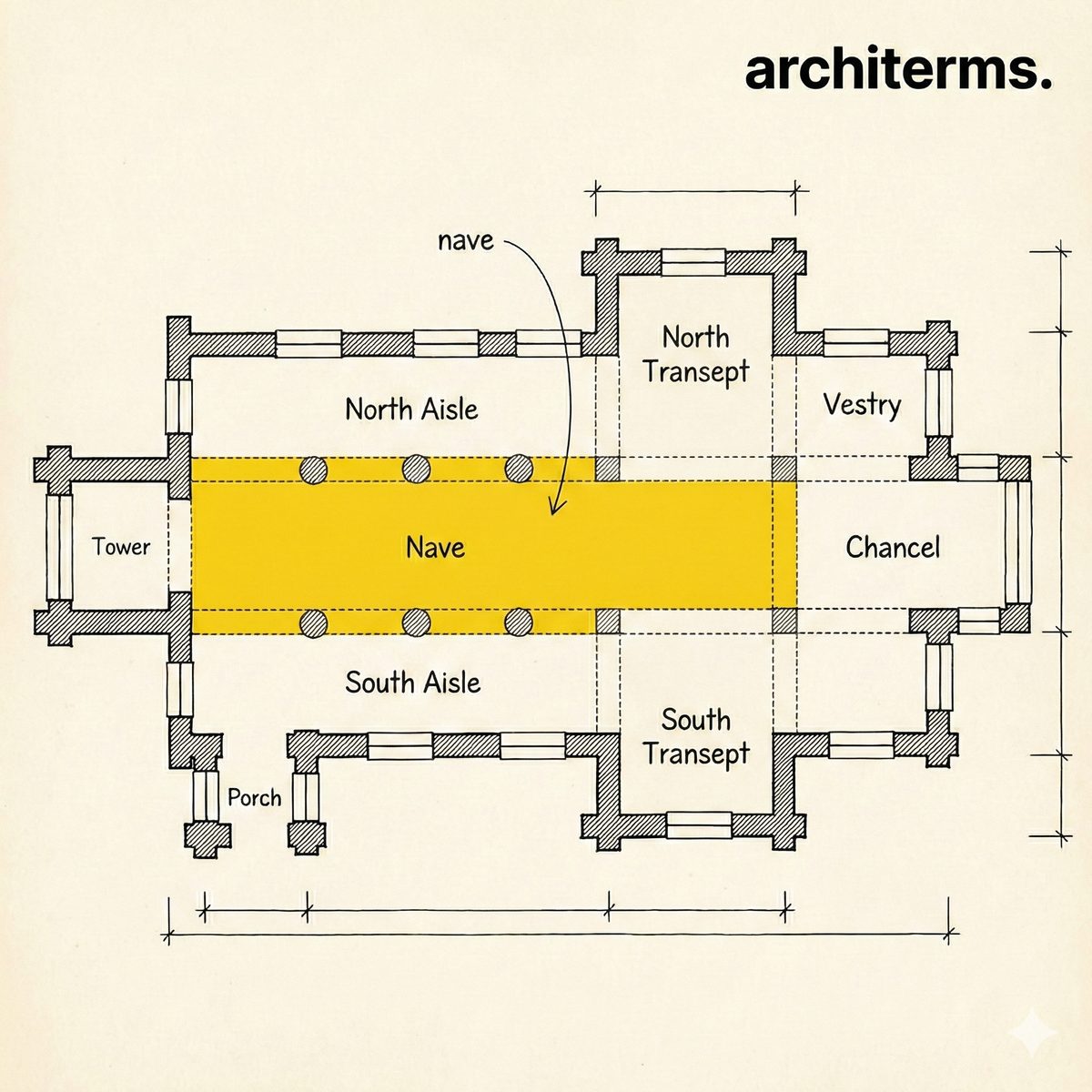
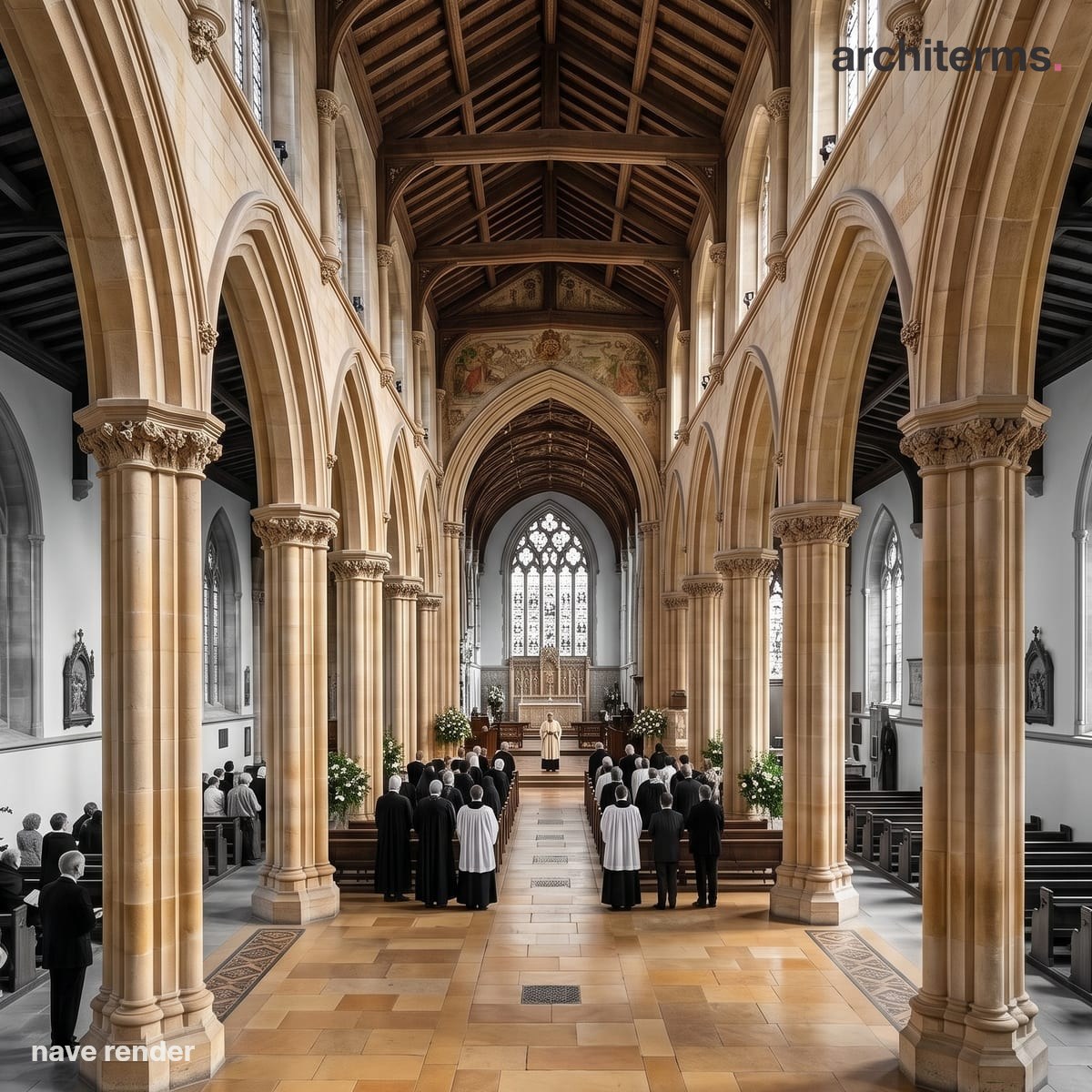
The nave is the long central hall running from the entrance to the chancel, flanked by arcades that separate it from the side aisles. The congregation gathers along its length and faces down the axis toward the altar at the far end.
Visualized with Reviz.Design — AI rendering for architects and interior designers
Definition
The nave is the heart of a church's interior—the main body of the building where worshippers stand or sit. It stretches along the long axis from the entrance at the west end toward the chancel and altar at the east, and its height, length, and rhythm of supports do much to create the sense of awe people feel on entering a great church.
In most traditional churches the nave is flanked by lower side aisles, separated from it by rows of columns or piers carrying an arcade. Above the arcade the nave wall often rises through further levels to a band of windows that floods the central space with light. This layered, vertical section is what gives cathedrals their soaring character.
The nave is the central, longitudinal space of a church between the main entrance and the chancel, reserved for the congregation. It is typically taller and wider than the side aisles that flank it, and it is defined along its sides by an arcade of columns or piers. The word comes from the Latin navis, meaning ship, a reference both to the hull-like shape of its vaulted ceiling and to the old image of the church as a vessel carrying the faithful. The nave establishes the main axis of the building, drawing the eye and the body forward toward the altar.
Nave History
The nave has its roots in the Roman basilica, a long colonnaded hall used for law and commerce, which early Christians adapted as a model for places of worship. Early Christian and Romanesque naves were relatively dark, with thick walls, round arches, and small windows. The Gothic period transformed the nave: pointed arches, rib vaults, and flying buttresses let builders raise the central vessel to extraordinary heights and replace solid wall with stained glass, as at Chartres and Amiens. Renaissance and Baroque architects reinterpreted the nave with classical orders, coffered vaults, and domes, while keeping its essential role as the processional spine of the church.
Nave in Architecture
The nave organizes both the structure and the experience of a church:
- —Axis and procession: The nave sets the building's main axis, leading the congregation from entrance to altar and shaping liturgical processions.
- —Section and light: In a classic Gothic nave, the wall rises in three stages—arcade, triarium or gallery, and clerestory—so light enters high above the aisles and washes down into the central space.
- —Structure: The arcade carries the upper nave wall and the thrust of the vault; in vaulted churches that thrust is caught by the aisle roofs and, where needed, by flying buttresses outside.
- —Acoustics and scale: The nave's volume gives music and the spoken word their resonance, and its proportions—tall and narrow, or broad and calm—set the emotional tone of the interior.
Where the nave crosses the transept, the resulting crossing is often marked by a tower or dome, the visual climax of the plan.
Common confusion
Nave vs. aisle: The nave is the tall central vessel; the aisles are the lower passages running alongside it, separated by the arcade. The nave is for the main body of the congregation, while aisles allow movement and access.
Nave vs. chancel: The nave is the congregation's space at the entrance side; the chancel (with the choir and sanctuary) is the area around the altar reserved for clergy. A screen or step often marks the boundary between them.
Nave vs. transept: The nave runs along the building's long axis; the transept is the arm that crosses it at right angles, giving many churches their cross-shaped plan. The two meet at the crossing.
Nave vs. apse: The apse is the rounded recess that usually terminates the chancel beyond the nave; it is the end point of the axis, not the central hall itself.
Frequently Asked Questions
What is the nave of a church?
The nave is the long central hall of a church between the main entrance and the chancel, where the congregation gathers. It is usually the tallest and widest interior space, flanked by lower side aisles and separated from them by an arcade of columns or piers.
Why is it called a nave?
The word nave comes from the Latin navis, meaning ship. The name reflects both the hull-like shape of the vaulted ceiling overhead and the traditional Christian image of the church as a vessel that carries the faithful, with the congregation gathered inside its central body.
What is the difference between the nave and the aisle?
The nave is the tall central vessel of the church where most worshippers gather, while the aisles are the lower passages running along each side of it. The two are separated by the arcade, a row of columns or piers, and the aisles mainly provide circulation and access.
Where is the nave located in a church?
The nave occupies the main body of the church along its long axis, beginning just inside the main entrance at the west end and running east toward the crossing and chancel. The altar lies beyond the nave, so the space naturally directs attention forward.
What is the difference between the nave and the chancel?
The nave is the congregation's space toward the entrance, while the chancel is the area around the altar, including the choir and sanctuary, traditionally reserved for the clergy. A step, rail, or screen usually marks the transition from the nave to the chancel.