Ogee.
An ogee is an S-shaped curve formed by joining a concave arc smoothly to a convex one, producing a continuous double curve. In architecture the form appears in moldings, arches, and roof profiles, where it lends a graceful, flowing transition between surfaces. The term is used across classical, Gothic, and Islamic traditions.
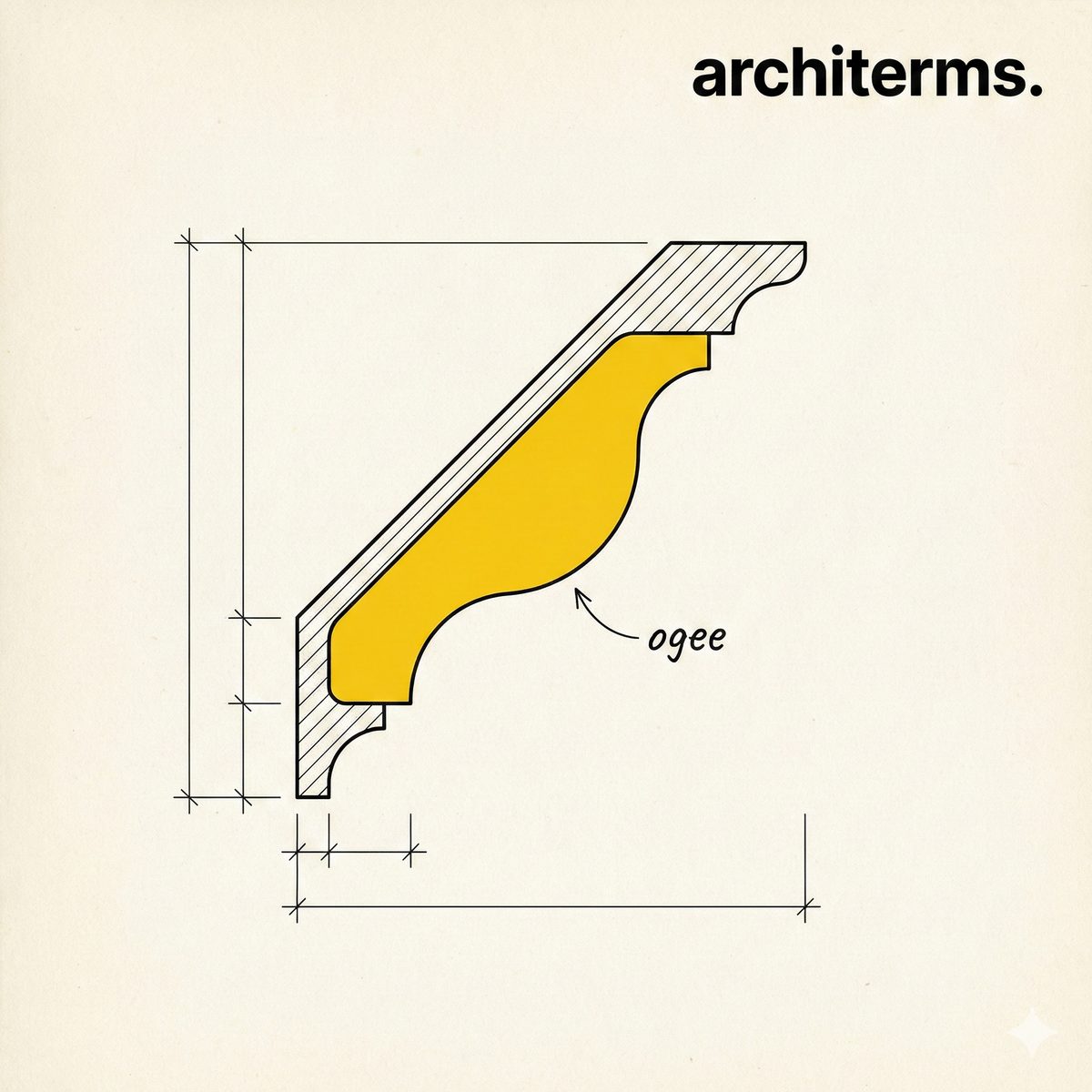
Definition
An ogee is a continuous double curve composed of two arcs of opposite curvature — one concave and one convex — meeting at a point of inflection where the curve reverses direction. The resulting silhouette resembles an elongated, slender letter S. In architectural drawing and stone-cutting, the ogee is treated as a precise geometric profile rather than a freehand line, often set out from two centers so that the concave and convex segments are tangent at the reversal point. The shape is applied at many scales: as a small molding profile running along a cornice, as the curved sides of a pointed ogee arch, and as the swept outline of an ogee dome or ogee roof. Because the form combines softness with a defined apex, it reads as both decorative and structural, depending on where it is used. The classical molding cyma is the canonical example of the profile, and the words cyma recta and cyma reversa describe the two orientations of the ogee curve.
Ogee History
The ogee profile has ancient roots. The Greek cyma molding, found crowning entablatures of temples in both the Doric and Ionic orders, established the S-curve as a refined finishing element well before the medieval period. Roman builders inherited and standardized the profile, codifying the cyma recta and cyma reversa as named members within the classical cornice. The pointed ogee arch, however, is most strongly associated with later traditions. It appears prominently in Islamic architecture across the Middle East, North Africa, and South Asia, where the doubly curved arch and bulbous ogee dome became hallmarks of mosque, palace, and tomb design. In Europe the ogee arch entered the vocabulary of the late Gothic style during the fourteenth century, flourishing in the English Decorated period and the French Flamboyant style. Tracery, niche heads, doorways, and canopy work of this era frequently terminate in slender ogee points, sometimes crowned with a finial. The form's popularity reflected a broader medieval taste for movement, ornament, and visual lightness. The shape was later revived by the Gothic Revival movement of the nineteenth century, which reintroduced ogee arches and moldings into churches, civic buildings, and domestic architecture.
Ogee in Architecture
In contemporary and historical practice the ogee survives in several distinct applications. As a molding, the ogee profile remains a standard element in cornice, baseboard, and panel detailing, valued for the soft shadow line its reversing curve casts. Cabinetmakers and joiners use the same profile in trim and furniture, while metalworkers employ ogee gutters whose cross-section follows the classic S-curve. At building scale, the ogee dome — sometimes called a bell or onion dome — caps towers, pavilions, and garden structures, with notable examples in Mughal architecture such as the silhouettes of pavilions at Indian palaces and tombs. The ogee roof, where two ogee curves meet at a ridge or apex, appears on cupolas, bandstands, and lantern structures. In ecclesiastical work the ogee arch frames windows, sedilia, and tomb canopies, and it continues to be specified in restoration and revival projects. Modern computer-aided design has made the precise generation of ogee profiles routine, allowing architects to scale and repeat the curve accurately. Even in minimalist contemporary buildings, designers occasionally borrow the ogee silhouette for fascia profiles and signage to introduce a note of traditional elegance.
Types of Ogee Several variants of the ogee are commonly distinguished. The simple ogee, or cyma, is the basic two-arc molding. The reverse ogee, equivalent to the cyma reversa, places the convex portion uppermost and the concave below, while the cyma recta does the opposite. The ogee arch is a pointed arch whose two sides are each ogee curves rising to a sharp apex. The compound or double ogee multiplies the reversals to create a richer, more sculptural profile. Finally, the ogee dome and ogee roof apply the curve in three dimensions to a vault or covering.
Ogee Examples Clear examples of the ogee include the cyma recta crowning a classical cornice, the flowing ogee arches of England's Decorated Gothic cathedrals, the onion-shaped ogee domes of Mughal and Russian buildings, and the swept ogee roofs of garden pavilions and cupolas. In everyday construction, the ogee gutter and ogee skirting board carry the same profile into ordinary buildings, showing how thoroughly the curve has entered the standard catalogue of architectural elements.
Common confusion
The ogee is frequently confused with several related forms. It is often mistaken for a plain pointed arch, but a pointed arch is built from two circular arcs that curve only inward toward a point, whereas an ogee arch reverses curvature near the top, bulging outward before sweeping to its apex. It is also confused with the ovolo and the cavetto, two single-curve moldings: the ovolo is a convex quarter-round and the cavetto a concave quarter-round, while the ogee combines both concave and convex segments in one profile. The onion dome and the ogee dome overlap in appearance, but not every onion dome is geometrically a true ogee, and the term ogee specifically describes the S-curve generating the profile. Finally, the words cyma and ogee are sometimes treated as interchangeable; strictly, cyma is the classical molding name and ogee is the general geometric description of the same double curve. Recognizing the point of inflection — the single place where the curve changes from concave to convex — is the surest way to identify a genuine ogee.
Frequently Asked Questions
What is an ogee in architecture?
An ogee is an S-shaped curve made by joining a concave arc to a convex arc, with a point where the curve reverses direction. In architecture it appears in moldings, arches, domes, and roof profiles, giving a graceful flowing transition between surfaces.
What is the difference between an ogee arch and a pointed arch?
A pointed arch is formed from two circular arcs that curve only inward to meet at a point. An ogee arch reverses curvature near the top, bulging outward before sweeping back to a sharp apex, producing a more decorative, doubly curved silhouette.
Is an ogee the same as a cyma molding?
They describe the same double curve, but the terms differ in emphasis. Cyma is the classical molding name, with cyma recta and cyma reversa indicating its orientation, while ogee is the general geometric description of the S-shaped profile.