Fascia.
A fascia is a horizontal board or panel that runs along the edge of a roof, typically covering the ends of rafters and providing a finished appearance. In plain terms: it's the vertical board you see at the edge of a roof, often where gutters are attached.
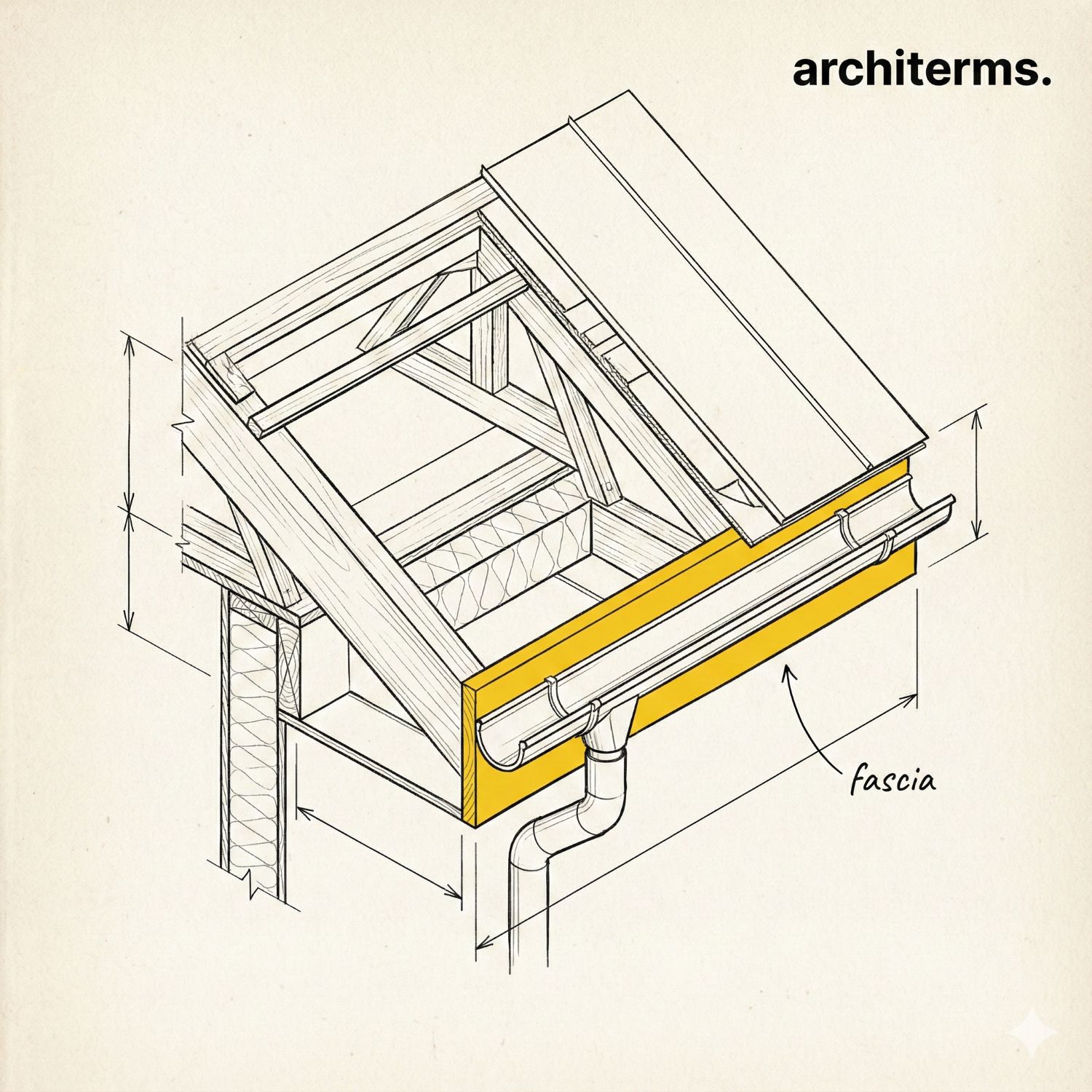
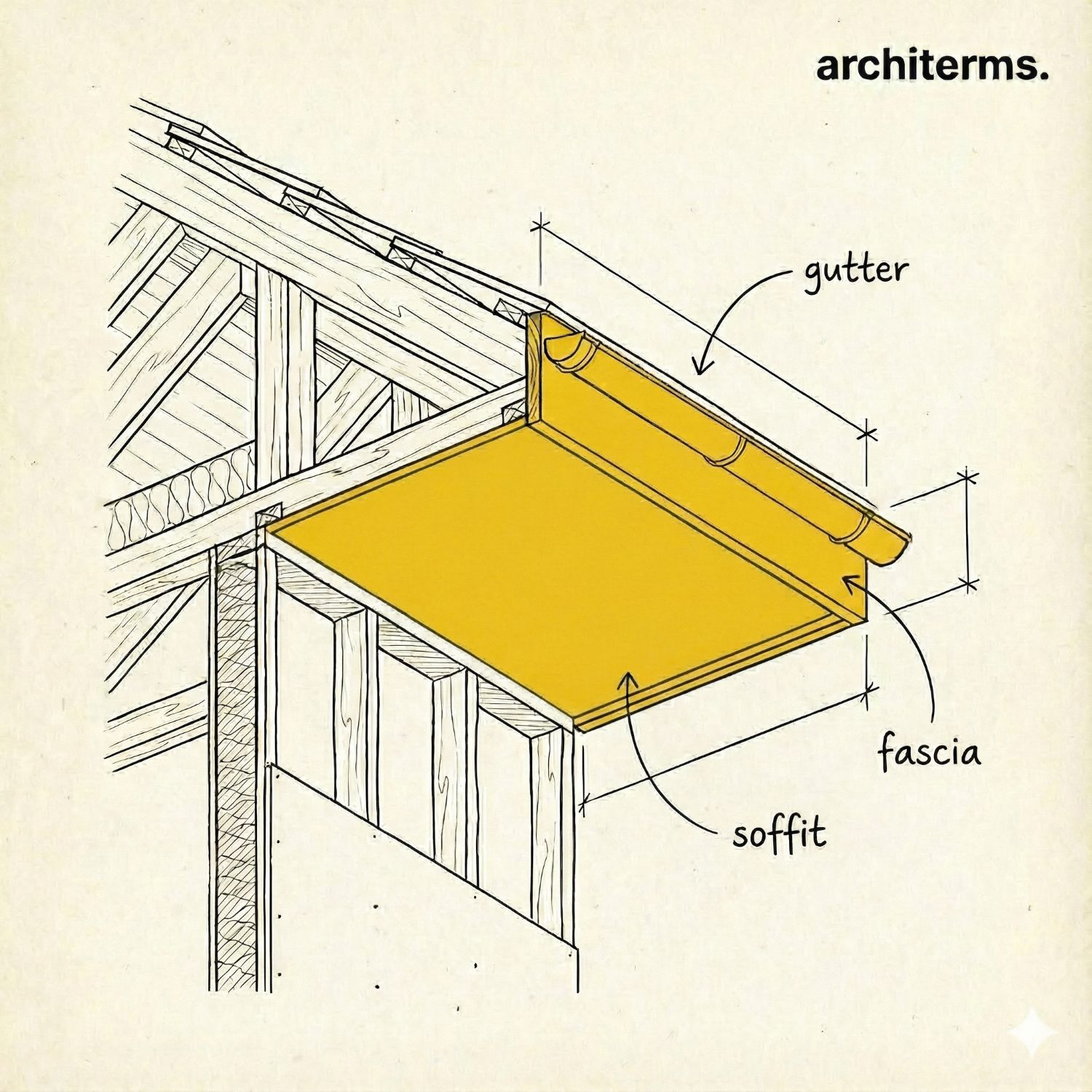
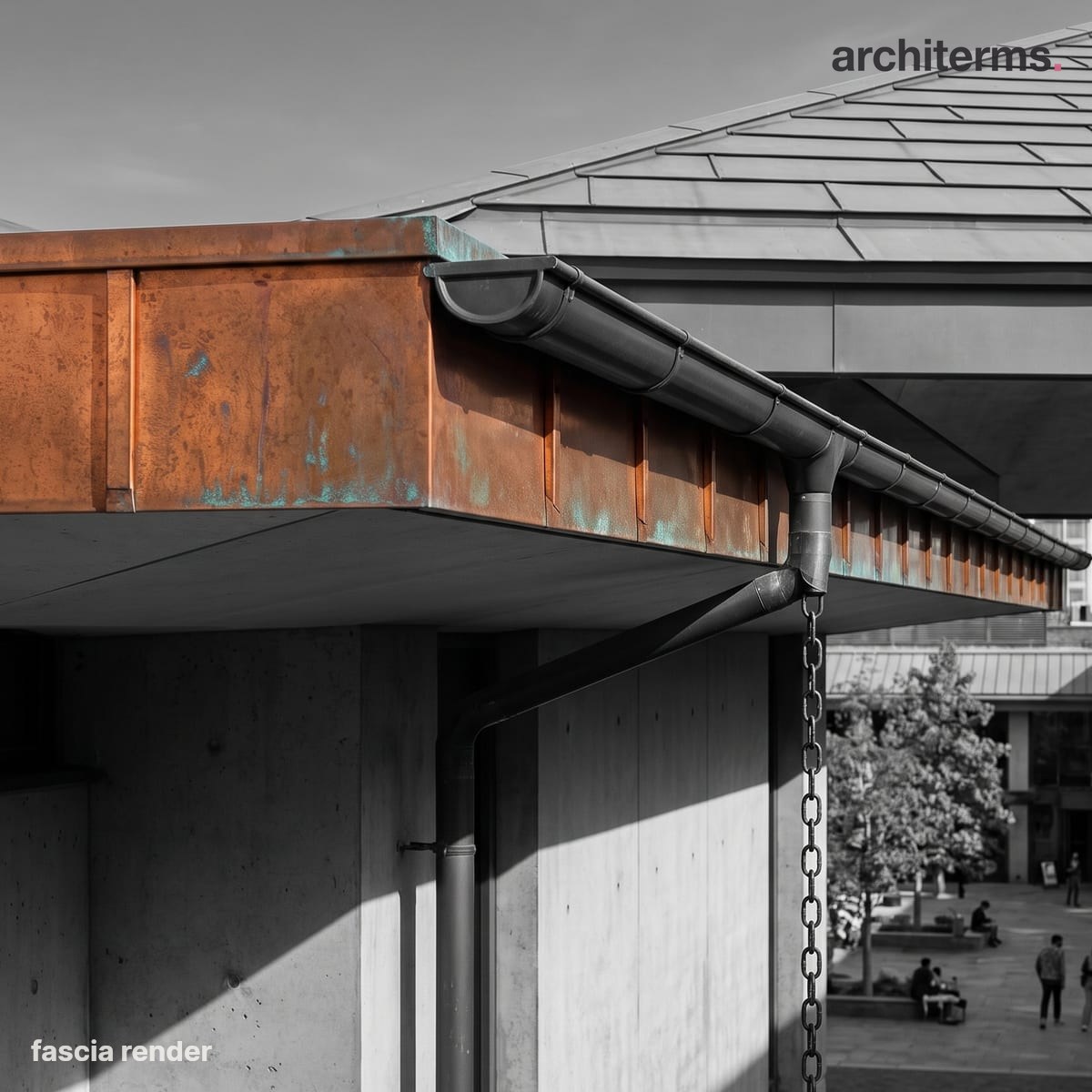
The fascia is the board fixed vertically across the ends of the rafters, closing off the eaves with a clean line. It hides the cut rafter ends behind a finished face and gives the gutter a solid edge to hang from.
Visualized with Reviz.Design — AI rendering for architects and interior designers
Definition
A fascia (pronounced FAY-shuh or FASH-ee-uh) is a horizontal board or panel that runs along the lower edge of a roof, typically covering the ends of the rafters and providing a clean, finished appearance to the roofline. The fascia is one of the most visible elements of a building's exterior, forming the vertical face at the roof's edge.
The word "fascia" comes from the Latin word "fascia," meaning "band" or "strip," which accurately describes this architectural element's function as a horizontal band that finishes the roof edge.
Fascia serves both functional and aesthetic purposes in architecture. Functionally, it protects the roof structure from weather, provides a surface for gutter attachment, and helps prevent water from entering the building. Aesthetically, it creates a clean, finished appearance and can be used to add architectural detail or color to a building's roofline.
Fascia architecture
In fascia architecture, the fascia is a critical element that affects both the building's appearance and performance:
Visual continuity: The fascia creates a continuous horizontal line along the roofline, providing visual continuity and finishing the building's silhouette. This is especially important in modern architecture where clean lines are emphasized.
Proportional relationships: The fascia's width and depth affect the perceived scale of the building. A wider fascia can make a building appear more substantial, while a narrower fascia can create a lighter, more delicate appearance.
Material expression: The fascia's material (wood, metal, composite, etc.) contributes to the building's overall material expression and can reference traditional or modern architectural languages.
Color and finish: The fascia is often painted or finished in a color that contrasts or complements the building's main color, adding visual interest and architectural detail.
Integration with other elements: The fascia integrates with other roofline elements like soffits, gutters, and cornices, creating a cohesive architectural system.
Historical reference: In traditional architecture, fascia boards often featured decorative moldings or details that referenced classical or regional architectural traditions.
Fascia roof
In fascia roof construction, the fascia is a critical component of the roof system:
Structural function: The fascia covers and protects the ends of the rafters, preventing water infiltration and protecting the roof structure from weather damage. It also provides a surface for attaching gutters and other roof elements.
Gutter attachment: The fascia is the primary surface for attaching gutters. Gutters are typically mounted to the fascia using brackets or hangers, making the fascia's condition and strength critical for proper gutter installation.
Water management: The fascia helps direct water into the gutters and away from the building. A properly installed fascia prevents water from running down the building's walls or entering the roof structure.
Ventilation: In some roof designs, the fascia includes vents or openings that allow air to circulate in the attic or roof space, helping to prevent moisture buildup and regulate temperature.
Aesthetic finish: The fascia provides a clean, finished appearance to the roofline, hiding the rough ends of rafters and creating a professional, polished look.
Material selection: Fascia materials must be durable, weather-resistant, and able to withstand exposure to sun, rain, and temperature changes. Common materials include wood, metal (aluminum, steel, copper), composite materials, and PVC.
Fascia board
A fascia board is the specific board or panel used to create the fascia element:
Standard dimensions: Fascia boards are typically 1x6, 1x8, or 2x6 inches (nominal dimensions), though custom sizes are also used. The width depends on the roof's design and the desired aesthetic.
Material options:
- —Wood fascia boards: Traditional choice, often cedar, pine, or redwood. Requires regular maintenance and painting but offers natural appearance and easy customization.
- —Composite fascia boards: Made from wood fibers and plastic, offering durability and low maintenance. Resistant to rot, insects, and weather.
- —PVC fascia boards: Plastic boards that are maintenance-free and highly durable. Available in various colors and finishes.
- —Metal fascia boards: Aluminum, steel, or copper panels that are extremely durable and low-maintenance. Often used in modern or commercial architecture.
Fascia wall meaning
The fascia wall meaning refers to the fascia's relationship to the building's wall:
Vertical face: The fascia creates a vertical face at the roof's edge, forming a transition between the roof and the wall below. This vertical face is what gives the fascia its name and visual prominence.
Wall protection: The fascia helps protect the wall below from water damage by directing water into gutters and away from the building. Without a proper fascia, water can run down the wall, causing staining, damage, and potential structural issues.
Visual connection: The fascia connects the roof to the wall, creating a visual and functional connection between these two major building elements. The fascia's color, material, and details can reference or contrast with the wall's design.
Architectural detail: In some architectural styles, the fascia is treated as an architectural detail that relates to the wall's design. For example, the fascia might match the wall's material or color, or it might contrast to create visual interest.
Integration with wall systems: The fascia integrates with wall systems like siding, cladding, and trim, creating a cohesive building envelope. Proper integration requires careful attention to flashing, sealing, and material transitions.
Fascia in construction
In fascia in construction, the fascia is installed as part of the roof framing and finishing process:
Installation sequence: The fascia is typically installed after the roof framing is complete but before the roofing material is applied. This allows the fascia to be properly integrated with the roof structure and provides a surface for gutter installation.
Attachment methods: Fascia boards are attached to the rafter ends using nails or screws. In some cases, a blocking board is installed first, and the fascia is attached to the blocking. Proper attachment is critical for structural integrity and weather resistance.
Flashing and sealing: Where the fascia meets other building elements (walls, chimneys, etc.), proper flashing and sealing are essential to prevent water infiltration. This is especially important at corners and transitions.
Ventilation considerations: If the roof requires ventilation, the fascia may include vents or be designed to allow air flow. This is common in attic ventilation systems where air enters through soffit vents and exits through roof vents.
Gutter integration: The fascia must be strong enough to support gutters and their loads (water, ice, debris). In areas with heavy snow or ice, the fascia must be designed to handle additional loads.
Code requirements: Building codes may specify minimum fascia dimensions, materials, or installation methods. Compliance with local codes is essential for safety and durability.
Types of fascia architecture
There are several types of fascia architecture, each with different characteristics and applications:
Flat fascia: A simple, flat board with no decorative details. This is the most common type, used in modern and contemporary architecture where clean lines are emphasized.
Molded fascia: A fascia board with decorative moldings or profiles. Common in traditional and classical architecture, where the fascia adds architectural detail and references historical styles.
Boxed fascia: A fascia that creates a boxed or enclosed appearance, often used with boxed eaves. This creates a more substantial, formal appearance.
Open fascia: A fascia that allows ventilation, often with perforations or gaps. Used in roofs that require ventilation, such as attics or cathedral ceilings.
Metal fascia: A fascia made from metal panels, typically aluminum or steel. Common in commercial and modern architecture, offering durability and low maintenance.
Composite fascia: A fascia made from composite materials (wood fibers and plastic). Offers the appearance of wood with the durability of plastic.
Decorative fascia: A fascia with decorative elements like brackets, moldings, or trim. Used in traditional and historic architecture to add visual interest and architectural detail.
Integrated fascia: A fascia that is integrated with other roofline elements like soffits or gutters, creating a unified system. Common in modern architecture where clean, integrated systems are preferred.
History
Fascia has been used in architecture for centuries, evolving from simple functional elements to sophisticated architectural details:
Ancient origins: Early fascia were simple boards used to finish roof edges and protect building structures. In ancient Greek and Roman architecture, fascia were often integrated with cornices and other architectural elements.
Medieval architecture: In medieval architecture, fascia were often decorative, featuring carvings or moldings that reflected the building's style and importance. Gothic architecture used fascia as part of elaborate roofline details.
Renaissance and Baroque: During the Renaissance and Baroque periods, fascia became more sophisticated, with elaborate moldings and decorative details that referenced classical architecture.
Colonial architecture: In Colonial architecture, fascia were typically simple, functional boards that finished the roofline. They were often painted to match or contrast with the building's color scheme.
Victorian era: Victorian architecture used fascia as decorative elements, with elaborate moldings, brackets, and trim that added visual interest to rooflines.
Modern architecture: Modern architecture simplified fascia, emphasizing clean lines and functional design. Materials expanded to include metal, composite, and plastic options.
Contemporary architecture: Today, fascia are used in both traditional and modern architecture, with materials and designs that reflect current building practices and aesthetic preferences.
Application
Residential construction: Fascia are essential in residential construction, providing a finished appearance to rooflines and supporting gutter systems. They are used in all types of homes, from traditional to modern.
Commercial buildings: Commercial buildings use fascia for both functional and aesthetic purposes. Metal and composite fascia are common in commercial construction for their durability and low maintenance.
Historic preservation: In historic preservation projects, fascia are carefully restored or replaced to match original designs. This may involve custom millwork or specialized materials to match historical details.
Modern architecture: Contemporary architecture uses fascia to create clean, minimal rooflines. Integrated fascia systems that combine fascia, soffits, and gutters are common.
Industrial buildings: Industrial buildings use fascia for weather protection and to create a finished appearance. Metal fascia are common in industrial construction.
Institutional buildings: Schools, government buildings, and civic structures use fascia as part of their architectural expression, often with decorative details that reference traditional or classical architecture.
Common confusion
Fascia vs soffit: A fascia is the vertical board at the roof's edge. A soffit is the horizontal board under the eave. They work together but serve different functions—the fascia faces outward, while the soffit faces downward.
Fascia vs frieze: A fascia is a horizontal board at the roof edge. A frieze is a horizontal decorative band in classical architecture, typically between the architrave and cornice. They are different elements with different locations and functions.
Fascia vs trim: Fascia is a specific type of trim used at the roofline. "Trim" is a general term for finishing boards used throughout a building. Fascia is a subset of trim.
Fascia vs bargeboard: A fascia is a horizontal board at the roof edge. A bargeboard (vergeboard) is a decorative board on the gable end of a roof. They are different elements, though both are roofline details.
Fascia vs gutter: The fascia is the board that supports the gutter. The gutter is the channel that collects and directs water. They work together but are separate elements.