Ogive.
An ogive is a pointed arch shape with two curves that meet at a peak, characteristic of Gothic architecture. The ogive meaning refers to this distinctive pointed arch form that became the defining feature of Gothic vaults, windows, and doorways.
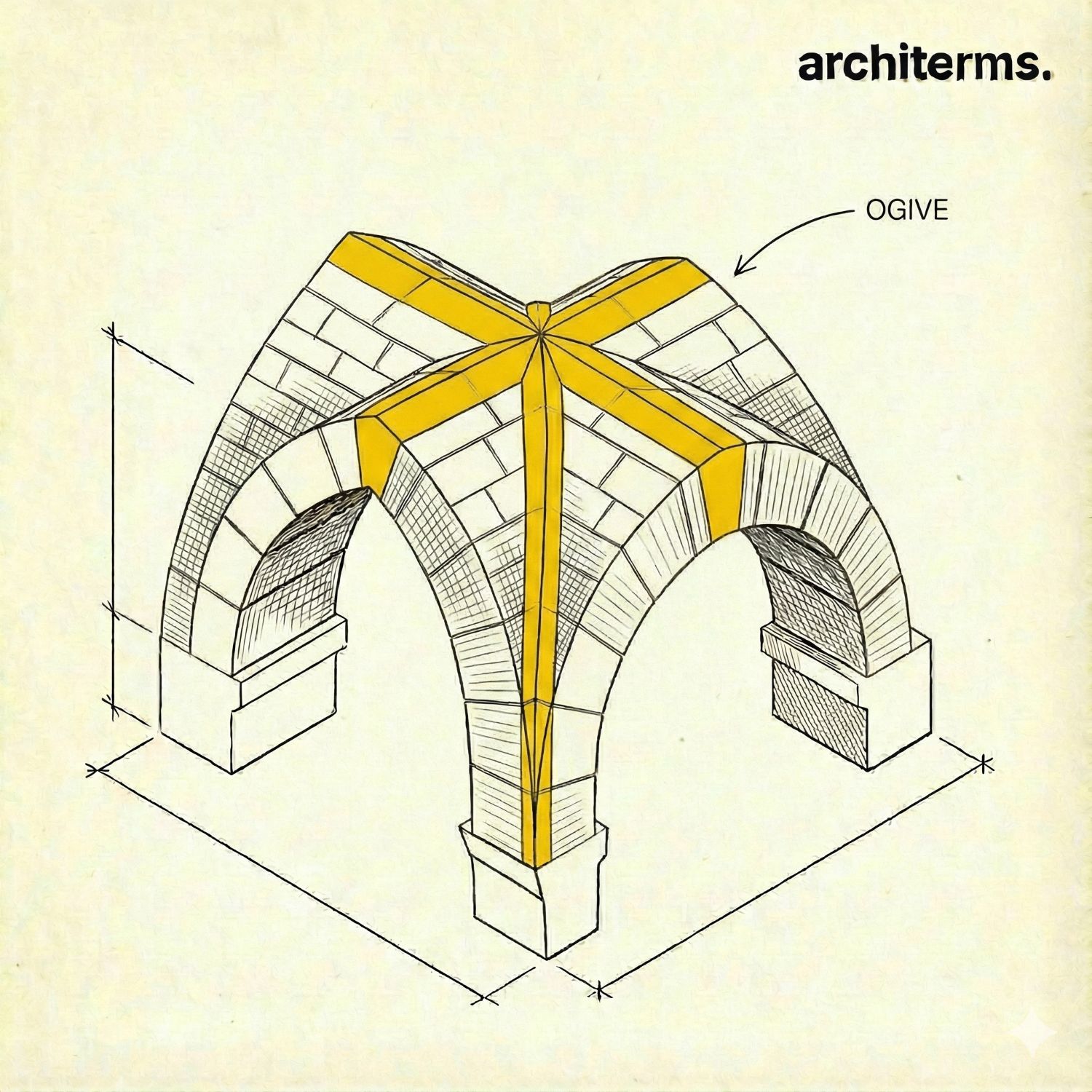
Definition (Ogive meaning / Ogive in architecture)
The ogive meaning in architecture refers to a pointed arch—specifically, an arch formed by two arcs of circles that intersect at a peak, creating a characteristic pointed or "lancet" shape. The ogive shape is one of the most recognizable features of Gothic architecture, appearing in windows, doorways, and most importantly, in the construction of ogive vaults.
The term "ogive" comes from the French word for a pointed arch, and it describes both the geometric form and the structural system that made Gothic architecture possible. Unlike the semicircular Roman arch, the ogive architecture form allows for taller, more vertical openings and more efficient load distribution.
Ogive architecture history
Understanding ogive architecture history requires looking at the transition from Romanesque to Gothic architecture in medieval Europe. The development of the ogive was revolutionary:
12th century origins: The ogive first appeared in France around the 12th century, particularly in the Île-de-France region. Early examples can be seen in the Abbey Church of Saint-Denis (1140s), where pointed arches were used in both the nave and the ambulatory.
Gothic revolution: The ogive became the signature element of Gothic architecture, allowing builders to create taller, lighter structures with larger windows. This was a dramatic shift from the heavy, thick-walled Romanesque buildings that preceded it.
Structural advantages: The pointed ogive shape directs loads more vertically than semicircular arches, reducing lateral thrust. This structural efficiency allowed Gothic builders to use thinner walls and larger openings, making buildings feel more open and light-filled.
Spread across Europe: From France, ogive architecture spread throughout Europe—to England (where it evolved into English Gothic), Germany (German Gothic), Spain, and Italy. Each region developed its own variations while maintaining the fundamental pointed arch form.
Renaissance and beyond: While Renaissance architects moved away from Gothic forms, the ogive experienced revivals in the 19th century (Gothic Revival) and continues to influence contemporary architecture that seeks verticality and structural expression.
Ogive vault (the structural system)
The ogive vault (also called a rib vault or pointed vault) is where the ogive shape becomes a complete structural system. An ogive vault consists of:
Ribs: The structural framework of pointed arches (ogives) that define the vault's geometry. These ribs carry the load and transfer it to supporting columns or piers.
Webbing: The infill between the ribs, which can be thinner because the ribs do most of the structural work.
Keystone: The central stone at the peak where the ogive curves meet, locking the arch together.
The ogive vault system was revolutionary because:
- —It allowed for more flexible floor plans—builders weren't limited to square or rectangular bays
- —It enabled taller, more dramatic interior spaces
- —It reduced the need for massive supporting walls
- —It created a clear structural logic that was both functional and visually expressive
Famous examples of ogive vaults include the nave of Notre-Dame de Paris, the choir of Chartres Cathedral, and the vaults of Westminster Abbey.
Ogive shape (geometry and design)
The ogive shape is defined by its geometry: two arcs of circles (or sometimes ellipses) that meet at a point. The key characteristics are:
Pointed apex: Unlike semicircular arches, ogives come to a sharp point at the top, creating a more vertical, upward-reaching form.
Variable steepness: The angle of the point can vary—from a very acute "lancet" arch (very pointed) to a more moderate pointed arch. This flexibility allowed Gothic architects to adapt the form to different contexts and structural needs.
Visual effect: The ogive shape creates a sense of verticality and upward movement, which was central to the Gothic aesthetic of reaching toward the heavens.
Structural behavior: The pointed form directs loads more efficiently downward, reducing the lateral thrust that semicircular arches create. This structural advantage was crucial for building taller structures with larger openings.
Application (where you see ogive architecture today)
Historic preservation: Many Gothic cathedrals and churches still stand as prime examples of ogive architecture. Restoration work on these buildings requires understanding ogive construction techniques.
Gothic Revival architecture: The 19th-century Gothic Revival movement brought ogive forms back into use, especially in churches, universities, and civic buildings. Examples include the Houses of Parliament in London and many university campuses.
Contemporary architecture: Modern architects sometimes use ogive-inspired forms to create vertical emphasis or to reference historical architectural language. The pointed arch shape appears in everything from modern church design to commercial buildings seeking a distinctive profile.
Interior design: Ogive shapes appear in interior elements like doorways, windows, and decorative elements, especially in spaces that reference Gothic or medieval aesthetics.
Common confusion
Ogive vs. arch: An ogive is a specific type of arch—a pointed arch. Not all arches are ogives (semicircular arches are not ogives), but all ogives are arches.
Ogive vs. Gothic arch: These terms are essentially synonymous. "Ogive" is the technical term, while "Gothic arch" is the more common descriptive term. Both refer to the pointed arch shape.
Ogive vs. lancet arch: A lancet arch is a very acute, narrow ogive—essentially a very pointed version of the ogive shape. All lancet arches are ogives, but not all ogives are as acute as lancet arches.
Ogive vault vs. barrel vault: A barrel vault is a continuous semicircular vault. An ogive vault uses pointed arches (ogives) as ribs to create a more complex, flexible structural system.
Ogive vs. pointed arch: These are the same thing. "Ogive" is the architectural/technical term, while "pointed arch" is the more general descriptive term.