Flying Buttress.
A flying buttress is an exterior arched support that carries sideways forces from a vault or roof away from a wall and into a separate pier. In simple terms, it lets tall walls stay upright while making space for larger windows.
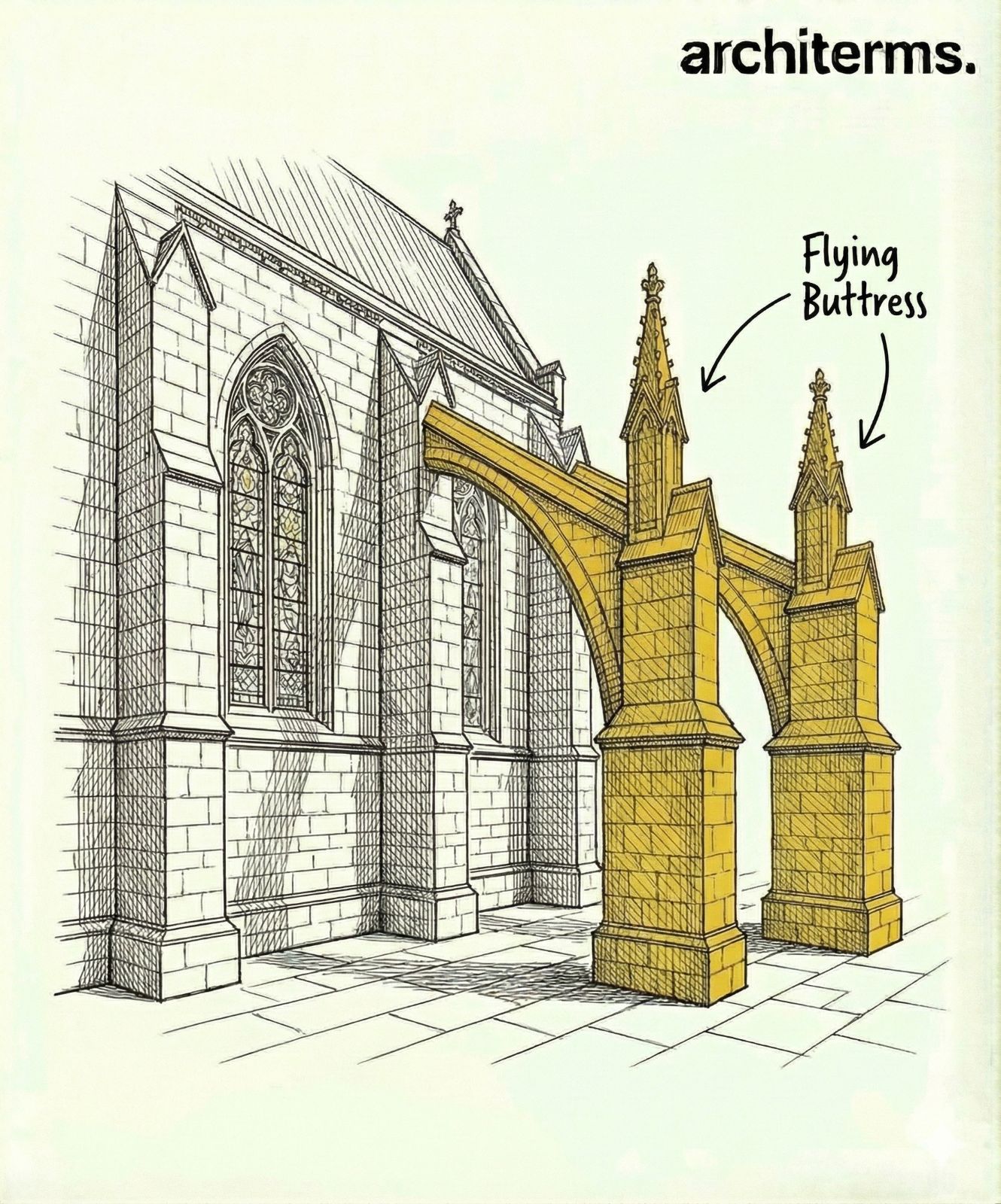
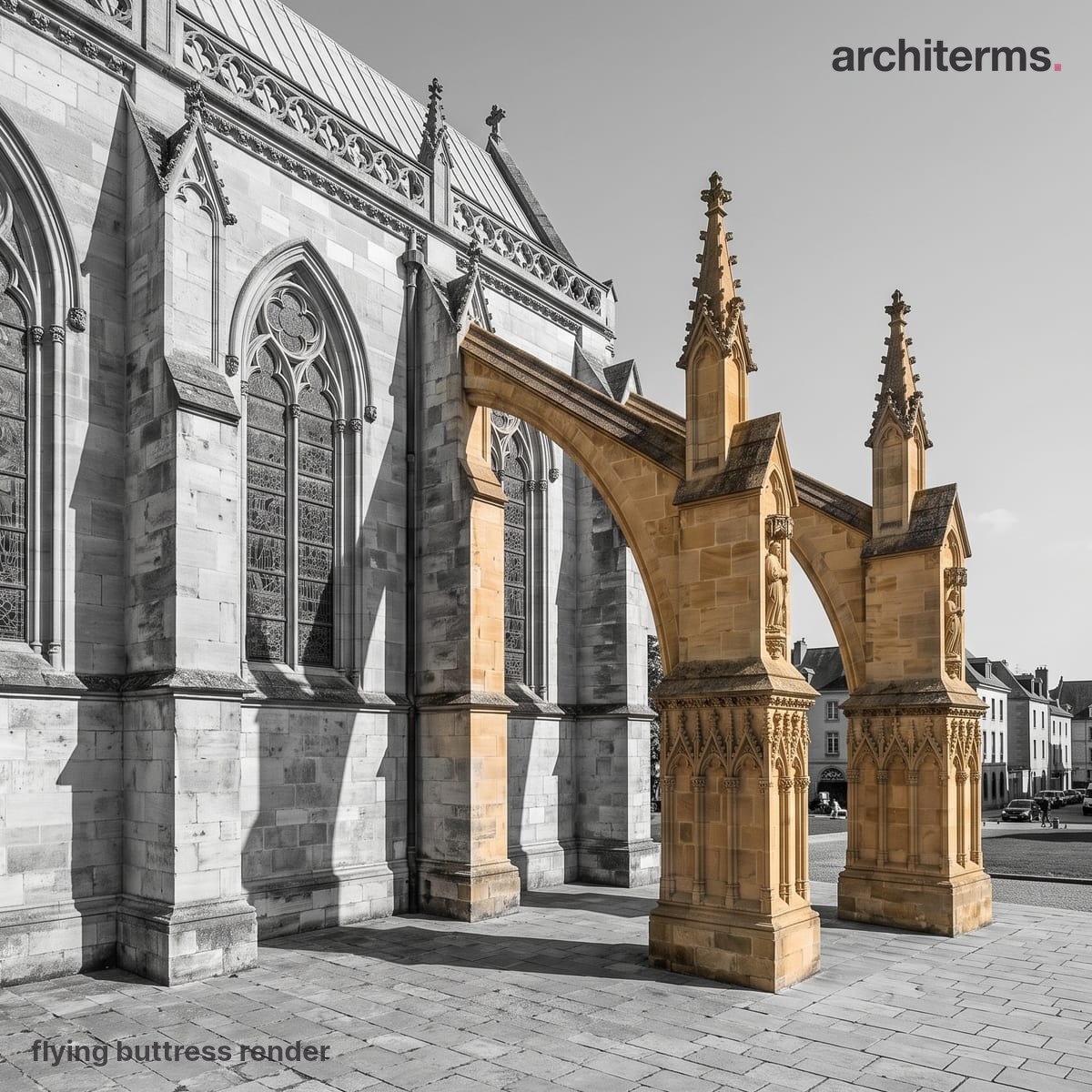
A flying buttress catches the outward thrust of the vault at the top of the wall and carries it along an arched strut down to a freestanding pier. With the sideways force taken outside, the wall itself can be thinned and opened up for large windows.
Rendered with Reviz.Design — AI visualization for architects and interior designers
Definition
A flying buttress is a clever structural detour. Vaults and high roofs don't just push straight down—they also push outward on the walls. If you rely only on thick masonry, you end up with heavy walls and small openings. A flying buttress changes the load path: it uses an exterior arch (the "flyer") to pick up that outward thrust and deliver it into a freestanding pier that can take the force safely down to the ground.
Structurally, the flying buttress works mainly in compression. The arch channels the thrust efficiently, while the pier acts like the anchor that resists the push. The result is a wall that can be thinner and taller, because it's no longer responsible for resisting all lateral forces on its own.
How it works (load path)
A simple way to understand the system is to follow the forces:
- —The vault/roof generates outward thrust.
- —The thrust reaches the upper wall where it would normally cause cracking or spreading.
- —The flying arch collects that thrust and transfers it outward.
- —The pier absorbs the force and sends it down into the foundation.
This is why flying buttresses are placed exactly where the thrust is strongest—typically at the springing points of vaults and along the outer aisles of large churches.
Why it matters (taller walls, bigger windows)
The practical payoff is huge: flying buttresses allow walls to become more like a skin for openings rather than a thick block of masonry. Historically, that's what made large areas of glazing possible—especially in tall buildings with vaulted roofs. Even if you're not building a cathedral, the concept is a good reminder that structure isn't just about holding up weight; it's about controlling forces so space and light can happen.
Today (where you still see the idea)
Modern buildings often resist lateral forces with shear walls, rigid frames, and cores, so the "flying buttress look" isn't always needed. But flying buttresses still show up in:
- —Restoration and structural reinforcement of historic masonry
- —Projects that want to express the load path clearly on the exterior
- —Structural designs that borrow the same idea: moving forces to a separate support rather than thickening the main wall
Common confusion
- —Flying buttress vs. buttress: a regular buttress thickens/supports the wall directly; a flying buttress transfers thrust through an arch to a separate pier.
- —Flying buttress vs. arch: an arch spans an opening; a flying buttress is an exterior arch used specifically to transfer lateral thrust.