Apse.
An apse is a semicircular or polygonal recess, typically found at the east end of a church, that projects outward from the main body of the building. It often houses the altar and is topped by a half-dome or vault, creating a distinctive architectural feature that emphasizes the sacred space within.
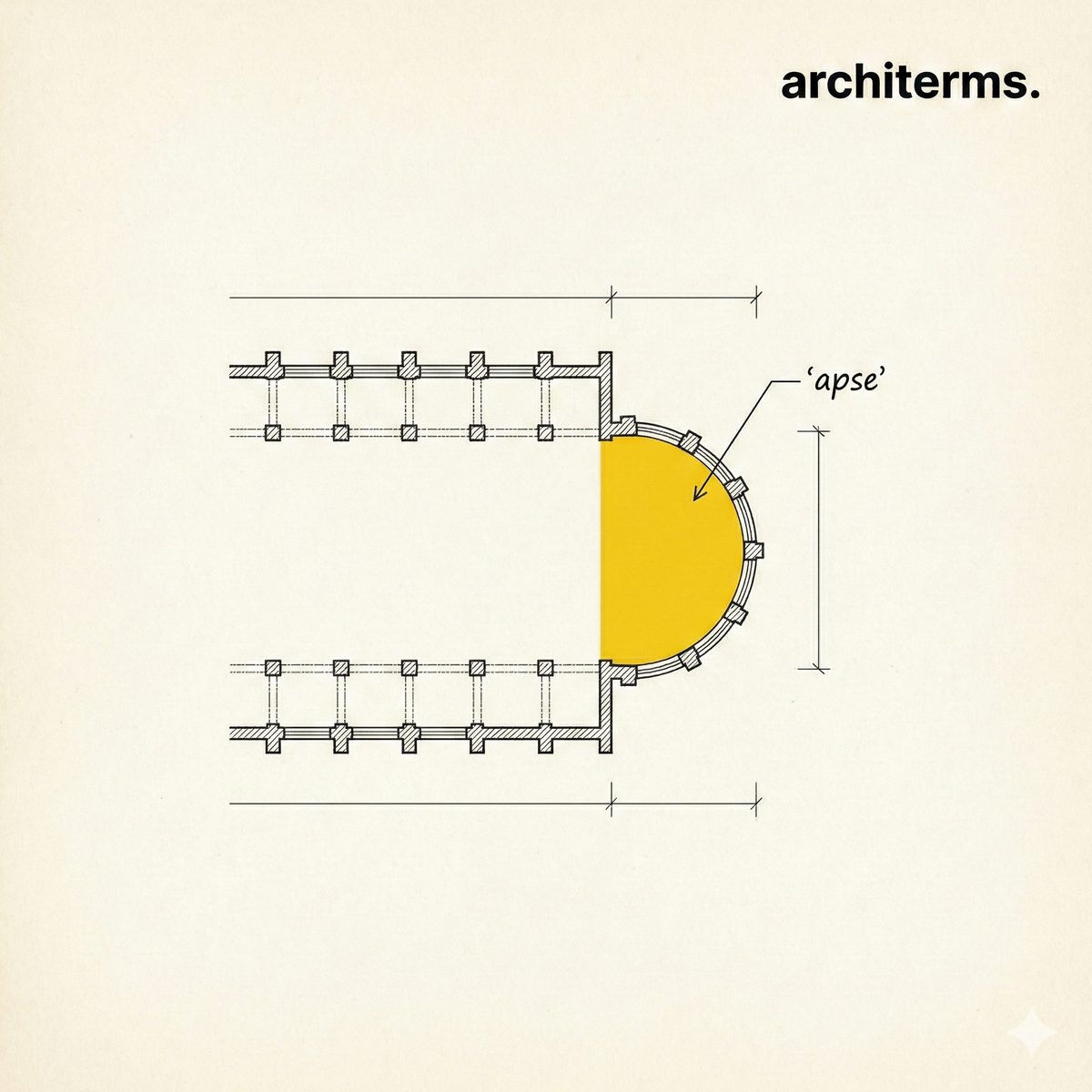
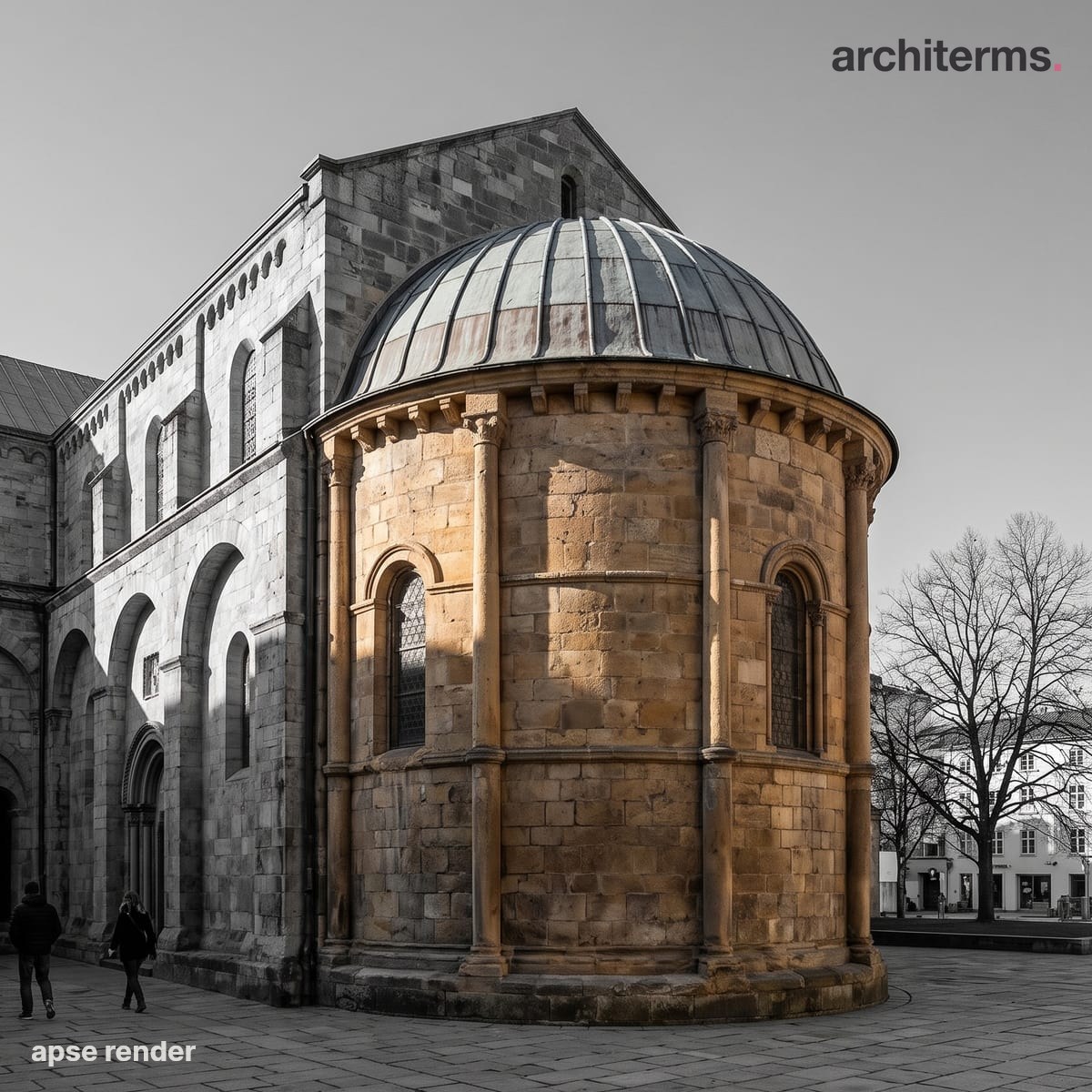
An apse closes the axis of a church with a semicircular recess capped by a half-dome. Projecting from the main body of the building, it gathers the eye toward the altar it shelters and concentrates the sacred focus at one end.
Visualized with Reviz.Design — AI rendering for architects and interior designers
Definition
An apse is one of architecture's most enduring spatial and symbolic devices, especially in religious buildings. At its simplest, it is a recessed, curved (or polygonal) room that extends beyond the main wall plane—usually topped by a vault or dome that mirrors its footprint on the ground. The form is immediately recognizable: from outside, it reads as a bulge; from inside, it creates an intimate, focused chamber often lit by windows and often housing an altar, bishop's throne, or other ceremonial focal point.
The term "apse" comes from the Latin "apsis," meaning arch or vault. Architecturally, an apse is defined by several key properties: it is typically semicircular or polygonal in plan, it projects outward from the body of the building (rather than being recessed inward like an alcove), and it is almost always crowned by a half-dome, barrel vault, or ribbed vault. The boundary between the apse and the main space is marked by an arch—often a large, prominent arch that frames the apse as a distinct zone. In section, the apse rises from the main floor and typically culminates in a vault that is lower than the central roof, creating a hierarchical relationship of heights and spaces.
Apse History
The apse originated in Roman civic and religious architecture, particularly in basilicas, where a magistrate or leader would sit in an apse at one or both ends of a rectangular hall. As Christianity developed, the apse became the defining feature of the early Christian basilica, positioned at the east end to house the altar. From the 4th century onward, virtually every church, cathedral, and chapel adopted the apse as standard. During the Romanesque period, apses often multiplied—a large chancel apse was flanked by smaller apses in the side aisles, creating a cascading effect. In Gothic architecture, the apse evolved into more complex, polygonal forms (sometimes called chevet plans in French cathedrals), and apses became canvases for stained glass, mosaic, and sculptural decoration.
The apse did not die out with modernism; it persisted in ecclesiastical architecture well into the 20th century and appears in contemporary buildings where a focused, sacred, or ceremonial space is desired. The form has also influenced non-religious architecture—concert halls, parliaments, and civic buildings sometimes use apsidal ends to create a sense of importance and visual closure.
Apse in Architecture
From a functional standpoint, the apse solves several problems at once. It creates a liturgical focal point—the altar sits within the apse and is visually framed and illuminated from above, drawing the eye and concentrating attention. Structurally, the half-dome or vault of the apse handles loads efficiently by directing them down into the curved walls and into piers or buttresses below. Spatially, it creates a sense of enclosure and sanctuary within a larger room, a psychological effect that has made the apse a powerful tool in religious and ceremonial architecture for over two thousand years.
Apses appear in several recurring arrangements:
- —Single apse: the most common form, found in smaller churches and chapels, terminating the nave and housing the main altar.
- —Multiple apses: typical of larger Romanesque cathedrals and some Byzantine churches, creating a multi-focal interior in which the chancel apse is primary and smaller apses open off the transept or side aisles.
- —Orthodox apse: often separated from the nave by an iconostasis (a decorated screen), making it a distinct liturgical zone.
- —Secular apse: in concert halls and auditoria, an apse-like termination may house the stage or orchestra, with acoustic and sightline benefits.
A key detail is the ambulatory—a passage that wraps around the back of an apse, allowing processions and pilgrimage routes to move behind the altar without disturbing the service. Medieval pilgrimage churches especially relied on ambulatories and radiating chapels off the apse to accommodate crowds of visitors.
Apses also vary by geometry. A semicircular apse is a half-circle in plan with a half-dome overhead; a polygonal apse (common in Gothic churches) uses straight walls arranged in a polygon of five or seven sides to approximate the curve while easing window placement; an ambulatory apse is wrapped by a circulation passage; and a radiating apse adds smaller chapels arranged radially, as at Chartres or Santiago de Compostela. Eastern Orthodox churches often use a tripartite apse of three compartments.
The most iconic apses appear in great medieval cathedrals. Chartres Cathedral's apse is a polygonal Gothic form ringed by an ambulatory and radiating chapels, pierced by stained glass and braced by flying buttress work that resists its outward thrust. Hagia Sophia in Istanbul features a massive apse nearly as wide as its great dome—an engineering marvel of Byzantine ambition. Durham Cathedral's Romanesque apse (around 1100) shows the rib-vaulted form carried on the heavy piers typical of Norman architecture, while Saint Peter's Basilica in Rome has a grand apse crowned by Michelangelo's dome.
Common confusion
Apse vs. choir: The choir is the area where singers sit, typically between the nave and the apse (or within the apse itself). The apse is the architectural vessel; the choir is a functional zone that may or may not occupy it.
Apse vs. chancel: The chancel is the liturgical space at the east end of a church, reserved for clergy and the altar. The apse is the specific architectural form (a curved, vaulted room) that typically houses the chancel. Not all chancels are apsidal, and not all apses are called chancels, though the terms are often used together.
Apse vs. alcove: An alcove is a recess into a wall, whereas an apse projects outward. An alcove is typically shallower and not always vaulted; an apse is volumetric and usually crowned by a dome or vault.
Apse vs. narthex: A narthex is an entrance vestibule at the west end of a church, while an apse is the terminating feature at the east end. They are opposite ends of a church's floor plan.
Apse vs. a curved facade: Some buildings end in a curved facade or rounded wall that looks apsidal from outside but is not a true apse—the apse must be a vaulted chamber that projects outward and reads as a distinct interior space. Likewise the transept may have apsidal ends, but a transept is a full arm of the building, whereas an apse is a terminating feature.
Frequently Asked Questions
What is an apse in architecture?
An apse is a semicircular or polygonal recess, usually found at the end of a church, that projects outward from the main building and is topped by a vault or dome. It typically houses the altar and creates a focused liturgical space. The apse is framed by a large arch and is one of the defining features of religious architecture from the early Christian period onward.
What is the difference between an apse and a chancel?
The chancel is a liturgical zone—the area where clergy and the altar are positioned, usually at the east end of a church. The apse is the specific architectural form (curved, vaulted chamber) that often houses the chancel. Not all chancels are apsidal, and some apses may contain other functions, so the apse is a shape while the chancel is a functional designation.
Where did the apse originate in architecture?
The apse originated in Roman civic architecture, where magistrates sat in apses at the end of basilica halls. Early Christians adopted the form for churches around the 4th century, placing the altar in the apse at the east end. From then on, the apse became the standard terminating feature of nearly every church and cathedral in the Christian tradition.
How is an apse structurally supported?
An apse is supported by its curved walls and the vault or dome overhead, which redirect loads outward and downward into piers, buttresses, or thick walls at the base. The half-dome vault is particularly efficient because it naturally distributes weight along its curved surface. Large apses often require flying buttresses or external bracing to handle the outward thrust of the vault.
What is an ambulatory in relation to an apse?
An ambulatory is a passage that wraps around the back of an apse, allowing pilgrims and processions to move behind the altar without disrupting the main service. This design became especially important in medieval pilgrimage churches, which often combined an ambulatory with radiating chapels around the apse to accommodate large numbers of visitors circulating through the building.