Trellis.
A trellis is an open framework of crossing or spaced members used to support climbing plants or to form a light, see-through screen, canopy, or partition. In plain terms: it's a lattice or grid of slats that plants grow up, or that filters light and views.
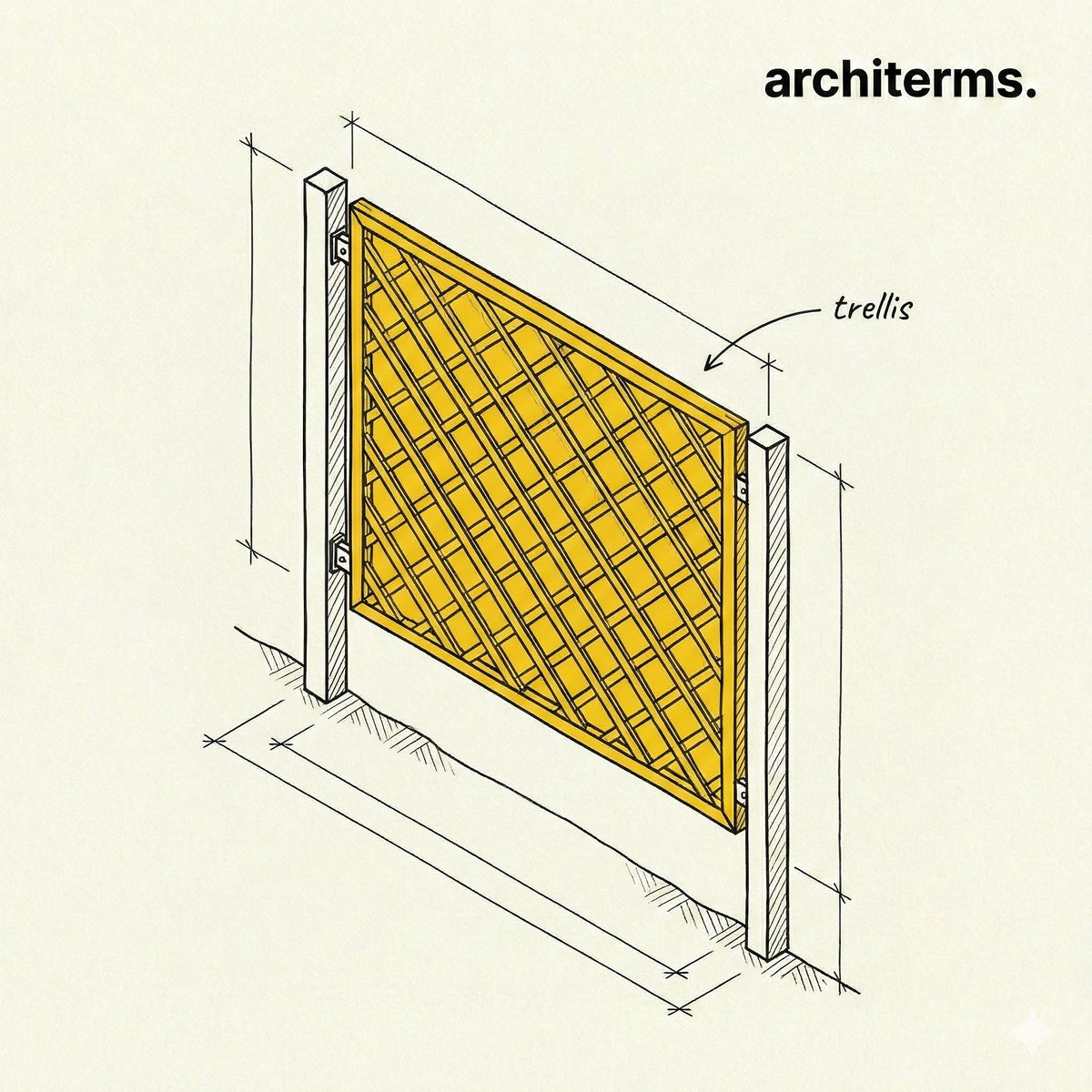
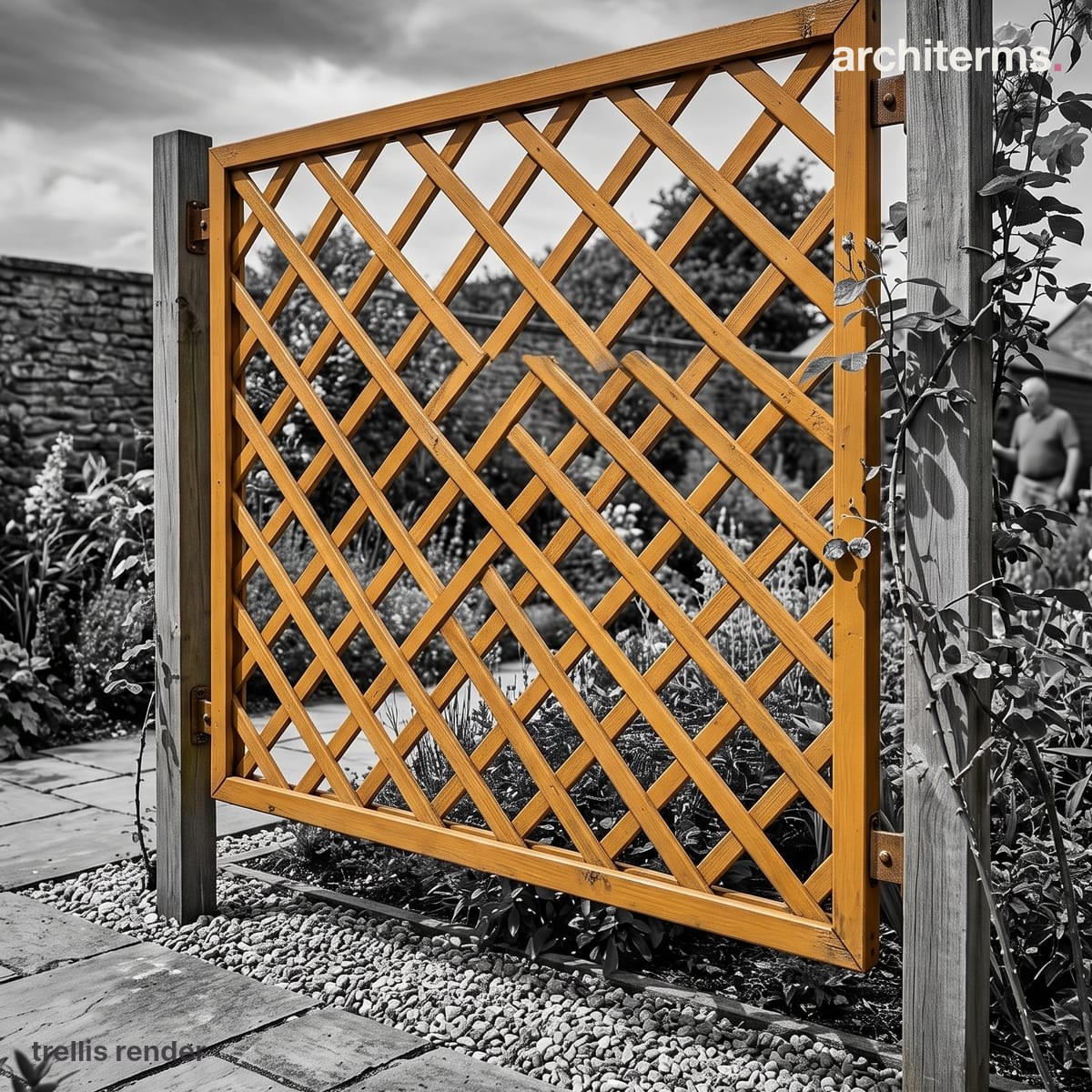
A trellis is an open framework of crossing slats set between supporting posts. The diagonal grid is mostly air, so it screens and divides a garden without blocking light or wind, and those same crossing members are what a climbing plant grips once it is planted up.
Created with Reviz.Design — AI rendering for architects and interior designers
Definition
A trellis is a lightweight, open framework — usually a lattice or grid of timber, metal, or composite members — used to support climbing plants or to form a permeable screen. It is one of the oldest devices in garden and landscape design, sitting on the boundary between architecture and planting. Because it is mostly air, a trellis defines space and filters light and views without fully blocking them.
In contemporary architecture the idea has grown well beyond the garden fence. Trellis screens are used as shading devices, facade layers, and privacy elements on balconies and terraces, sometimes planted and sometimes left bare as pure pattern. Whether rustic or refined, the trellis works by the same logic: an open grid that supports, screens, and shades while still letting air and dappled light through, often softened by climbing plants.
A trellis is an open structure of intersecting or evenly spaced members forming a lattice, used to train and support climbing plants or to act as a light screen, canopy, or partition. It can stand freely, attach to a wall, or span overhead like an open roof. Unlike a solid wall, a trellis is deliberately porous, so it shapes space and shade rather than enclosing them.
Trellis History
Trellises appear in some of the earliest records of gardens, from Egyptian and Roman vineyards to the enclosed gardens of the medieval period, where they supported vines and roses and framed shaded walks. In the formal gardens of Renaissance and Baroque Europe, treillage became a refined art — elaborate timber latticework built into arbors, niches, and false perspectives. The same elements gave rise to the pergola and the arbor, and in modern landscape and building design the trellis has been rediscovered as a clean, repetitive screen.
Trellis in Architecture
A trellis is versatile precisely because it is open:
- —Supports planting: its original role is a frame for vines and climbers, closely related to the pergola and arbor.
- —Screens and divides: it gives privacy and marks the edge of a space without the heaviness of a solid wall.
- —Shades: as a sun filter over a terrace or across a window, it cuts glare while keeping airflow and a view.
- —Becomes a facade layer: trellis and lattice screens are increasingly used as an outer skin on a building's facade, planted as a green wall or left as pattern.
- —Expresses material and rhythm: timber lattice, metal mesh, and tensioned cable systems all create a repeating, ordered texture.
Common confusion
- —Trellis vs. pergola: a trellis is a flat or panel-like open frame or screen; a pergola is a larger walk-through structure with posts and an open beam roof. A pergola may carry trellis panels, but they are not the same thing.
- —Trellis vs. lattice: lattice is the criss-cross pattern itself; a trellis is a structure that often uses a lattice pattern.
- —Trellis vs. arbor: an arbor is a small, often arched garden shelter or seat, frequently built from trellis panels; a trellis is the flat framework.
- —Trellis vs. espalier: espalier is the technique of training a tree or shrub flat against a support; a trellis is one of the supports used to do it.
Frequently Asked Questions
What is a trellis?
A trellis is an open framework of crossing or spaced members, usually forming a lattice, used to support climbing plants or to create a light screen, canopy, or partition. Because it is mostly open, it shapes space and filters light rather than fully enclosing an area.
What is the difference between a trellis and a pergola?
A trellis is a flat or panel-like open frame, often used as a screen or a support for plants. A pergola is a larger, walk-through structure with posts and an open roof of beams. A pergola can include trellis panels for shade or privacy, but the pergola is the bigger architectural structure.
What is a trellis used for?
Traditionally a trellis supports climbing plants such as vines, roses, and ivy. In design it is also used to screen for privacy, divide outdoor rooms, shade terraces and windows, and act as a decorative or green outer layer on building facades.
What materials are trellises made from?
Trellises are commonly made from timber, but also from galvanized or coated steel, aluminum, stainless cable systems, and composite materials. The choice depends on whether the trellis is a temporary garden support or a permanent architectural screen exposed to weather and plant loads.
Is a trellis structural?
A garden trellis is generally light and non-structural, supporting only plants and resisting wind. When a trellis becomes a building-scale facade screen or canopy, it is engineered to carry its own weight, wind loads, and sometimes the weight of mature planting, so it is designed more like a piece of the structure.