Stud.
A stud is a vertical framing member in a wall, repeated at regular spacing to form the wall's skeleton and carry loads from above. In plain terms: it's one of the upright timbers (or steel channels) inside a wall that everything else is fixed to.
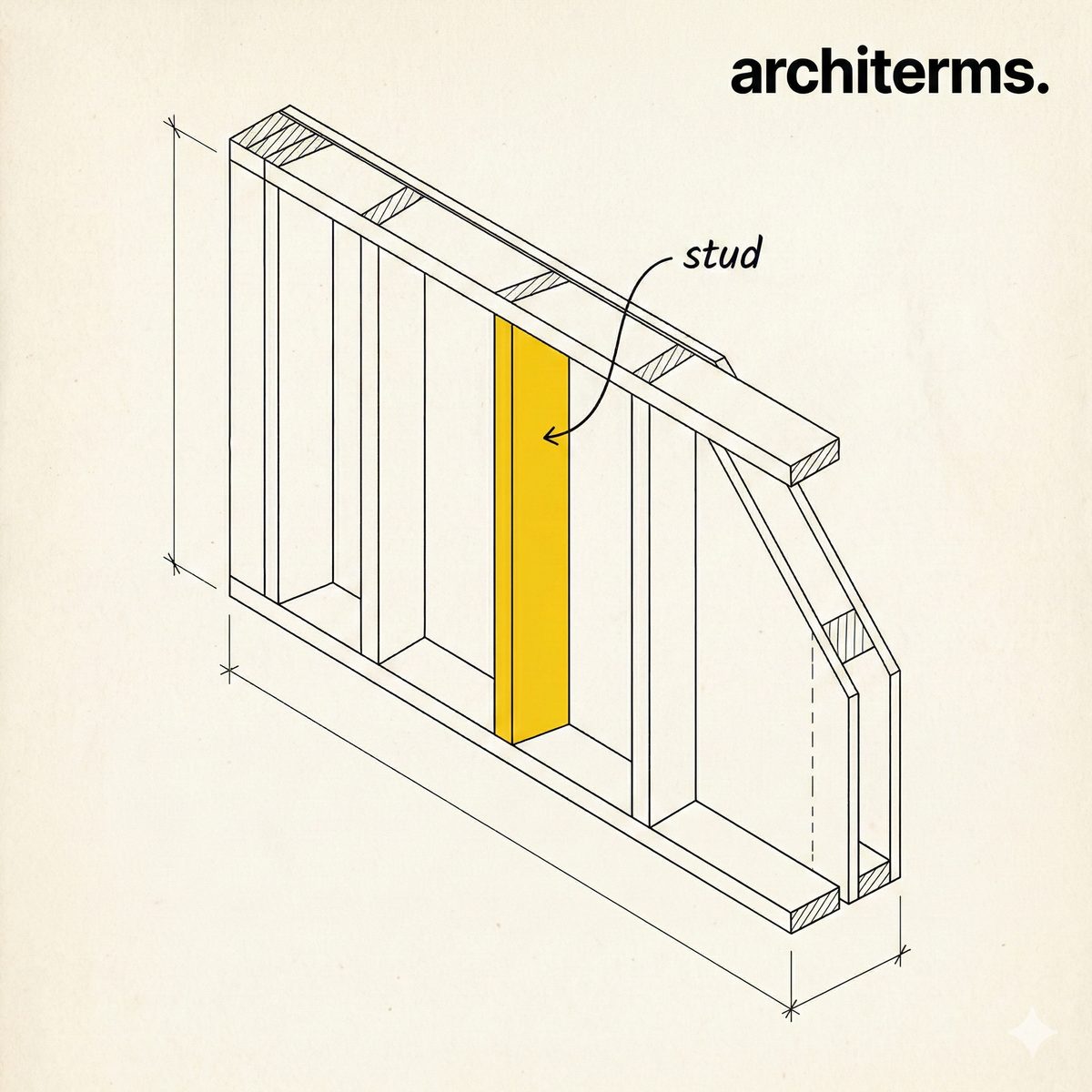
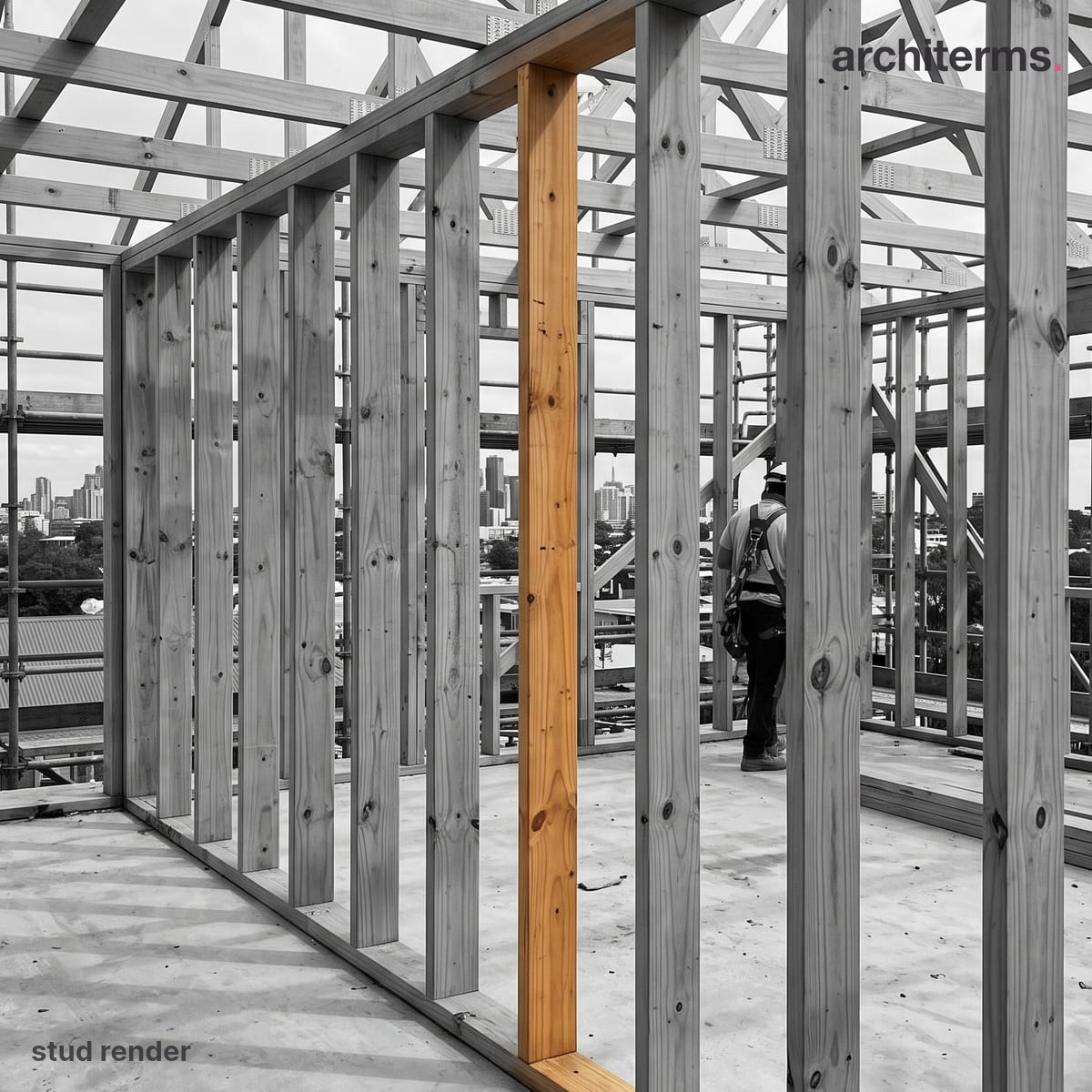
A stud is one of the upright members set at regular spacing along a wall frame. Standing between the bottom and top plates, each one carries load from above and gives the wall its skeleton, with linings and cladding fixed to its faces.
Made with Reviz.Design — AI visualization for architects and interior designers
Definition
A stud is the vertical member that makes up the skeleton of a framed wall. Studs are repeated at a regular spacing — typically 16 or 24 inches (400 or 600 mm) on center — and run between a bottom plate and a top plate to form a wall panel. Almost every modern timber or light-steel building relies on this simple, repetitive system, because framed walls are fast to build, easy to insulate, and easy to run services through.
Studs do two jobs at once: they carry vertical load from the floors and roof above down to the structure below, and they give a fixing surface for sheathing, drywall, cladding, and insulation. In a load bearing wall the studs are structural and cannot be removed casually; in a partition wall they only carry the wall's own finishes. Either way, the spacing of the studs sets the rhythm for everything else — sheet sizes, fixings, and where you can safely hang things.
A stud is a vertical structural member in a framed wall, fixed between a horizontal bottom (sole) plate and a top plate and spaced at regular centers. Studs are made of dimensional lumber or cold-formed steel. Together with the plates, the headers over openings, and diagonal or sheathing bracing, they form the wall frame that supports loads and receives the wall finishes.
Stud History
The stud wall grew out of two North American framing systems. Balloon framing, popular in the 19th century, ran continuous studs from the foundation to the roof in a single tall storey-height. Platform framing, which became standard in the 20th century, builds one floor at a time, each wall sitting on the platform below — safer, simpler, and now the default for timber housing. The arrival of standardized, mass-produced lumber (the familiar 2x4) and, later, cold-formed steel studs turned wall framing into a fast, predictable, modular process.
Stud in Architecture
The humble stud quietly governs how a building goes together:
- —Carries load: in a structural wall, studs collect load from the joists or roof above and pass it through the plates to the structure below.
- —Sets the module: 16 or 24 inch spacing matches standard sheet materials, so drywall, plywood, and insulation fit the bays with little waste.
- —Receives finishes: studs are the fixing grid for drywall inside and sheathing or cladding outside.
- —Holds services and insulation: the cavities between studs are where wiring, pipes, and insulation live.
- —Distinguishes wall types: the same member builds both a structural load bearing wall and a non-structural partition wall — what differs is what it carries.
Common confusion
- —Stud vs. joist: a stud is vertical and builds walls; a joist is horizontal and builds floors and ceilings. They are the upright and the flat members of the same framing family.
- —Stud vs. post or column: a stud is a light, closely spaced member that shares load with its neighbors; a post or column is a heavier, isolated member that carries a concentrated load on its own.
- —Load-bearing stud wall vs. partition: both are framed from studs, but only the load-bearing wall carries weight from above — removing or altering it has structural consequences.
- —Stud vs. plate: studs are the vertical members; the plates are the horizontal members at the top and bottom that the studs are fixed between.
Frequently Asked Questions
What is a stud in a wall?
A stud is a vertical framing member inside a wall, repeated at a regular spacing to form the wall's skeleton. Studs run between a bottom plate and a top plate, carry load from above, and provide the surface that drywall, sheathing, and cladding are fixed to.
How far apart are wall studs spaced?
Studs are typically spaced 16 inches (400 mm) on center, and sometimes 24 inches (600 mm) for non-load-bearing or lighter walls. The spacing matches standard sheet sizes for drywall and sheathing, so materials fit the bays with minimal cutting and waste.
What is the difference between a stud and a joist?
A stud is a vertical member used in walls, while a joist is a horizontal member used in floors and ceilings. Studs carry load downward through the wall; joists span across to support floors and ceilings. They are the upright and horizontal members of the same light-framing system.
Are all stud walls load-bearing?
No. A load-bearing stud wall carries weight from the floors or roof above, while a partition wall built from the same studs only supports its own finishes and divides space. You should always confirm which type a wall is before altering it, because removing a load-bearing wall has structural consequences.
What are steel studs?
Steel studs are cold-formed C-shaped channels used in place of timber studs, common in commercial construction and in fire-rated or moisture-prone walls. They are light, straight, non-combustible, and dimensionally stable, and they frame walls on the same plate-and-spacing principle as timber studs.