Partition Wall.
A partition wall is a non-load-bearing interior wall that divides space into rooms but carries no structural load other than its own weight. In plain terms: it is a dividing wall you can usually move or remove without affecting how the building stands up.
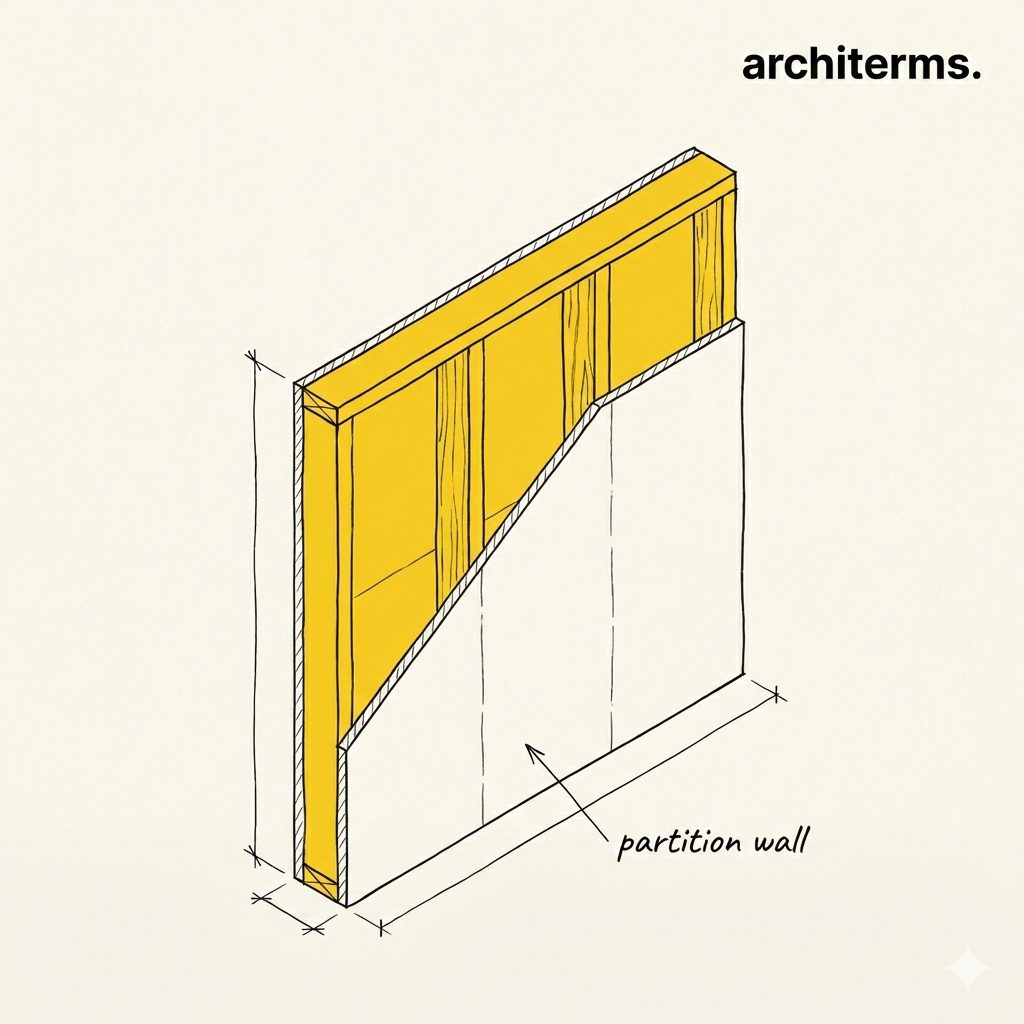
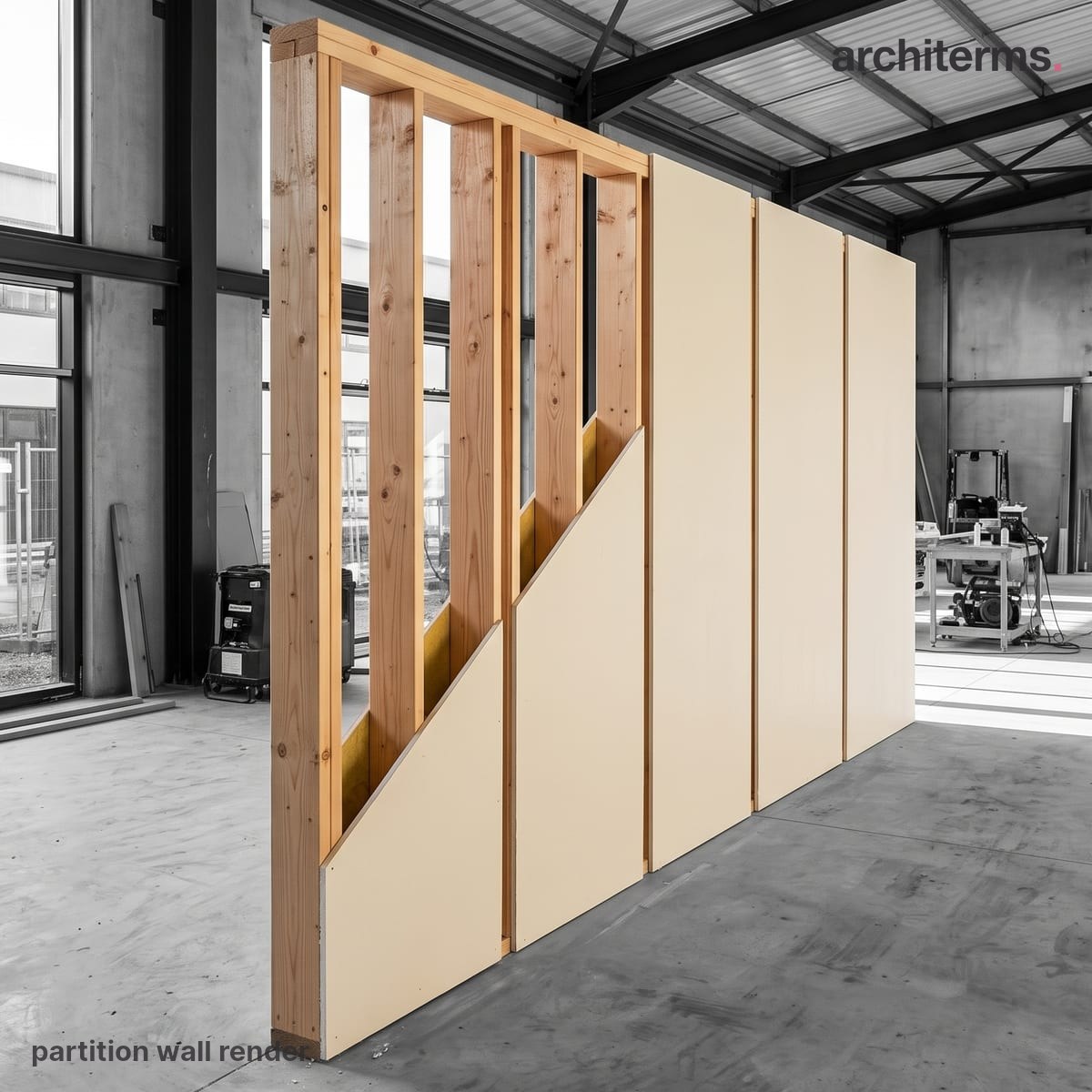
A partition wall divides interior space without carrying the building's load. Here the timber studs run only between floor and head plate, and the plasterboard cladding simply encloses the frame, so the wall bears little more than its own weight and can be moved or removed at will.
Made with Reviz.Design — AI visualization for architects and interior designers
Definition
A partition wall is about organizing space, not holding up the building. It separates the interior into rooms, corridors, and zones, and provides surfaces for finishes, doors, and services, but it does not carry the floors or roof above. Because it is non-structural, a partition can be relatively thin, lightweight, and—important for flexible buildings—rearranged as needs change.
Partitions range from solid masonry to lightweight stud walls of timber or metal faced with drywall, and they may be fixed or demountable. In offices and other modern interiors, movable and demountable partitions let the same floor be reconfigured many times over a building's life.
A partition wall is an interior, non-load-bearing wall that subdivides the space within a building and supports only its own weight. Unlike a load-bearing wall, it does not transmit loads from the floors or roof to the foundation, so it can be placed, altered, or removed with little or no structural consequence. Partitions may be solid (brick or block) or framed (timber or metal studs clad with drywall or boards), and they can be fixed, relocatable, or fully demountable. They commonly also provide acoustic separation, fire resistance, and a route for concealed services.
Partition Wall History
Dividing interior space is as old as building itself, but for centuries internal divisions were often masonry. As framed construction spread in the 19th and 20th centuries and the building's structure moved into columns, beams, and a few key bearing walls, internal walls were freed to become light, non-structural partitions. The development of plasterboard (drywall) and metal stud framing made partitions fast to build and easy to alter. The rise of open-plan offices and flexible workplaces drove demountable and movable partition systems, so interiors could be reconfigured without major construction.
Partition Wall in Architecture
Partitions give buildings their interior flexibility:
- —Space division: They turn large structural floors into rooms, corridors, and functional zones, defining how a building is used.
- —Lightweight and movable: Because they carry no building loads, partitions can be thin and, in many systems, relocated or removed as needs change.
- —Performance: Partitions are detailed for acoustic privacy and fire compartmentation, with insulation, multiple board layers, and rated assemblies where required.
- —Services: Stud partitions provide a hollow zone to run wiring, pipes, and switches out of sight.
Because they are non-structural, partitions are usually the first thing changed in a fit-out or renovation—but acoustic and fire-rated partitions still need correct detailing.
Common confusion
Partition wall vs. load-bearing wall: A partition carries only its own weight and divides space; a load-bearing wall supports the structure above and transfers loads to the foundation. Partitions can usually be removed freely, load-bearing walls cannot.
Partition wall vs. drywall: Drywall (plasterboard) is a board material used to face a wall; a partition wall is the whole non-structural dividing wall, which may be built from drywall on studs, or from masonry, or from a demountable system.
Fixed vs. demountable partition: A fixed partition is built in place and not intended to move; a demountable partition is a manufactured system designed to be taken apart and reassembled elsewhere, common in offices.
Partition vs. curtain wall: A partition divides interior space and is non-structural; a curtain wall is a non-structural exterior cladding skin. Both carry no building loads, but one is inside and the other is the building's outer envelope.
Frequently Asked Questions
What is a partition wall?
A partition wall is a non-load-bearing interior wall that divides the space inside a building into rooms and zones while carrying only its own weight. Because it does not support the structure above, it can usually be added, moved, or removed without affecting how the building stands.
Is a partition wall load-bearing?
No. By definition a partition wall is non-load-bearing—it supports only its own weight and does not carry the floors or roof above. If a dividing wall does carry structural load, it is a load-bearing wall rather than a true partition, even though it may look similar.
What are partition walls made of?
Partitions can be solid masonry such as brick or block, but more often they are framed walls of timber or metal studs clad with drywall (plasterboard). Office buildings also use demountable partition systems made of panels and glass that can be relocated as the layout changes.
What is the difference between a partition wall and a load-bearing wall?
A partition wall only divides space and carries its own weight, while a load-bearing wall supports the floors and roof above and transfers their loads to the foundation. Partitions can generally be removed freely, but removing a load-bearing wall requires a replacement beam and structural design.
Can a partition wall be removed?
Yes. Because a partition is non-structural, it can usually be removed without affecting the building's stability, making it the first thing changed in most renovations. You should still check it is not actually load-bearing, and account for any wiring, pipes, or fire and acoustic ratings it provides.