Mansard Roof.
A mansard roof is a four-sided roof with two slopes on each side—a steep lower slope and a flatter upper slope. In plain terms: it's a roof that looks like it has a "second story" because the lower slope is so steep it appears almost vertical.
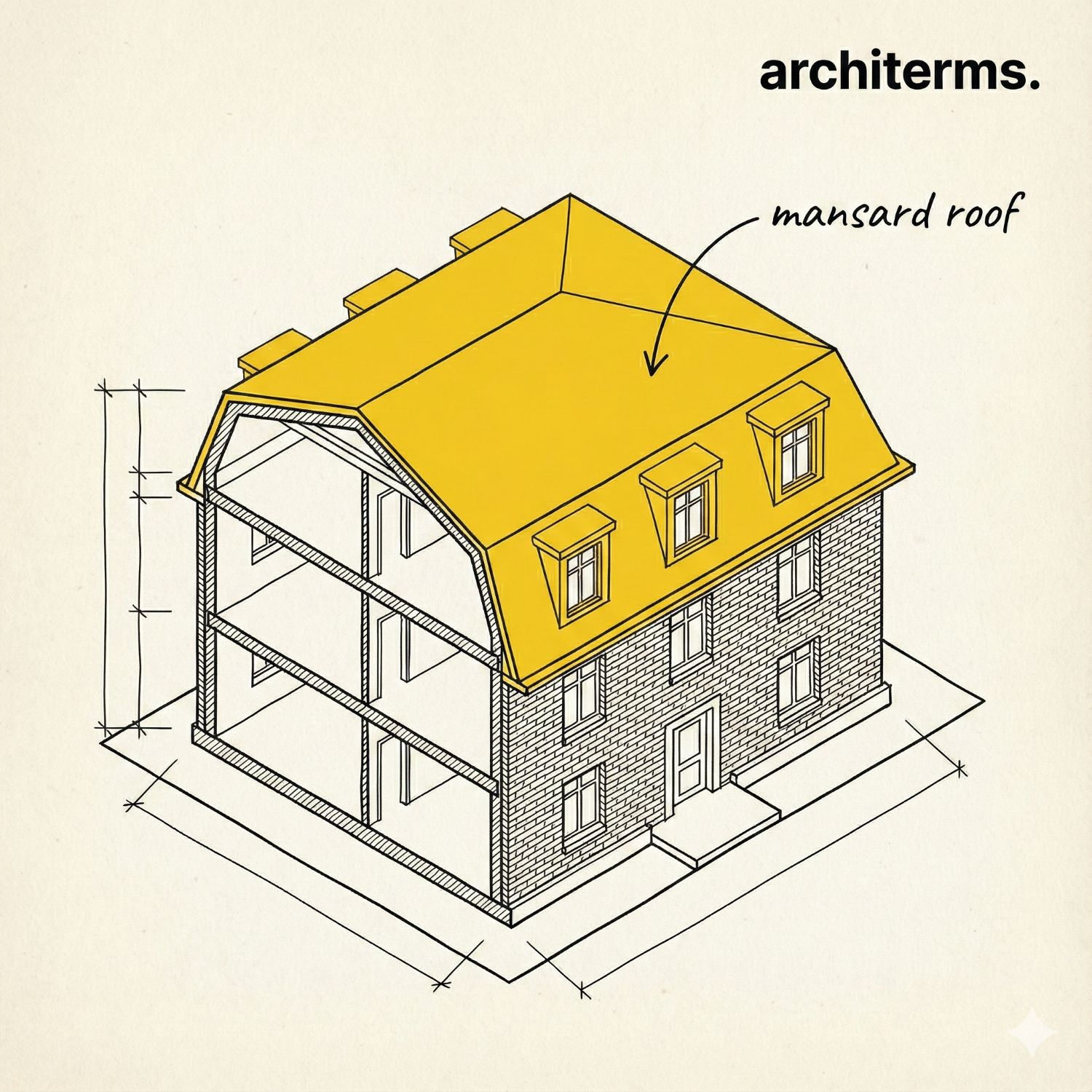
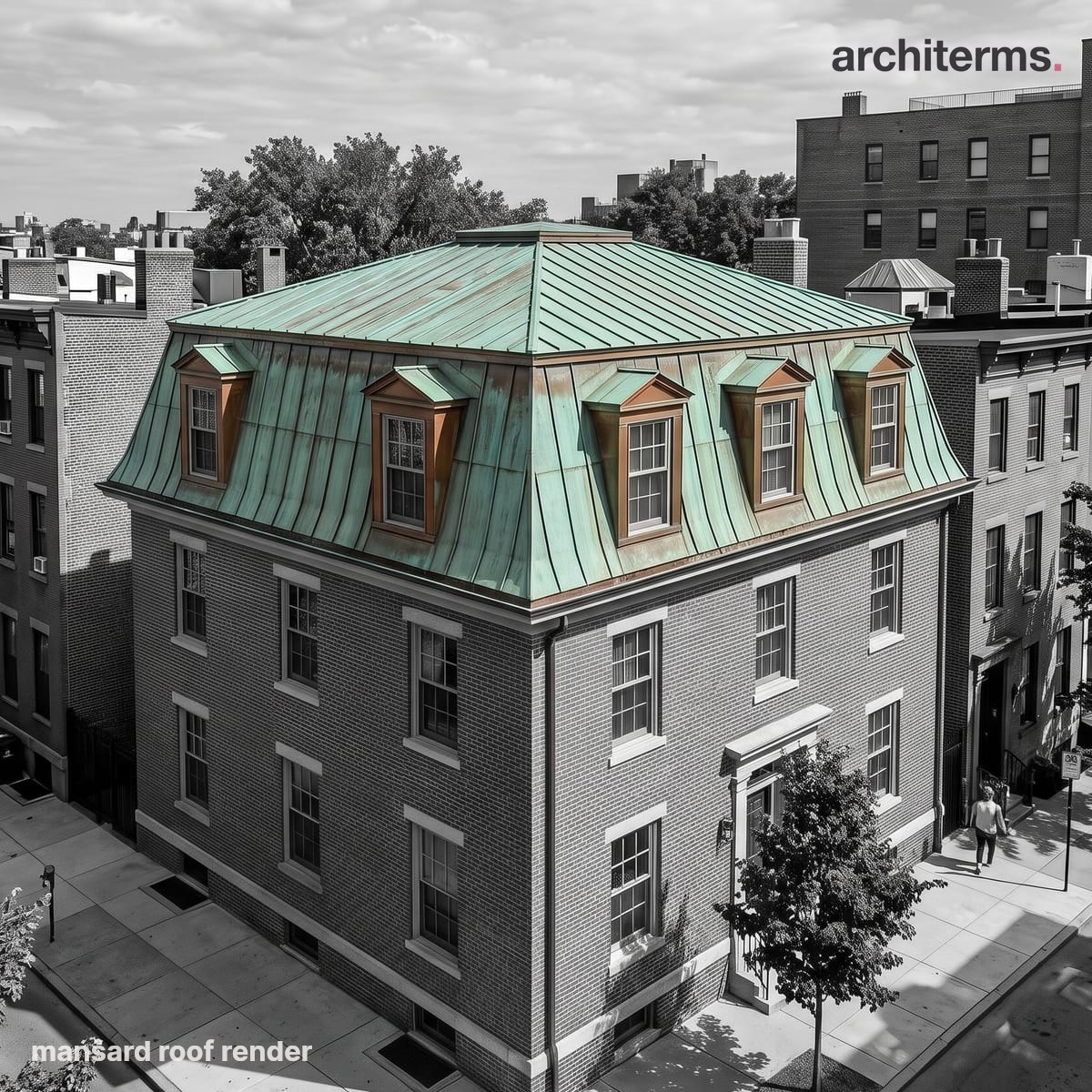
A mansard roof breaks each side into two pitches: the steep lower slope stands almost vertical and holds dormer windows, turning the roof space into a full habitable storey, while the shallow upper slope caps it off nearly out of sight from the street.
Created with Reviz.Design — AI rendering for architects and interior designers
Definition
A mansard roof (also called a French roof or curb roof) is a four-sided roof where each side has two distinct slopes: a steep lower slope and a much flatter upper slope. The steep lower slope creates the illusion of an additional story, while the flatter upper portion provides usable attic space. This dual-slope design is the defining characteristic of mansard roof architecture.
The mansard roof is named after François Mansart, a 17th-century French architect who popularized this style, though the design predates him. The roof's distinctive shape creates a dramatic silhouette and maximizes interior space within the roof structure.
Mansard roof designs
In mansard roof designs, architects consider several key elements:
Lower slope pitch: The steep lower slope typically ranges from 60° to 70° (almost vertical), creating the dramatic visual effect. This steep angle makes the roof appear to be part of the building's wall.
Upper slope pitch: The flatter upper slope is usually between 5° and 15°, providing a nearly horizontal surface that maximizes usable attic space.
Dormers: Mansard roofs almost always include dormers (windows projecting from the roof) on the steep lower slope. These provide light and ventilation to the upper floor while adding architectural detail.
Eave treatment: The transition between the steep and flat slopes (the "curb" or "break") is a critical design element that can be emphasized or minimized depending on the desired aesthetic.
Material selection: The steep lower slope often uses slate, tile, or metal, while the flatter upper portion may use different materials or be hidden from view.
Mansard roof detail
When examining mansard roof detail, the critical construction elements are:
Curb or break: The horizontal line where the steep lower slope transitions to the flatter upper slope. This is a key structural and visual element.
Lower slope framing: The steep slope requires careful framing to support the weight and handle water drainage. This often involves closely spaced rafters or trusses.
Upper slope framing: The flatter upper portion needs structural support that doesn't interfere with the usable space below. This may involve engineered trusses or beams.
Dormer integration: Dormers must be carefully integrated into the steep slope, requiring proper flashing, waterproofing, and structural support.
Gutter and drainage: The transition point (curb) needs special attention for water management, as water can accumulate at this junction.
Flashing details: Where the mansard roof meets walls, chimneys, or other elements, careful flashing is essential because of the complex geometry.
These details matter because mansard roofs have more complex geometry than simple gable or hip roofs, requiring precise construction and careful waterproofing.
Mansard roof types
Straight mansard: The lower slope is straight (planar), creating a clean, geometric appearance. This is the most common type.
Convex mansard (bell-cast): The lower slope curves outward (convex), creating a bell-like shape. This adds visual interest and can help with water drainage.
Concave mansard roof: The lower slope curves inward (concave), creating a softer, more organic appearance. This is less common but creates a distinctive silhouette.
French mansard roof: The classic French style with steep lower slopes (often 70° or more), prominent dormers, and decorative elements. This is the most recognizable mansard style.
Modern mansard: Contemporary interpretations that may use different materials, simplified forms, or asymmetrical designs while maintaining the dual-slope concept.
Mansard with hip ends: A mansard roof where the ends are hipped (sloped) rather than gabled, creating a more enclosed appearance.
Concave mansard roof
A concave mansard roof is a variation where the lower slope curves inward rather than being straight or convex. This creates a distinctive, softer silhouette that differs from the typical sharp-angled mansard.
Characteristics:
- —Lower slope curves inward (concave)
- —Creates a more organic, flowing appearance
- —Less common than straight or convex mansards
- —Requires specialized construction techniques for the curved surface
- —Often used in Art Nouveau or organic architectural styles
French mansard roof
The French mansard roof is the classic, original mansard style that became popular in 17th-century France and spread throughout Europe and America.
Key features:
- —Very steep lower slopes (often 70° or steeper)
- —Prominent dormers with decorative elements
- —Often includes decorative brackets, moldings, or trim
- —Typically uses slate, tile, or metal roofing
- —Creates maximum usable space in the upper floor
- —Associated with Second Empire architecture (1850s-1870s)
Modern use: Today, French mansard roofs are used in both historic preservation and new construction that references classical or traditional styles.
History
Mansard roofs have a rich architectural history. The design is named after François Mansart (1598-1666), a French architect who popularized the style, though similar roofs existed earlier. The mansard roof became especially popular during the Second Empire period in France (1852-1870) under Napoleon III, when it was used extensively in Parisian architecture, including the famous renovations by Baron Haussmann.
In American architecture, mansard roofs became popular in the mid-19th century, particularly in Second Empire style buildings. They were used in government buildings, grand houses, and commercial structures. The style fell out of favor in the early 20th century but has seen revivals in postmodern and contemporary architecture.
Today, mansard roofs are used in both historic preservation and new construction, especially in buildings that want to maximize upper-floor space while maintaining a traditional or classical appearance.
Application
Historic preservation: Mansard roofs are common in restoration projects for Second Empire, Victorian, and Beaux-Arts buildings.
Urban architecture: Mansard roofs are used in dense urban areas where maximizing usable space is important, as the design creates additional floor area within the roof structure.
Commercial buildings: Hotels, office buildings, and mixed-use developments use mansard roofs to create distinctive appearances and maximize rentable space.
Residential construction: Mansard roofs are used in both traditional and contemporary homes, especially when additional upper-floor space is desired.
Institutional buildings: Schools, government buildings, and civic structures use mansard roofs for their formal, classical appearance.
Common confusion
Mansard roof vs gambrel roof: A gambrel roof (barn roof) has two slopes on each side, but only on two sides (like a gable). A mansard roof has two slopes on all four sides.
Mansard roof vs hip roof: A hip roof has a single slope on each of four sides. A mansard roof has two slopes on each of four sides.
Mansard roof vs flat roof: A flat roof has no slope (or minimal slope). A mansard roof has two distinct slopes on each side, with the lower slope being very steep.
Mansard vs mansard-style: True mansard roofs have the dual-slope construction. "Mansard-style" may refer to buildings that have a mansard-like appearance but use different construction methods.