Voussoir.
A voussoir is one of the wedge-shaped stones or bricks that together form an arch or vault, each tapered so the units lock against one another in compression. In plain terms: voussoirs are the individual wedge blocks that make an arch stand up.
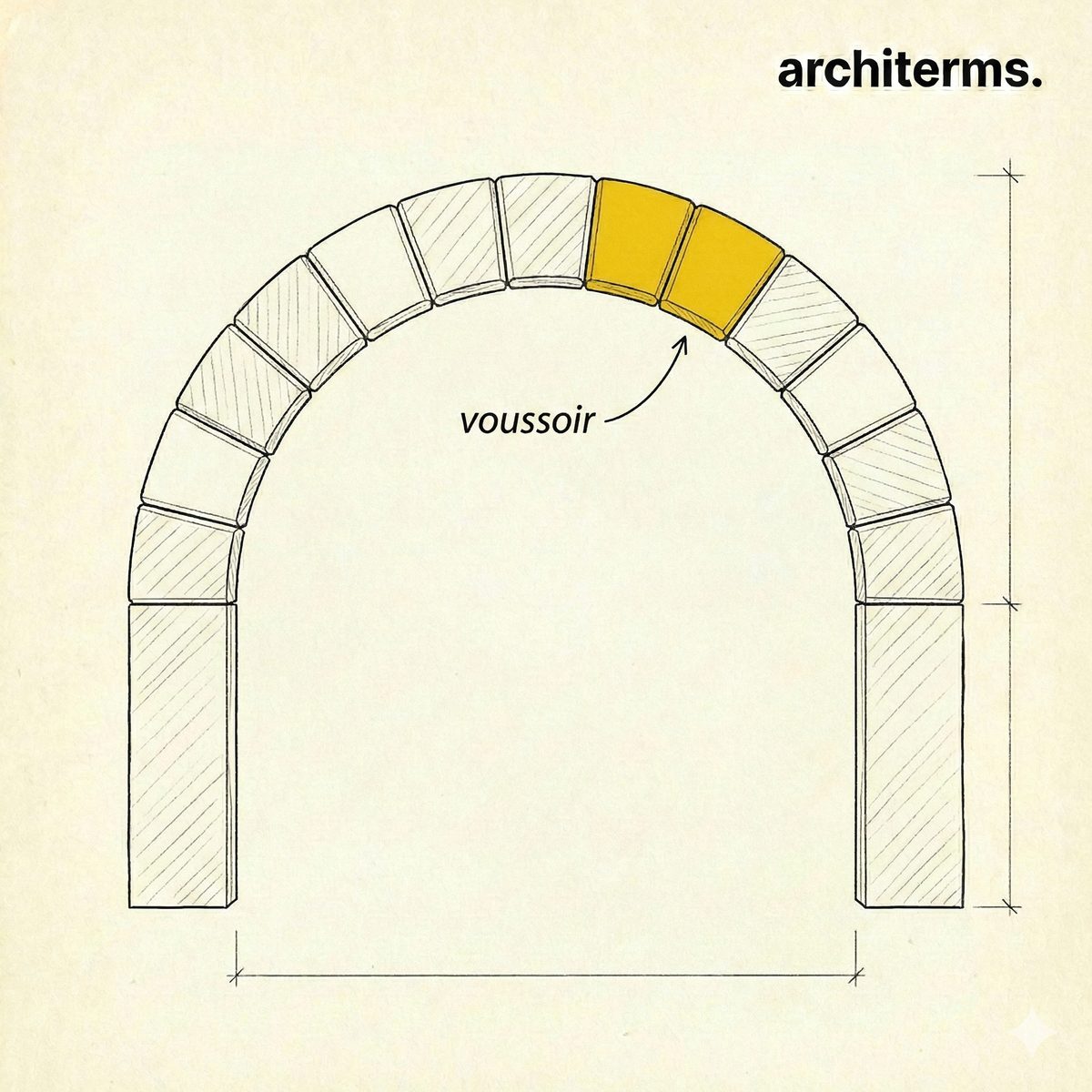
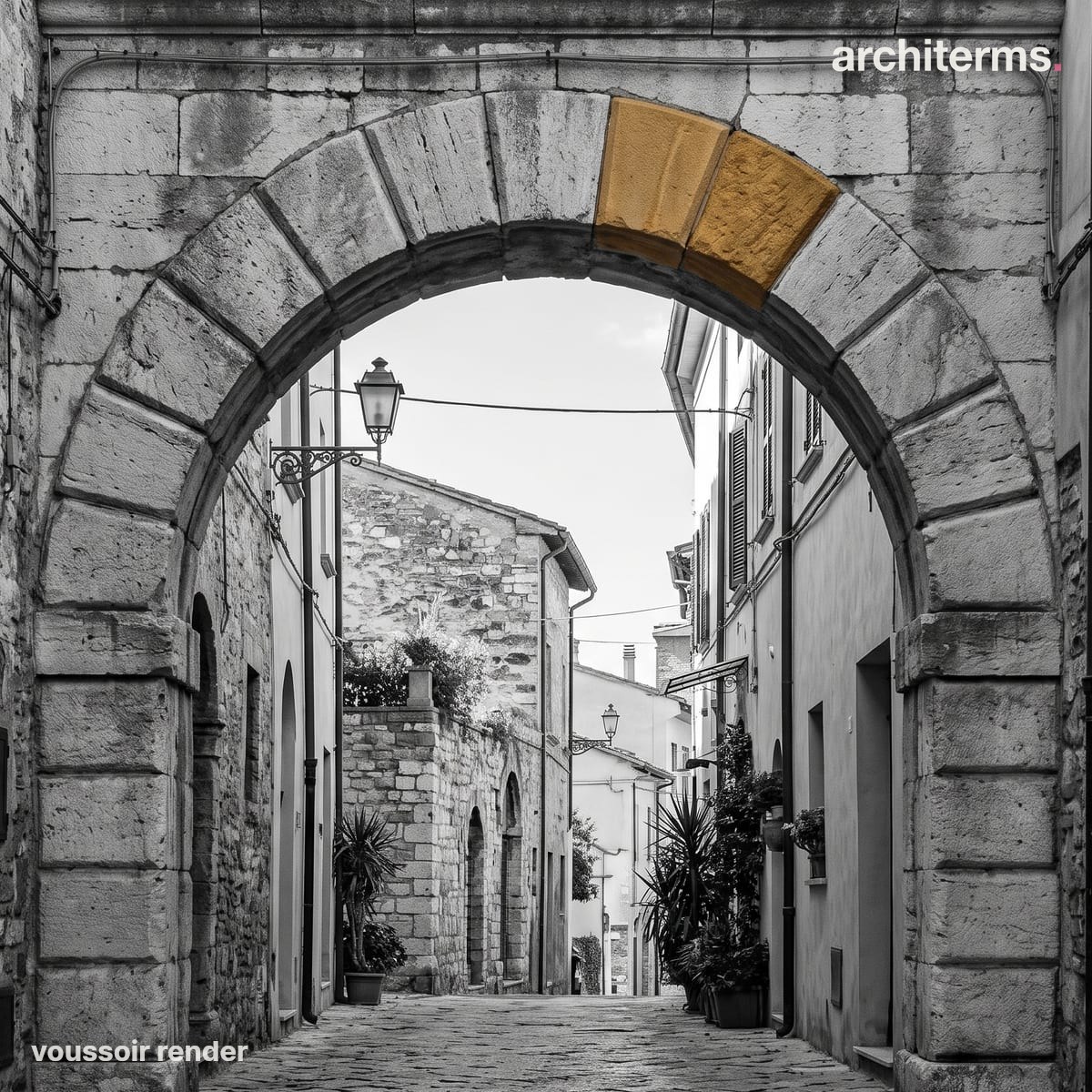
Each voussoir is a single wedge-shaped block cut so its sides radiate from the centre of the arch. Set side by side around the curve, they press against one another in compression and lock into a self-supporting ring over the opening.
Made with Reviz.Design — AI visualization for architects and interior designers
Definition
A voussoir is one of the wedge-shaped units—stone, brick, or sometimes terracotta—that are assembled side by side to build an arch or vault. Because each block is cut narrower at the bottom than the top, the voussoirs cannot fall inward; instead they jam together and transfer their load sideways and downward around the curve of the arch. The wedge shape is the whole secret of the arch: it turns a row of separate blocks into a single curved structure that carries load purely in compression.
The arch was one of the great structural inventions of antiquity precisely because of the voussoir. A flat stone lintel can only span a short distance before it cracks in tension, but an arch built of voussoirs spans far wider openings by avoiding tension almost entirely. Every voussoir presses on its neighbours, and the line of thrust runs through the ring of stones into the supports at each side.
A voussoir is one of the wedge-shaped stones or bricks that form the curved part of an arch or vault. Each voussoir is tapered so that its joint faces radiate from the arch's centre, and when the blocks are set together they lock against one another in compression, carrying load around the curve to the supports. The central voussoir at the crown is the keystone; the lowest voussoir on each side, resting on the support, is the springer. The faces between adjacent voussoirs are the joints, and the inner and outer curved edges of the ring are the intrados and extrados.
Voussoir History
The voussoir arch was developed in the ancient Near East and brought to its fullest expression by the Romans, who used arches of cut-stone or brick voussoirs for bridges, aqueducts, gateways, and the great vaults of their public buildings. Roman builders raised arches on temporary timber frames called centering, set the voussoirs in place around the curve, and dropped in the keystone last to lock the ring; the centering could then be struck and the arch would stand on its own. Medieval masons inherited this knowledge and refined the cutting of voussoirs—a craft called stereotomy—to extraordinary precision, building the pointed arches and ribbed vaults of Gothic cathedrals. The geometry of the voussoir remained central to masonry construction until iron, steel, and reinforced concrete offered other ways to span.
Voussoir in Architecture
Voussoirs are both structural and expressive:
- —The keystone: The central voussoir is often enlarged or carved as a feature, marking the crown of the arch over a doorway or window.
- —Decorative patterns: Voussoirs of alternating colour or material—as in many Islamic and Romanesque arches—turn the structural ring into a striking visual band.
- —Reading the structure: Exposed voussoirs make the logic of the arch legible; you can see each block leaning on the next and the thrust travelling down to the piers or abutments.
Because an arch of voussoirs pushes outward as well as down, the supports must resist that lateral thrust—which is why arches and vaults are paired with thick piers, buttresses, or tie-rods.
Common confusion
Voussoir vs. keystone: The keystone is simply the single voussoir at the very top, or crown, of the arch. Every block in the curve is a voussoir; the keystone is the special central one that is set last and locks the ring.
Voussoir vs. springer: The springer is the lowest voussoir on each side, the first block of the curve where the arch springs from its support or impost. It is still a voussoir, just the one at the bottom of the ring.
Voussoir vs. quoin: Voussoirs are the wedge-shaped blocks of an arch; quoins are the dressed corner stones at the external angle of a wall. Both are cut masonry, but they do entirely different jobs.
Arch vs. voussoir: The arch is the whole curved structure; the voussoirs are the individual wedge units it is built from. An arch is made of many voussoirs working together.
Frequently Asked Questions
What is a voussoir?
A voussoir is one of the wedge-shaped stones or bricks used to build an arch or vault. Each block is tapered so its sides radiate from the arch's centre, and when assembled the voussoirs lock against one another in compression, carrying the load around the curve to the supports on each side.
What is the difference between a voussoir and a keystone?
The keystone is the single voussoir at the very top, or crown, of an arch. Every wedge-shaped block in the arch is a voussoir, but the keystone is the central one that is set in place last to lock all the other voussoirs together.
What is a springer voussoir?
The springer is the lowest voussoir on each side of an arch, resting on the support or impost where the curve begins to rise. It is the first block of the arch ring, the point from which the arch is said to spring.
How do voussoirs hold an arch up?
Because each voussoir is wedge-shaped, the blocks cannot slip inward; they press against their neighbours and transfer load around the curve in compression rather than tension. The thrust travels down the ring of voussoirs to the supports, which must resist both the downward weight and the outward push of the arch.
What are voussoirs made of?
Voussoirs are traditionally made of cut stone or brick, and sometimes of terracotta or moulded concrete. The material must be strong in compression, since the whole arch works by the blocks pressing tightly against one another. In decorative arches, voussoirs of contrasting colours or stones are often alternated for visual effect.