Site Plan.
A site plan is a scaled drawing seen from above that shows a building and all its surroundings on the property — boundaries, access, parking, landscaping, and services. In plain terms: it's the bird's-eye map of the whole plot, not just the building.
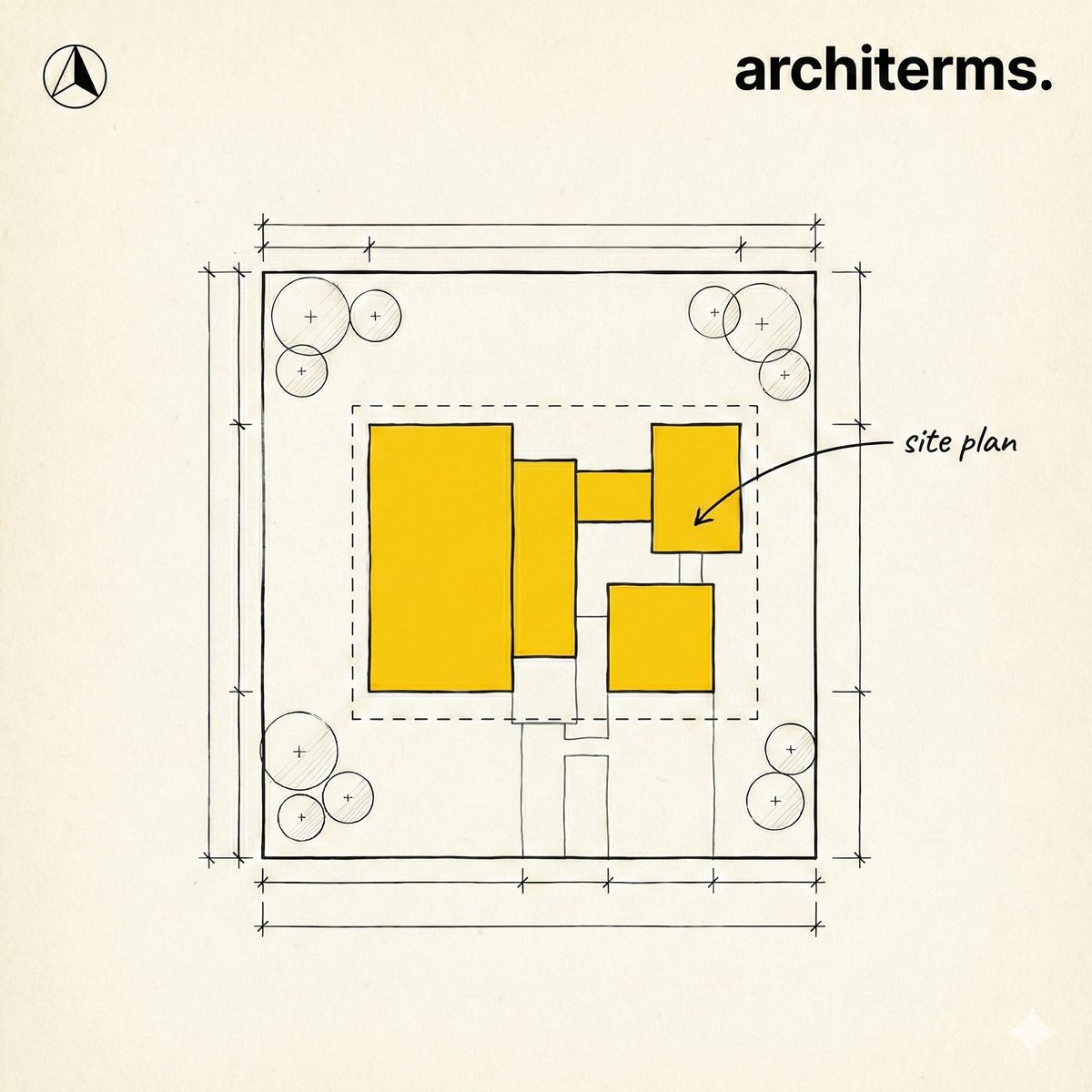
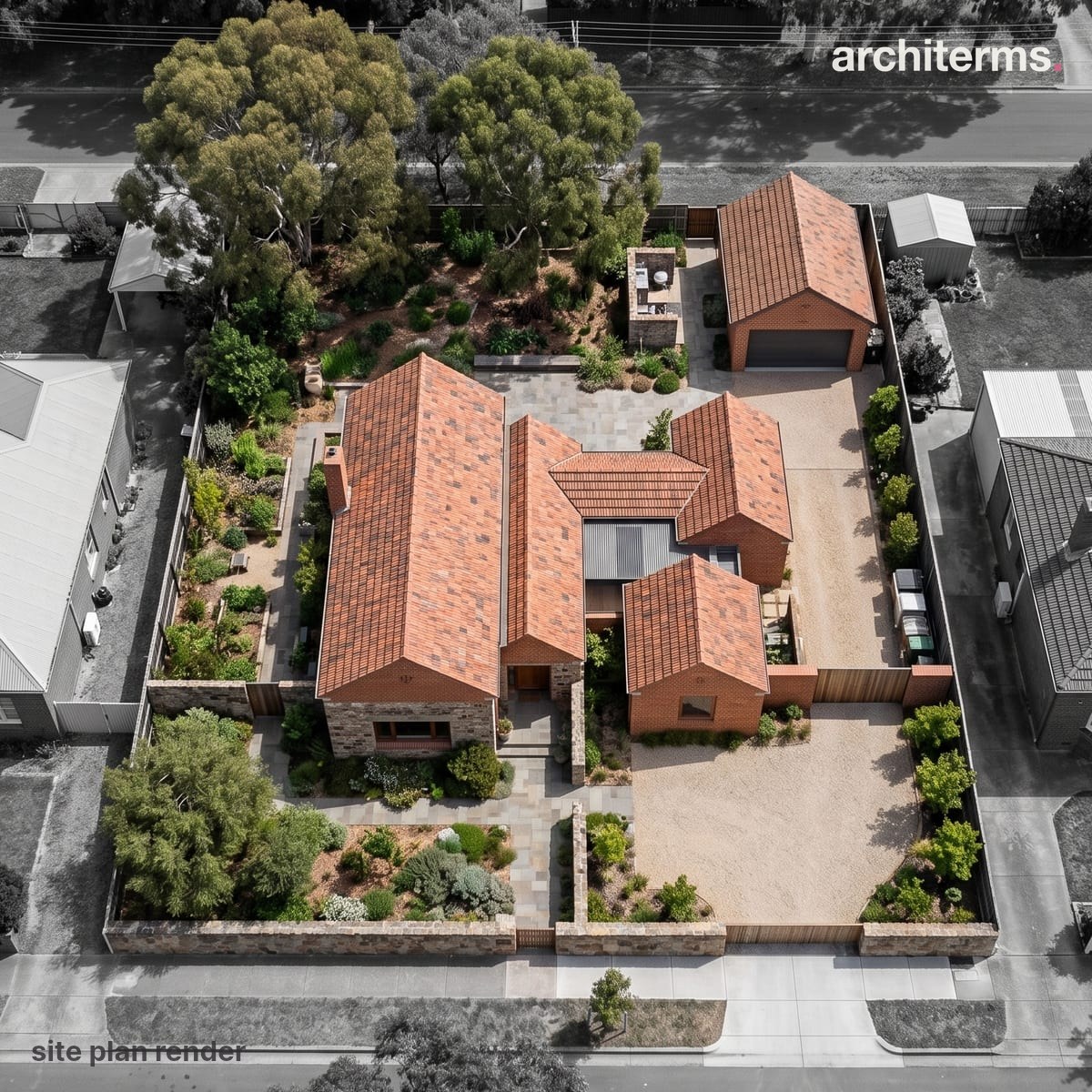
A site plan reads the whole plot from directly above: the house sits within its boundaries alongside the driveway, garage, paved paths, planted garden and perimeter walls, showing how the building relates to access and open ground rather than the building alone.
Created with Reviz.Design — AI rendering for architects and interior designers
Definition
A site plan is a top-down, scaled drawing of an entire property, showing the building (or buildings) in relation to everything around them: the site boundaries, roads and driveways, parking, paths, landscaping, drainage, and utilities. Where a floor plan zooms in on the inside of a building, the site plan zooms out to show how the building sits on its land. It is the drawing that answers where rather than what.
Because it covers the whole plot, the site plan is central to planning approvals, setbacks, and how a project meets its surroundings. It coordinates the work of architects, landscape architects, and civil engineers, and it is usually the first drawing a planning authority looks at. A clear site plan — sometimes called a plot plan — shows not just the building footprint but how people, cars, water, and services move across the site.
A site plan is a scaled orthographic drawing, viewed from directly above, that locates a building and its associated works within the legal boundaries of its plot. It shows the building footprint, the setbacks and distances to boundaries, access and circulation, parking, hard and soft landscaping, ground levels and drainage, and the routing of services. Together with the floor plan, the elevation, and the section, it completes the basic set of drawings that describe a project.
Site Plan History
Drawing a building together with its grounds is an old idea — estate and garden plans laid out houses, avenues, and parterres as a single composition for centuries. The Beaux-Arts tradition treated the site plan as a formal design in its own right, organizing buildings around axes and approaches. As cities grew and zoning emerged in the 20th century, the site plan also became a regulatory document: the drawing that proves a proposal respects boundaries, setbacks, and access. Today it is often produced from a digital survey and coordinated within a BIM or GIS model.
Site Plan in Architecture
The site plan is where a building meets its context:
- —Locates the building: it fixes the footprint, orientation, and the setbacks and distances to every boundary.
- —Shows circulation: roads, driveways, parking, footpaths, and entrances are all set out so people and vehicles can move through the site.
- —Coordinates site works: levels, grading, drainage, retaining structures, and landscaping are resolved on the site plan before they reach the ground.
- —Drives approvals: it is usually the key drawing for planning and zoning review, showing how the project fits its street and neighbors.
- —Completes the drawing set: alongside the floor plan, elevation, and section, it gives a full picture of a design from the scale of the plot down to the room.
Common confusion
- —Site plan vs. floor plan: a site plan shows the whole property from above, including the ground around the building; a floor plan shows the internal layout of a single level inside the building.
- —Site plan vs. plot plan: the two are largely the same; plot plan often emphasizes a single lot and its setbacks for permitting.
- —Site plan vs. location plan: a location plan is zoomed out further to show the site within the wider neighborhood; a site plan focuses on the plot itself.
- —Site plan vs. survey: a survey records the existing boundaries and conditions of the land; the site plan uses that survey as a base to show the proposed design.
Frequently Asked Questions
What is a site plan?
A site plan is a scaled drawing seen from directly above that shows a building and everything around it on the property — boundaries, setbacks, access, parking, landscaping, levels, drainage, and services. It locates the building on its land rather than describing the inside of the building.
What is the difference between a site plan and a floor plan?
A site plan shows the entire property from above, including the ground and works around the building, and is used to show how the building sits on its plot. A floor plan shows the internal layout of one level of the building. The site plan answers where the building is; the floor plan answers how it is arranged inside.
What should a site plan include?
A typical site plan includes the site boundaries and dimensions, the building footprint and its setbacks, north orientation, access roads and driveways, parking, footpaths and entrances, hard and soft landscaping, ground levels and drainage, and the routing of utilities. The exact contents depend on the project and the planning authority's requirements.
Why is a site plan important for planning permission?
The site plan is usually the first drawing a planning or zoning authority reviews, because it shows whether a proposal respects boundaries, setbacks, access, and its relationship to neighboring buildings. It demonstrates how the project fits its context, which is central to most planning decisions.
What is the difference between a site plan and a location plan?
A location plan is drawn at a smaller scale and zooms out to show the site within the surrounding streets and area, so the plot can be found in context. A site plan is drawn at a larger scale and focuses on the plot itself, showing the building and works in detail.