Spandrel.
A spandrel is the roughly triangular surface left between the curve of an arch and the rectangle that encloses it, or between two adjacent arches. In plain terms: the leftover wall an arch creates, which architects have always chosen to decorate.
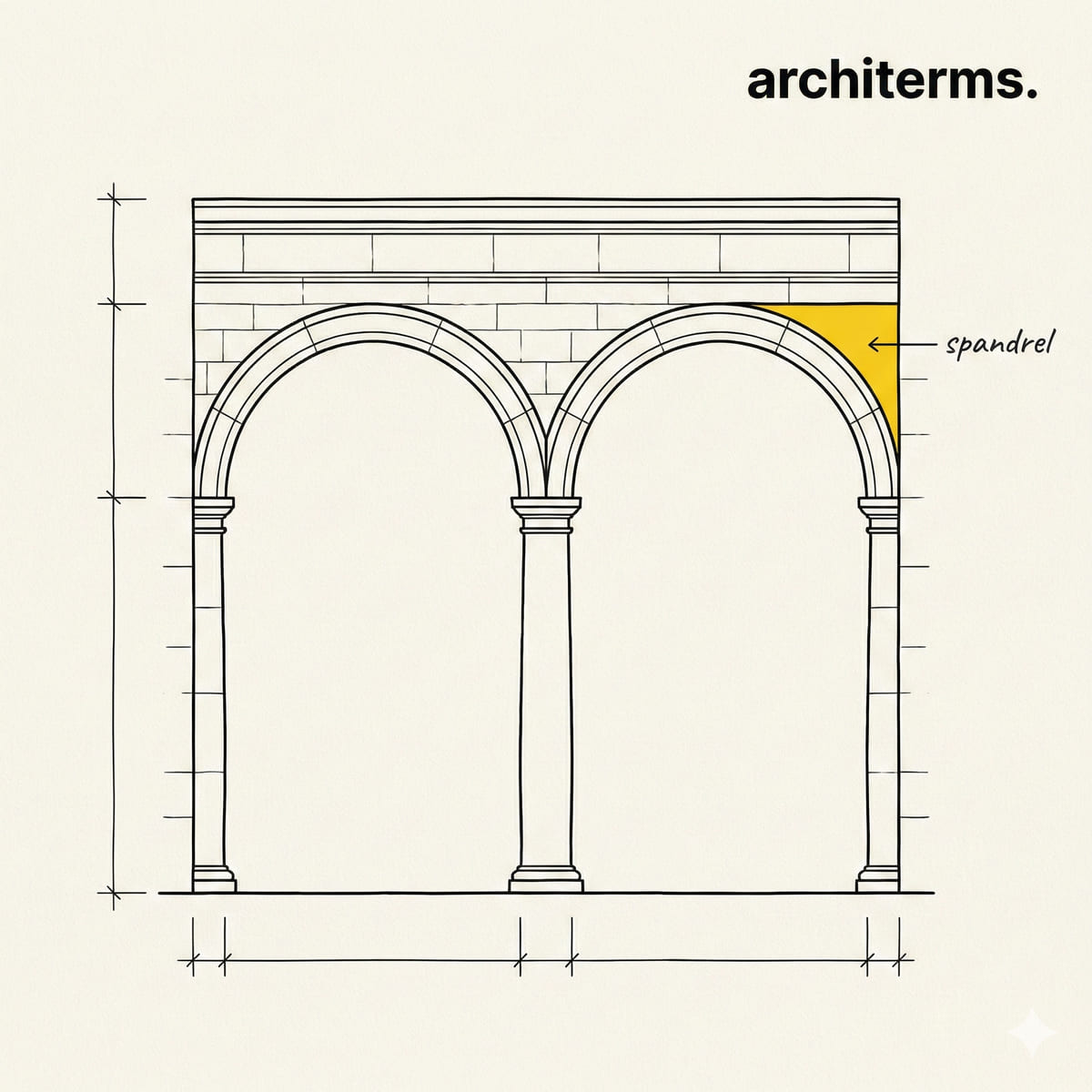
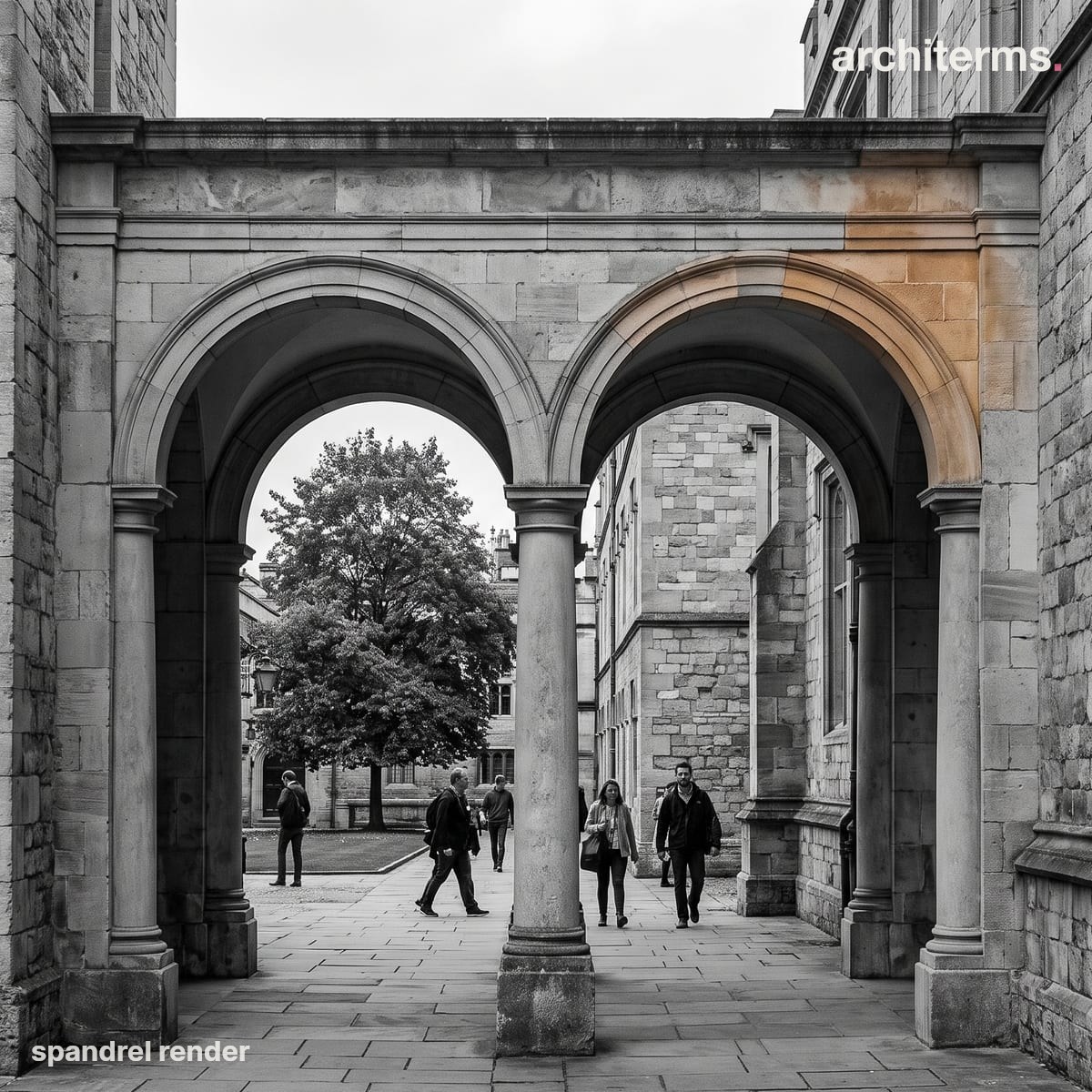
A spandrel is the roughly triangular patch of wall left when a curved arch sits beneath a horizontal line. Here it is the wedge above the right-hand arch, between the arch ring and the cornice band, filled with solid masonry so the wall above bears on the arch and the pier beside it.
Made with Reviz.Design — AI visualization for architects and interior designers
Definition
A spandrel is the surface left over when a curve is set inside a rectangle. Put an arch under a horizontal line and you are left with two roughly triangular pieces of wall, one at each haunch; put two arches side by side and the piece between them is a spandrel too. The shape is not designed, it is a residue — but it is a residue that appears everywhere arches are used, and architecture has spent two thousand years deciding what to do with it.
The answer has usually been to fill it with something. Roman triumphal arches carry winged Victories in their spandrels; Gothic arcades put quatrefoils and tracery there; Islamic architecture fills them with tilework and geometric interlace. The reason is compositional. A blank spandrel reads as an accident, whereas a carved or panelled one makes the arch look deliberate — as if the rectangle and the curve had been designed together rather than one being cut out of the other.
A spandrel is the surface bounded by the extrados of an arch, a horizontal line above it such as a stringcourse or cornice, and a vertical line at the side — or, between adjacent arches, the surface bounded by two extrados curves and the horizontal above. In a masonry structure the spandrel is load-bearing wall and contributes real stiffness to the arch beneath it. In modern framed construction the word has been transferred to a different but analogous residue: the spandrel panel is the opaque strip of curtain walling between the head of one window and the sill of the window on the floor above, covering the floor edge and the zone that is not vision glass.
Spandrel History
The spandrel appears the moment the arch does. Roman builders, working with the arch as their primary spanning device, treated the spandrels of aqueducts and bridges as structural mass and those of ceremonial arches as sculptural fields, and the two habits persisted separately for centuries. In Gothic work the spandrels of arcades became a place for pierced tracery and heraldry, and in the great bridges the spandrel could be left solid or opened up into smaller arches to save weight — the open-spandrel arch bridge is still the standard long-span form in stone and concrete.
The Renaissance formalised it: with arcades organised by classical proportion, the spandrel became a defined panel, often holding a roundel or a relief figure. Islamic and Mughal architecture developed a parallel tradition of filling the same surface with inlay and geometric pattern.
The word then jumped materials. When the steel frame separated structure from enclosure at the end of the nineteenth century, the facade became a grid of floors and columns with glass in between — and the opaque band hiding each floor edge inherited the name. Since the 1950s "spandrel glass" has meant back-painted or ceramic-fritted glazing used for exactly that purpose, so that the opaque strip matches the vision glass and the whole wall reads as one surface.
Spandrel in Architecture
- —Resolves curve against rectangle: it is what lets an Arch sit inside an orthogonal wall or frame without the geometry looking unfinished.
- —Carries the ornament: because the surface is flat, bounded and at eye level in an arcade, it is the natural home for relief carving, roundels and tracery.
- —Does structural work in masonry: the fill above the haunches of an arch stabilises it against asymmetric loading — which is why the Voussoir ring and the spandrel above it are designed as one thing, not two.
- —Hides the floor edge in a curtain wall: the modern spandrel panel conceals the slab edge, the perimeter fire-stopping and the services zone while keeping the Facade reading as continuous glazing.
Common confusion
- —Spandrel vs. pendentive: both fill an awkward gap left by curves, but a pendentive is a doubly curved triangular surface that carries a dome down onto four arches. It is three-dimensional and structural; a spandrel is a flat surface.
- —Masonry spandrel vs. spandrel panel: the historic meaning is a wall surface beside an arch. The modern meaning is an opaque cladding panel between windows. They share a logic — the part of the wall that is not the opening — but almost nothing else.
- —Spandrel glass vs. vision glass: spandrel glass is deliberately opaque, usually back-painted or fritted, and is not intended to be seen through. It often needs heat-strengthening because the trapped heat behind it raises thermal stress.
- —Spandrel vs. haunch: the haunch is the part of the arch itself between the springing and the crown. The spandrel is the wall surface outside the arch, above the haunch.
Frequently Asked Questions
What is a spandrel in architecture?
A spandrel is the roughly triangular surface between the curve of an arch and the rectangular frame around it, or the surface between two adjacent arches. It is the leftover wall an arch creates, and it is traditionally filled with carving, tracery or panelling.
What is the difference between a spandrel and a tympanum?
A tympanum is the surface enclosed inside an arch or a pediment; a spandrel is the surface outside it. On a Gothic doorway the carved semicircle above the lintel is the tympanum, and the two triangular areas flanking the arch are the spandrels.
What is a spandrel panel in a curtain wall?
It is the opaque horizontal band between the head of one window and the sill of the window above. It conceals the floor slab edge, the perimeter fire-stopping and the services zone, and it is usually made of back-painted or ceramic-fritted spandrel glass so it matches the vision glazing.
Is a spandrel structural?
In masonry construction, yes. The fill above the haunches of an arch adds weight and stiffness that helps stabilise the arch against uneven loading, and open-spandrel bridges deliberately remove part of it to save material. A curtain-wall spandrel panel, by contrast, is cladding and carries only itself and wind load.
Why is spandrel glass opaque?
Because there is nothing behind it worth seeing — a slab edge, insulation and fire-stopping. Making it opaque but visually similar to the vision glass lets the facade read as one continuous surface instead of a band of windows with gaps between them.