Tracery.
Tracery is the ornamental stonework of slender bars and shapes that subdivides a Gothic window, supporting the glass and forming patterns in its upper part. In plain terms: it is the carved stone lattice that splits a big church window into smaller sections and decorative shapes.
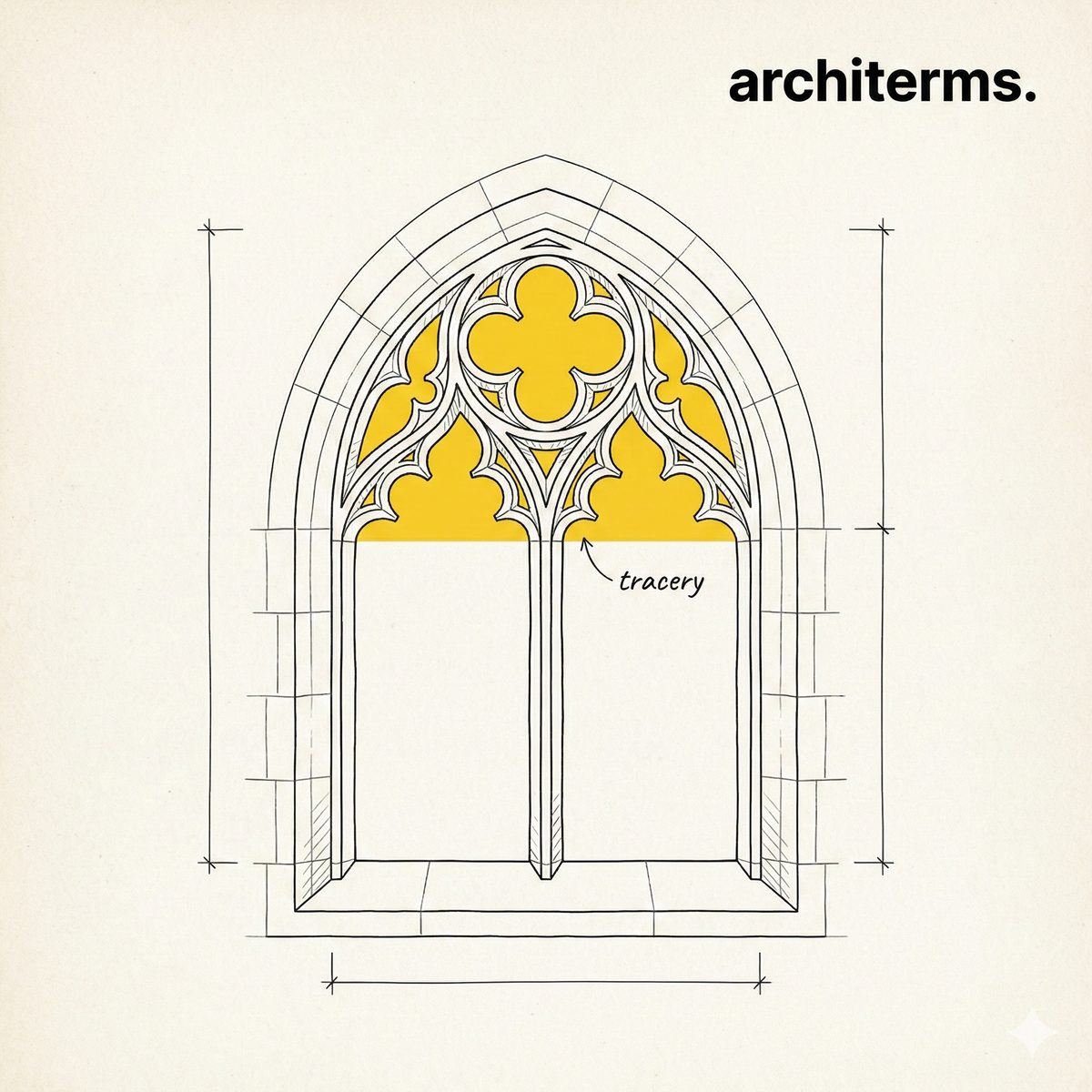
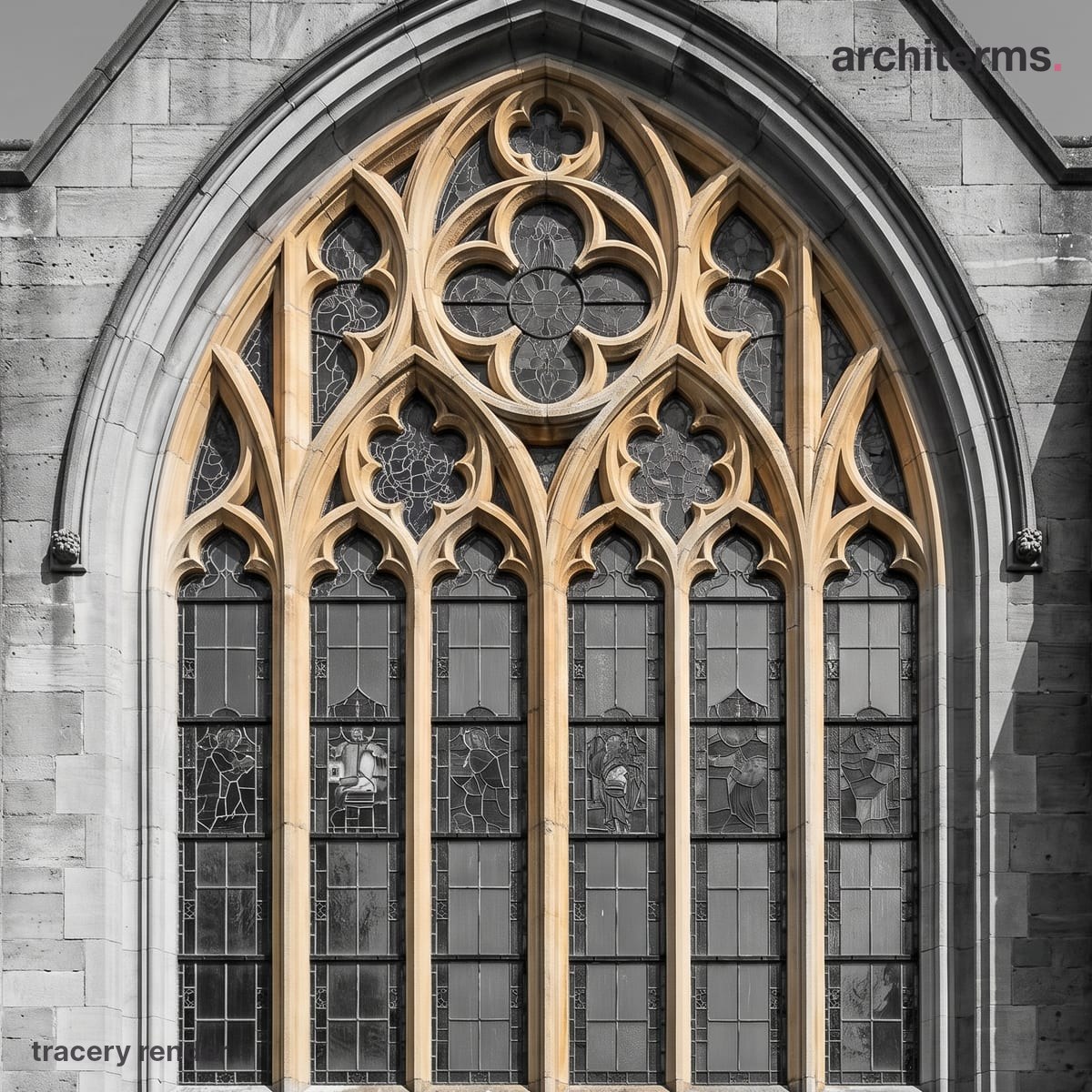
Tracery is the carved stone framework that subdivides a large window: slender mullions rise into the head and branch into foils and cusped rings, holding the panes of glass while shaping the pointed arch into an ordered pattern.
Created with Reviz.Design — AI rendering for architects and interior designers
Definition
Tracery is the lacework of stone that defines the Gothic window. As builders learned to carry roof and vault loads on piers and buttresses, walls could be opened into ever-larger windows—but those wide openings needed slender stone members to brace the glass and divide it into manageable lights. Tracery is that framework, and in skilled hands it became one of the great decorative arts of medieval architecture.
The pattern of a window's tracery is one of the surest ways to date and identify Gothic work. From simple pierced openings to flowing, flame-like curves, the styles evolved over centuries and varied from country to country, leaving a visual record of changing taste and technique.
Tracery is the ornamental, openwork stone framework that divides and decorates the upper part of a Gothic window, screen, panel, or vault. It consists of mullions—the vertical bars dividing the window into lights—that branch and interlace above into circles, foils, and curved bars filling the head of the opening. Tracery both organizes the stained glass into sections and braces the large opening structurally. The same patterns are also applied as blind tracery to solid wall surfaces for decoration.
Tracery History
The earliest form, plate tracery, was made by piercing shapes such as circles directly through a slab of stone above paired lancet windows. In the early 13th century this gave way to bar tracery, in which thin, molded stone bars were assembled into patterns, allowing far more glass and far finer designs. Bar tracery developed through recognizable phases: geometric tracery built from circles and simple foils; curvilinear or flowing tracery with sinuous, branching curves; and, in France, the flame-like forms of the Flamboyant style. In England the later Perpendicular style turned to rigid vertical mullions running straight to the window head. Tracery was revived throughout the 19th-century Gothic Revival.
Tracery in Architecture
Tracery serves structure, light, and ornament together:
- —Bracing the opening: Its mullions and bars stiffen a wide window so it can hold large areas of glass against wind.
- —Dividing the glass: Tracery breaks a window into lights of workable size and frames the compositions of the stained glass within.
- —Style and dating: The geometry of the tracery—geometric, curvilinear, Flamboyant, or Perpendicular—identifies the period and region of a building.
- —Surface decoration: Applied to walls, screens, and tombs as blind tracery, the same patterns enrich solid surfaces and unify a building's ornament.
The finest tracery demonded exact stone-cutting, as each molded bar had to meet its neighbors precisely while bearing on the wall around it.
Common confusion
Tracery vs. mullion: A mullion is a single vertical bar dividing a window into lights; tracery is the whole decorative framework, including the mullions and the branching, curved bars above them.
Tracery vs. rose window: A rose window is a complete circular window; tracery is the stonework that subdivides it (and other windows). The rose's radiating pattern is one form of tracery.
Plate vs. bar tracery: Plate tracery is made by cutting openings through a solid stone panel, so the stone dominates; bar tracery is assembled from slender molded bars, so the glass dominates and the patterns are finer.
Tracery vs. stained glass: Stained glass is the colored glazing that fills the openings; tracery is the stone skeleton that holds and frames it.
Frequently Asked Questions
What is tracery in architecture?
Tracery is the ornamental openwork stone framework that divides and decorates the upper part of a Gothic window. It is made of slender mullions and curved bars that brace the opening, split it into smaller lights, and form patterns of circles and foils that frame the stained glass.
What is the purpose of tracery?
Tracery braces a large window structurally so it can carry big areas of glass, divides the opening into lights of workable size, and frames the stained-glass compositions. It also serves as decoration, both within windows and applied to walls as blind tracery.
What is the difference between plate tracery and bar tracery?
Plate tracery is made by piercing shapes through a solid slab of stone, so the stonework dominates the design. Bar tracery is assembled from thin molded stone bars, allowing much more glass and far finer, more elaborate patterns. Bar tracery largely replaced plate tracery in the 13th century.
What is the difference between tracery and a mullion?
A mullion is a single vertical bar that divides a window into separate lights. Tracery is the whole decorative framework of a window, which includes the mullions together with the curved and branching bars above them that form the patterned head of the opening.
How does tracery help date a Gothic building?
The geometry of tracery changed over time, so its style helps date and place a building. Geometric tracery uses circles and simple foils, curvilinear or flowing tracery uses sinuous curves, French Flamboyant uses flame-like forms, and English Perpendicular uses rigid vertical mullions to the window head.