Stringcourse.
A stringcourse is a continuous horizontal band — usually a projecting or contrasting strip of masonry — that runs across a building's facade, often marking a floor level. In plain terms: it's the horizontal line that wraps a building and visually divides it into storeys.
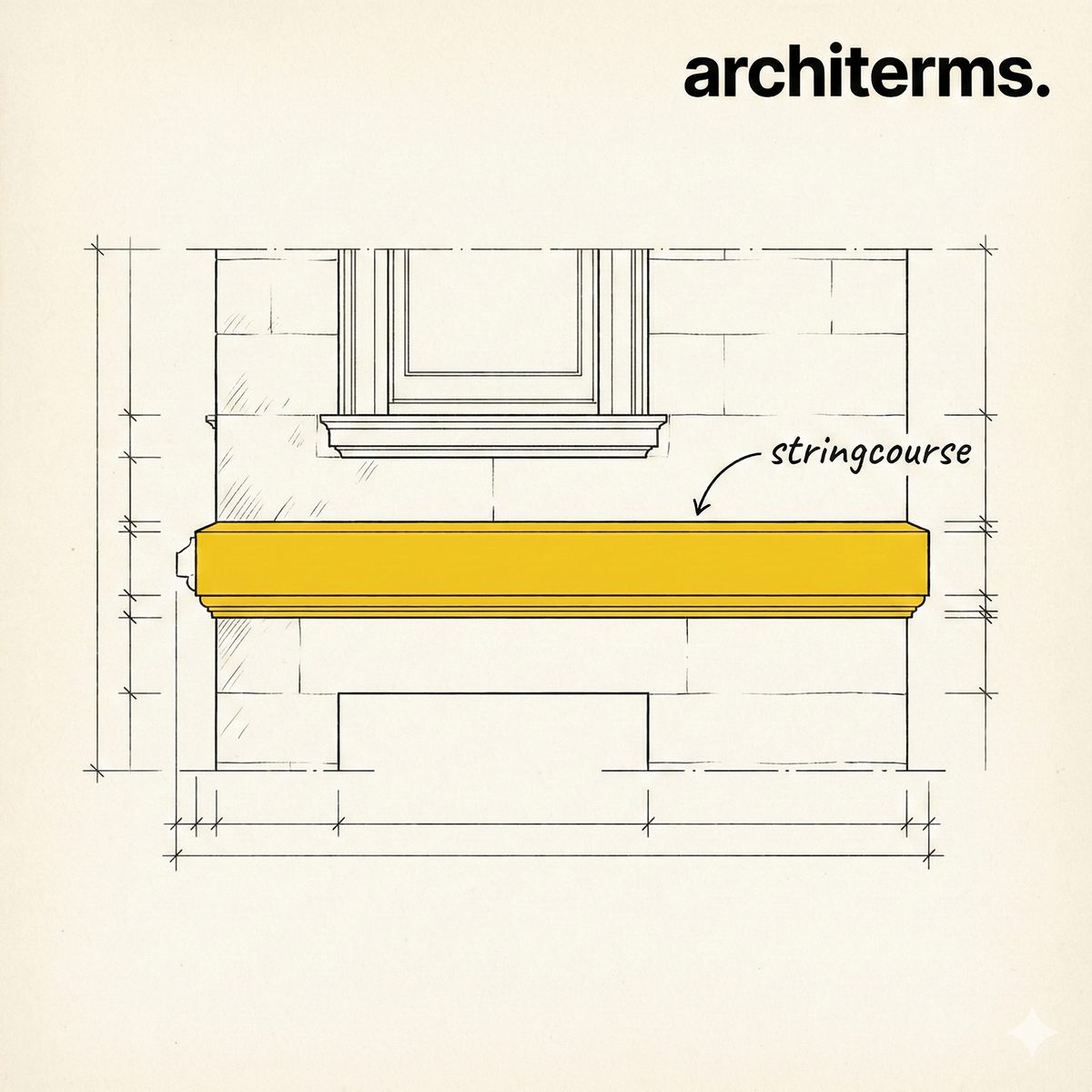
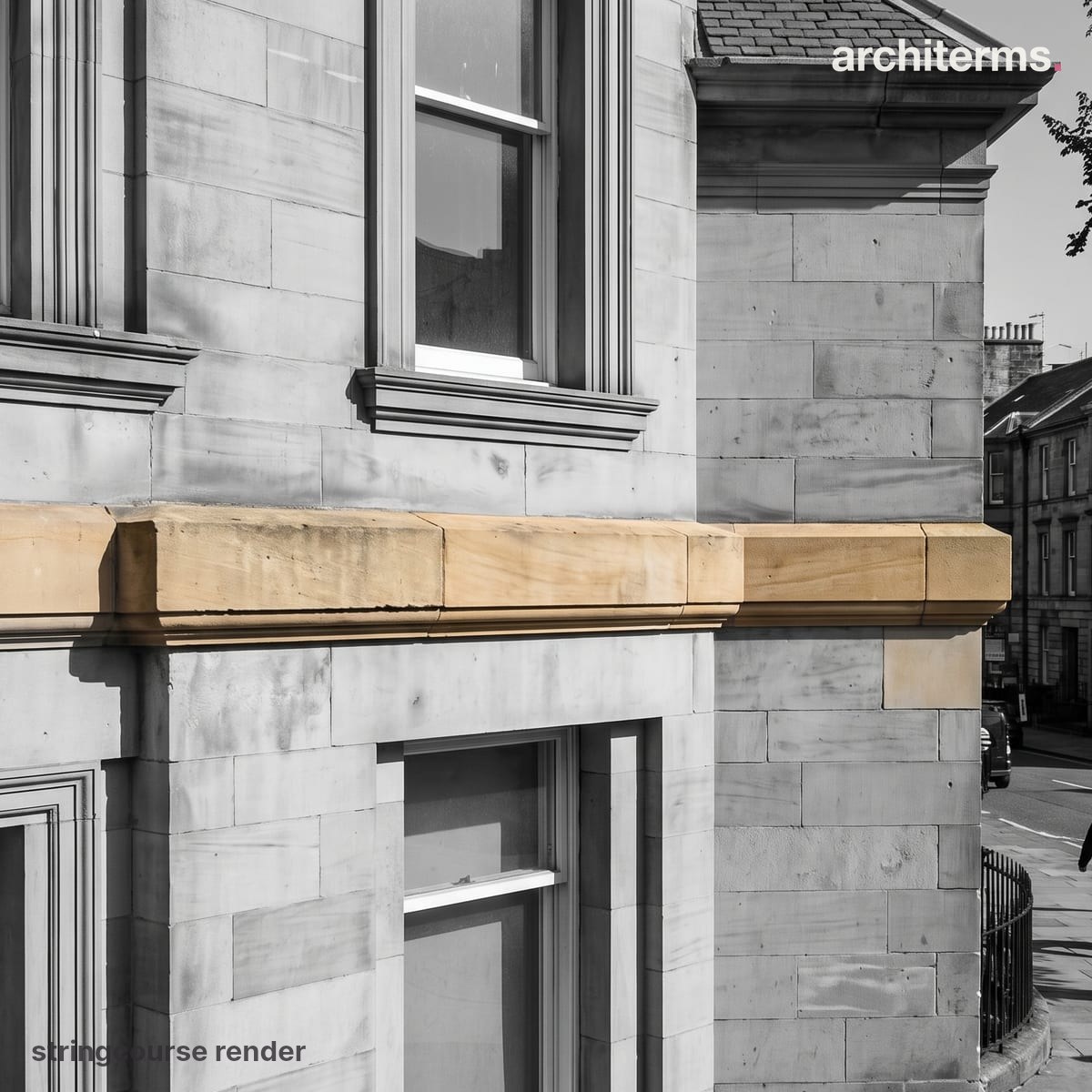
A stringcourse is a continuous horizontal band of masonry that projects slightly from the wall and wraps around the facade, here carrying the line across the corner. It reads as a division between one storey and the next.
Created with Reviz.Design — AI rendering for architects and interior designers
Definition
A stringcourse (also written string course) is a continuous horizontal band that runs across the face of a building, usually projecting slightly or made of a contrasting material. It is one of the quiet workhorses of facade design: a simple horizontal line that ties an elevation together, gives it scale, and most often marks the level of a floor inside. Where vertical elements like pilasters divide a building up and down, the stringcourse divides it across.
Functionally and visually, a stringcourse does several things at once. It breaks a tall facade into readable horizontal layers, it can throw rainwater clear of the wall where it projects, and it expresses the floors of the building on the outside. Stringcourses are common in everything from Renaissance palaces to ordinary brick buildings, where a single band of projecting or colored brick lifts an otherwise plain wall.
A stringcourse is a continuous, usually projecting horizontal band of masonry — or a contrasting strip of material — carried across a facade, frequently aligned with a floor level. It is in effect a horizontal moulding at a larger, building-wide scale, typically plainer than a cornice, used to divide a wall into storeys and give the elevation horizontal order. It may be flush or projecting, moulded or simple, and made of brick, stone, terracotta, or render.
Stringcourse History
Horizontal banding has ordered facades since antiquity, but the stringcourse became a defining device in Renaissance palace design, where projecting courses separated the storeys and emphasized the piano nobile, the important first floor. Medieval and later buildings used stringcourses both to shed water and to mark levels. In ordinary brick construction the stringcourse survived as one of the cheapest ways to give a plain wall articulation — a single band of projecting or contrasting brick that reads clearly from the street.
Stringcourse in Architecture
The stringcourse is a small element with an outsized effect on how a building reads:
- —Divides the facade horizontally: it breaks a tall facade into readable storeys.
- —Expresses the floors: it usually aligns with the floor levels inside, showing the building's layers on the outside.
- —Acts as a horizontal datum: a continuous line that orders the whole elevation, like a cornice but lower down.
- —Sheds water: a projecting course throws rain clear of the wall below, helping protect the masonry.
- —Adds richness cheaply: a band of contrasting or projecting brick veneer lifts an otherwise plain wall.
Common confusion
- —Stringcourse vs. cornice: a cornice is the projecting moulding at the very top of a wall or building; a stringcourse is a similar band running across the facade, usually at a floor level, and is generally simpler.
- —Stringcourse vs. belt course: they are the same thing — belt course is the common American term for a stringcourse.
- —Stringcourse vs. moulding: a moulding is any shaped profile; a stringcourse is specifically a continuous horizontal band at building scale.
- —Stringcourse vs. base course: a base course or plinth runs along the bottom of the wall; a stringcourse runs higher up, typically at the upper floor levels.
Frequently Asked Questions
What is a stringcourse?
A stringcourse is a continuous horizontal band — usually a projecting or contrasting strip of masonry — that runs across a building's facade, often at a floor level. It divides a tall wall into readable storeys, expresses the floors inside, and gives the elevation horizontal order.
What is the difference between a stringcourse and a cornice?
A cornice is the projecting moulding at the very top of a wall or building, crowning it. A stringcourse is a similar horizontal band but runs across the face of the facade, usually aligned with a floor level, and is generally simpler and less projecting than a cornice.
What is a stringcourse for?
It divides a facade into horizontal layers, marks the floor levels on the outside of the building, gives the elevation scale and order, and — where it projects — throws rainwater clear of the wall below. It is also an inexpensive way to add articulation to a plain wall.
Is a stringcourse the same as a belt course?
Yes. Belt course is the common American term for the same element: a continuous horizontal band running across a facade. Stringcourse is the more traditional British term, but they describe the same feature.
What are stringcourses made of?
Stringcourses are typically made of brick, stone, terracotta, or render. In masonry buildings they are often a course of projecting or differently colored brick or a band of cut stone; on rendered or modern facades they may be a moulded or contrasting horizontal strip.