Squinch.
A squinch is a small arch, niche, or set of stepped corbels built across the upper corner of a square room to turn it into an octagon, so a round dome can sit on a square base. In plain terms: it's the corner 'filler' that lets a dome rest on a square room.
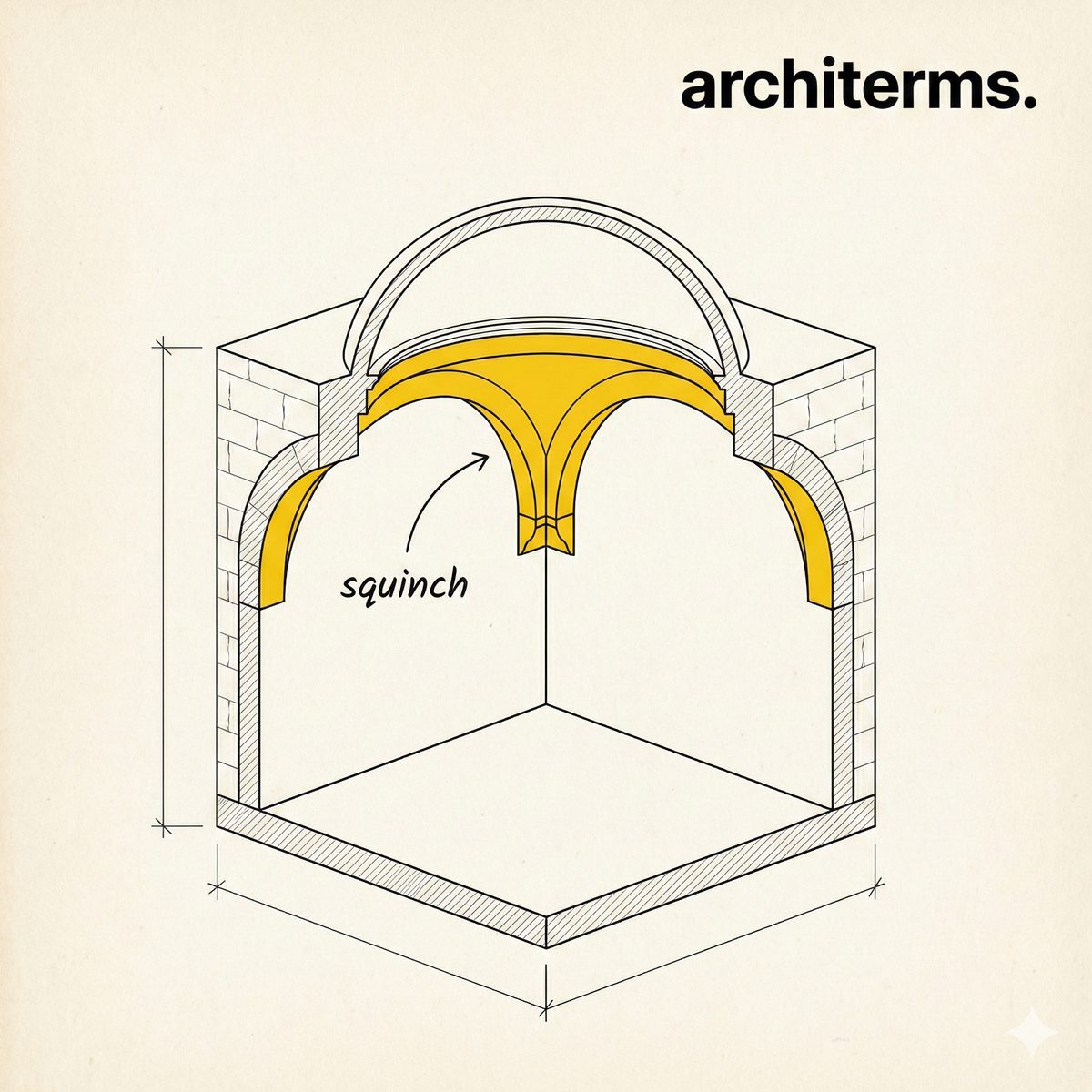
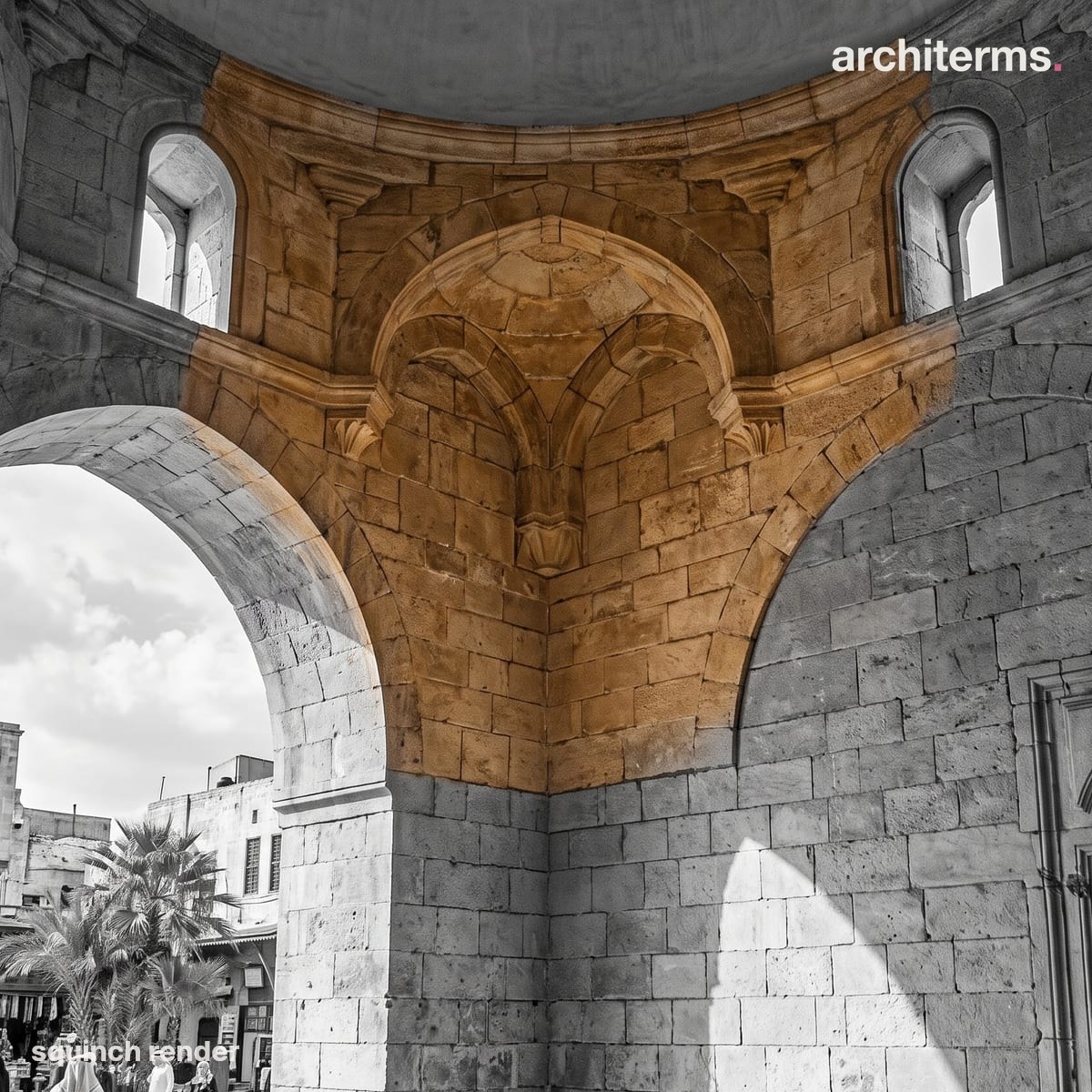
A squinch spans across the corner where two walls meet, its small arches stepping outward to carry the load. Repeated at each corner, it turns the square plan into an octagon on which a round dome can rest.
Rendered with Reviz.Design — AI visualization for architects and interior designers
Definition
A squinch is one of the oldest solutions to a basic geometry problem in architecture: how do you set a round dome on top of a square room? The corners of the square stick out past the circle of the dome, so the builder bridges each corner with a small arch or a stack of projecting stones. These corner bridges turn the square into an octagon — a shape much closer to a circle — giving the dome a continuous ring to sit on.
The squinch is essentially a structural trick for supporting a dome, and it shares that job with its more famous cousin, the pendentive. Where a pendentive is a smooth curved triangle, a squinch is a more direct, often visibly stepped or arched device tucked into the corner. Squinches are a signature of Persian, Islamic, and Romanesque building, where they made domes and drums possible long before modern engineering.
A squinch is a structural element placed diagonally across the interior corner of a square or polygonal space to carry the transition to a dome, drum, or octagonal vault above. It can be a single arch, a half-cone niche (a corner arch), a series of stepped corbels, or a small lintel. By cutting across each of the four corners, four squinches turn a square plan into an octagon onto which a round structure can be built.
Squinch History
The squinch appears very early in the architecture of the Near East and Persia, where builders needed to raise domes over square chambers in brick and stone. Sasanian palaces used deep corner arches as squinches, and the device was carried forward and refined throughout Islamic architecture, where layered squinches evolved into the dazzling honeycomb forms called muqarnas. In the European Middle Ages, Romanesque masons used squinches to seat towers and lanterns over the crossing of a church. Across all these traditions the squinch was the practical, buildable answer to the square-to-circle problem.
Squinch in Architecture
The squinch does one important structural and visual job:
- —Bridges the corner: it spans the awkward angle the dome cannot cover, transferring the dome's load down into the four corner piers or walls.
- —Squares the circle: four squinches convert a square into an octagon, and further tiers can step the octagon toward a full circle for the cupola or drum.
- —Carries decoration: because it sits at an eye-catching height, the squinch is often elaborated — stepped, scalloped, or developed into muqarnas — so structure becomes ornament.
- —Behaves like an arch: a squinch is really an arch (or corbel set) doing a specialized job, so it works in compression and needs solid support at its base.
Common confusion
- —Squinch vs. pendentive: both let a round dome sit on a square, but a pendentive is a continuous spherical-triangle surface, while a squinch bridges only the corner with an arch, niche, or corbels.
- —Squinch vs. corbel: a corbel is a single projecting bracket; a squinch may be built FROM stepped corbels, but its purpose is specifically to span the corner for a dome.
- —Squinch vs. arch: a squinch is a type of arch or arched niche set diagonally in a corner — the same structural behavior, a specialized position.
- —Squinch vs. drum: the drum is the cylindrical wall that raises a dome; squinches are the corner devices that create the base the drum or dome sits on.
Frequently Asked Questions
What is a squinch in architecture?
A squinch is a small arch, niche, or set of stepped corbels built across the upper corner of a square room. It bridges the corner so that a round dome or an octagonal drum can rest on a square base, transferring the load down into the corners.
What is the difference between a squinch and a pendentive?
Both solve the problem of placing a round dome on a square room. A squinch bridges each corner with an arch, niche, or corbels, creating an octagon. A pendentive is a smooth, curved triangular surface that fills the corner continuously. Squinches are more direct and often visibly stepped; pendentives give a seamless transition.
What is a squinch used for?
A squinch is used to make the transition from a square (or polygonal) plan to a circular one, so a dome, lantern, or drum can be built above. Four squinches turn a square into an octagon, which is close enough to a circle to seat a round structure.
How does a squinch relate to muqarnas?
Muqarnas is the honeycomb-like, tiered vaulting found in Islamic architecture. It developed in part from the squinch: builders multiplied and subdivided the corner squinches into many small niches, turning a structural device into an elaborate ornamental surface.
Is a squinch structural?
Yes. A squinch carries real load — it spans the corner and channels the weight of the dome or drum above down into the supporting piers or walls. Like an arch, it works mainly in compression and needs solid support at its base.