Brick Veneer.
Brick veneer is a single, non-structural outer layer of brick attached to a building's structural wall, giving the look of solid brick without carrying the building's loads. In plain terms: it's a brick 'skin' over a timber, steel, or block frame.
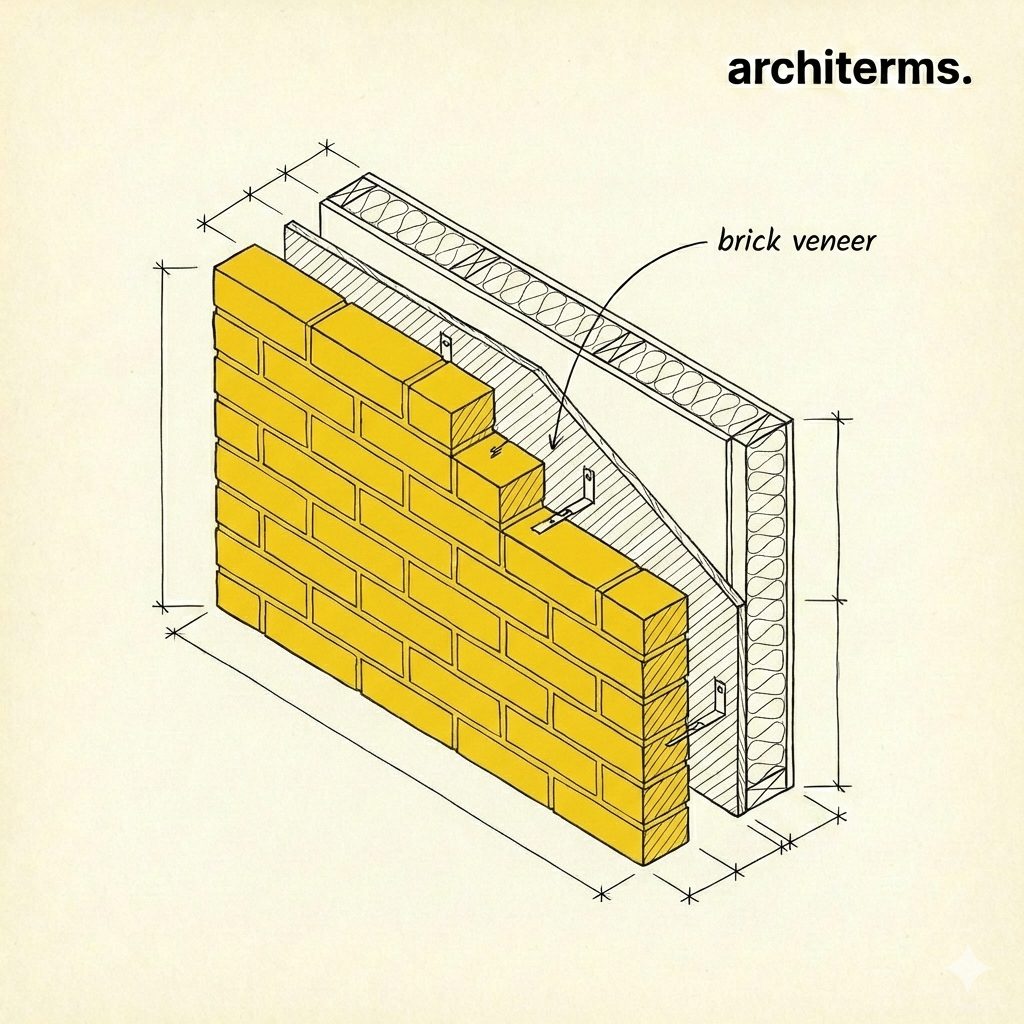
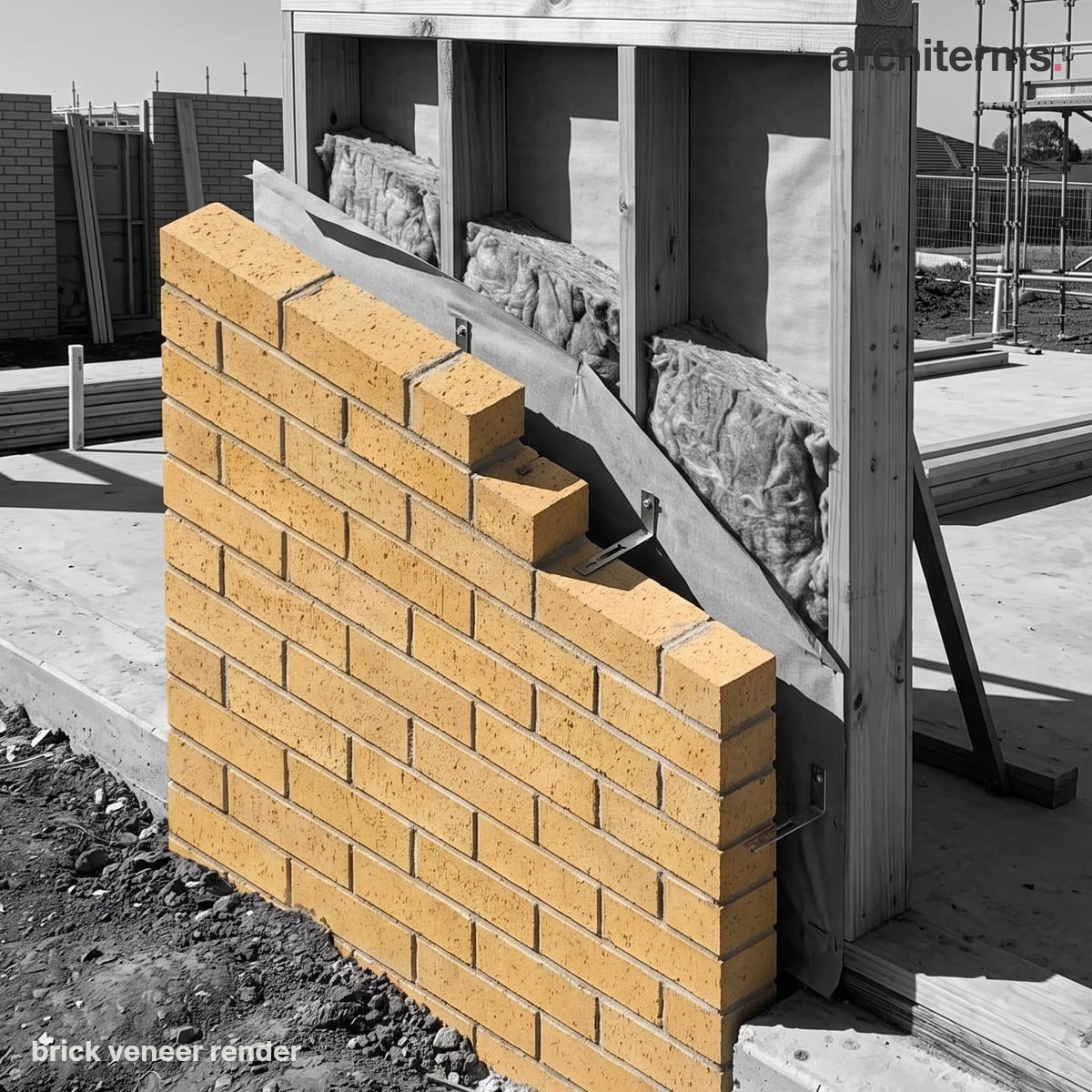
Brick veneer is a single outer wythe of brick that carries only its own weight. It stands clear of the framed wall behind it, tied back for stability across a narrow cavity, so the frame does the structural work while the brick provides the face.
Created with Reviz.Design — AI rendering for architects and interior designers
Definition
Brick veneer is a single-thickness outer layer of brickwork that wraps a building for appearance and weather protection, while the real structure is a separate wall behind it — usually timber or steel studs, or a blockwork backup. To the eye it looks like a solid masonry building, but the brick is doing almost no structural work; it is a cladding. This is how the great majority of modern brick-faced houses are actually built.
The veneer stands just clear of the structural wall, leaving an air gap, and is tied back to it with corrugated metal wall ties. That gap is the key to how the system works: it lets any water that gets through the brick drain back out, while the inner wall handles strength and insulation. Understanding brick veneer really means understanding that the brick you see and the wall that holds the building up are two different things.
Brick veneer is a non-load-bearing outer leaf of brickwork, one unit thick, anchored to a structural backing wall with metal ties and separated from it by a drained, vented air cavity. The veneer carries only its own weight — down to a foundation ledge or a steel shelf angle — and resists wind and weather, while the backing wall carries the building's floor and roof loads. Base flashing and weep holes let any collected water escape.
Brick Veneer History
For most of history, brick buildings were solid: several wythes of brick bonded together both held the building up and kept the weather out. As framed construction and, later, energy codes took over in the 20th century, builders separated those two jobs. The cavity wall — two leaves of masonry with a gap between — showed that an outer skin could drain and a backing could carry load. Brick veneer over a stud or block frame is the lightweight descendant of that idea, prized because it keeps the prized masonry look while building faster and insulating better than solid brick.
Brick Veneer in Architecture
The system is defined by a single clever separation:
- —Skin and structure split apart: the brick provides appearance and weather resistance; the frame or block wall behind provides strength.
- —It drains like a screen: the air gap, ties, base flashing, and weep holes work together so water that penetrates the brick runs back out — the same logic as a cavity wall and a rainscreen.
- —Openings need support: because the veneer cannot span, a lintel or shelf angle carries the brick over each window and door.
- —It keeps the masonry character: brick veneer gives a building a solid-looking facade at a fraction of the cost and weight of structural brick.
- —It must move: expansion joints and correctly spaced ties let the veneer expand, contract, and flex independently of the structure, and it is often finished at the top by a coping or parapet.
Common confusion
- —Brick veneer vs. solid brick: solid (structural) brick is several wythes thick and carries load; brick veneer is a single non-structural leaf over a separate structural wall.
- —Brick veneer vs. cavity wall: a traditional cavity wall has two masonry leaves; brick veneer pairs a brick outer leaf with a framed or block backing — but both rely on a drained cavity.
- —Brick veneer vs. brick slips: brick slips (or thin brick tiles) are thin brick faces glued to a board; brick veneer uses full bricks laid as a true, self-supporting leaf.
- —Veneer vs. structural masonry: a veneer is supported by and braced to the structure; structural masonry is the structure.
Frequently Asked Questions
What is brick veneer?
Brick veneer is a single, non-structural layer of brick attached to a building's real structural wall — usually a timber or steel frame or a block backup. It gives the appearance and weather protection of brick while the wall behind it carries the building's loads.
Is brick veneer structural?
No. A brick veneer carries only its own weight and resists wind and rain; it does not support the floors or roof. The structural backing wall behind the veneer carries the building loads, and the two are connected by metal ties across an air cavity.
What is the difference between brick veneer and solid brick?
Solid brick walls are several brick-widths thick and are both the structure and the weather barrier. Brick veneer is a single brick-width outer leaf over a separate structural wall, with a drained air gap between them. Veneer is lighter, faster, and easier to insulate, but only the look of the brick is load-bearing, not the brick itself.
Why is there a gap behind brick veneer?
The air cavity behind the veneer lets any rain that passes through the brick run down the back face and drain out through weep holes at the base, keeping the structural wall dry. The gap also breaks the path for water and allows the veneer to move independently of the structure.
What holds brick veneer to the wall?
Corrugated metal wall ties fixed to the backing wall and bedded into the mortar joints hold the veneer in place, resisting wind suction while still allowing slight movement. Over openings, a lintel or steel shelf angle supports the weight of the brick above.