Cavity Wall.
A cavity wall is an exterior wall built as two separate layers, or leaves, with a continuous air gap between them to keep out rain and improve insulation. In plain terms: it is a double wall with a hollow space in the middle that stops moisture and cold from passing straight through.
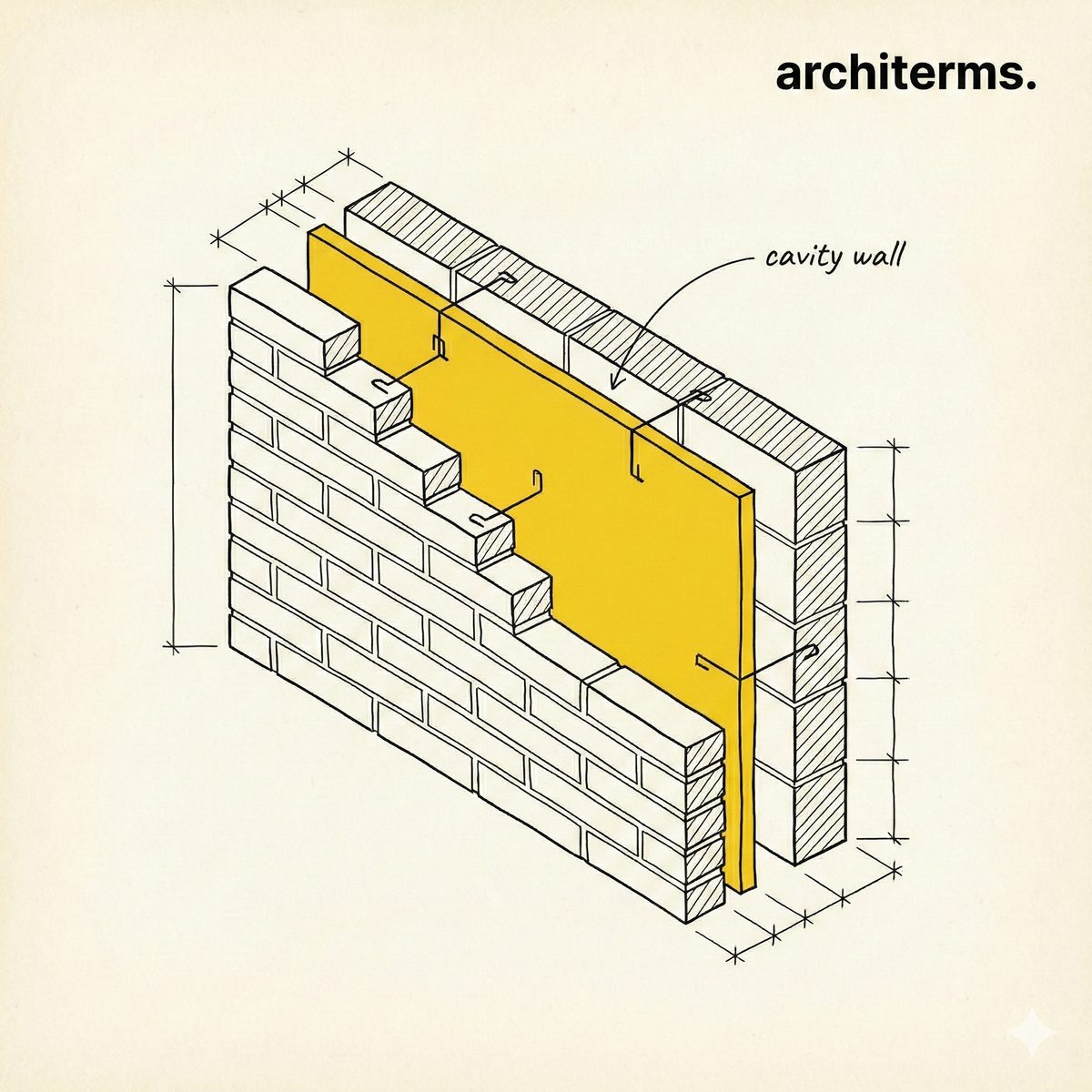
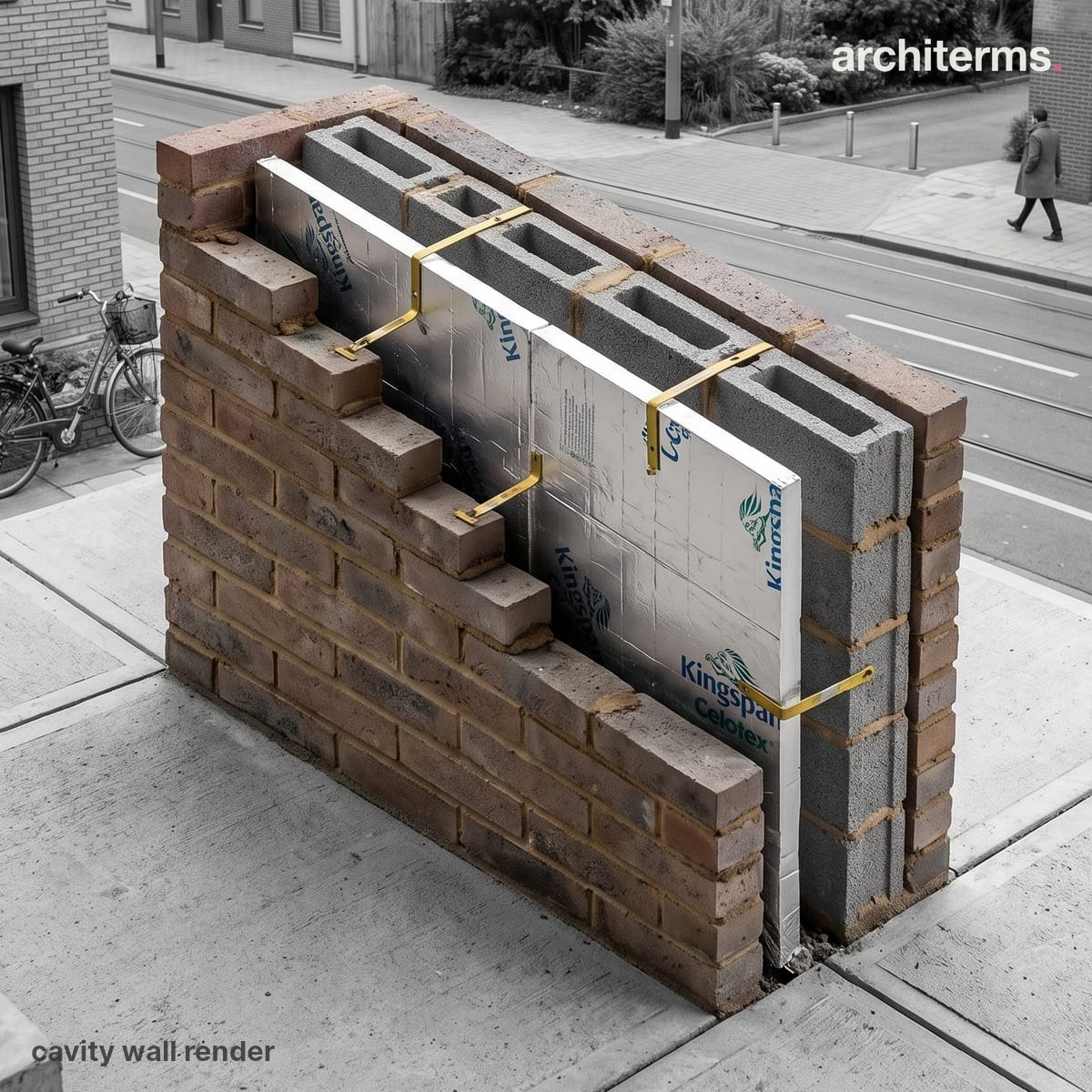
A cavity wall built as two leaves with a continuous gap between them: rain soaking the outer leaf cannot bridge the void, so moisture drains away down the cavity while the still air and any insulation slow the cold from reaching the inner leaf.
Rendered with Reviz.Design — AI visualization for architects and interior designers
Definition
A cavity wall solves an old problem: a single thick masonry wall can let driving rain soak through to the inside. By building the wall as two leaves separated by a gap, the cavity wall creates a break that water cannot easily cross. Any moisture that gets through the outer leaf runs down the inside of that leaf and is drained back out, leaving the inner leaf and the room beyond dry.
The same gap also reduces heat loss, and in modern construction it is usually filled or partly filled with insulation, making the cavity wall a standard way to build energy-efficient, weather-tight exterior walls. The two leaves are tied together with metal wall ties so they act as one wall while keeping their separation.
A cavity wall is an external wall consisting of two parallel leaves—an outer leaf and an inner leaf—separated by a continuous air space, or cavity, and connected by wall ties. The outer leaf resists the weather, the cavity stops moisture from bridging to the inside and adds thermal resistance, and the inner leaf supports the floors and finishes inside. The cavity is kept clear, or filled with insulation, and is drained and ventilated at the base through weep holes. Damp-proof courses and cavity trays direct any water that enters back to the outside.
Cavity Wall History
Solid masonry walls dominated building for millennia, but they transmitted damp in wet climates. Experiments with double walls appeared in the 19th century, and by the early-to-mid 20th century the cavity wall had become standard for housing in Britain and other rainy regions, replacing the solid wall. Early cavities were left empty as a moisture break. As energy concerns grew from the 1970s onward, builders began filling cavities with insulation—either fully filled during construction or retrofitted—turning the moisture-control feature into a key part of a building's thermal performance.
Cavity Wall in Architecture
The cavity wall does several jobs in one assembly:
- —Rain control: The cavity breaks the path of water through the wall; moisture penetrating the outer leaf drains down and exits through weep holes at the base.
- —Thermal performance: The air gap, and especially cavity insulation, slows heat loss and helps meet energy standards.
- —Structure: The inner leaf usually carries floor and roof loads, while the outer leaf acts mainly as a protective, weather-resisting skin; ties keep them working together.
- —Detailing: Damp-proof courses, cavity trays, and weep holes around openings are essential, as is keeping the cavity clear of mortar droppings that could bridge it.
Good cavity-wall performance depends heavily on careful detailing—bridged or blocked cavities are a common source of damp problems.
Common confusion
Cavity wall vs. solid wall: A solid wall is a single continuous mass of masonry; a cavity wall is two leaves with a gap between them. The gap is what gives the cavity wall its resistance to rain penetration and its better insulation.
Cavity wall vs. brick veneer: A brick veneer is a single outer leaf of brick backed by a framed (timber or steel) wall rather than a second masonry leaf; a true cavity wall has two masonry leaves. Both use an air space and ties, and the terms overlap in practice.
Leaf vs. wall tie: A leaf is one of the two layers of masonry; a wall tie is the metal connector that links the two leaves across the cavity so they act together without closing the gap.
Cavity vs. insulation: The cavity is the air space itself; insulation is a material that may be placed in that space. An empty cavity controls moisture, while a filled cavity adds thermal performance—but only if detailing still keeps water out.
Frequently Asked Questions
What is a cavity wall?
A cavity wall is an external wall built as two parallel leaves of masonry separated by a continuous air gap, or cavity, and joined by metal wall ties. The outer leaf resists the weather, the cavity stops moisture from reaching the inside and adds insulation, and the inner leaf supports the structure within.
What is the purpose of a cavity wall?
Its main purposes are to keep out rain and to improve insulation. The cavity breaks the path of water through the wall, so moisture that enters the outer leaf drains back outside, while the air gap and any insulation in it reduce heat loss compared with a single solid wall.
What is the difference between a cavity wall and a solid wall?
A solid wall is a single continuous thickness of masonry, while a cavity wall is two separate leaves with an air gap between them. The gap gives the cavity wall much better resistance to rain penetration and better thermal performance than a solid wall of similar thickness.
How is moisture kept out of a cavity wall?
Any rain that passes through the outer leaf runs down the inside face of that leaf and is collected by damp-proof courses and cavity trays, then drained back outside through small openings called weep holes near the base and above openings. Keeping the cavity clear of debris is essential for this to work.
What are wall ties in a cavity wall?
Wall ties are metal connectors built into the mortar joints to link the two leaves of a cavity wall across the gap. They make the two leaves act together structurally and keep the outer leaf stable, while their shape prevents water from running along them into the inner leaf.