Biophilic Design.
Biophilic design is an approach to the built environment that strengthens the connection between people and nature by incorporating natural elements, patterns, light, and materials into buildings and spaces. It draws on the idea that humans have an innate affinity for the natural world, and aims to support health, well-being, and productivity. The practice is closely tied to sustainable and human-centered design.
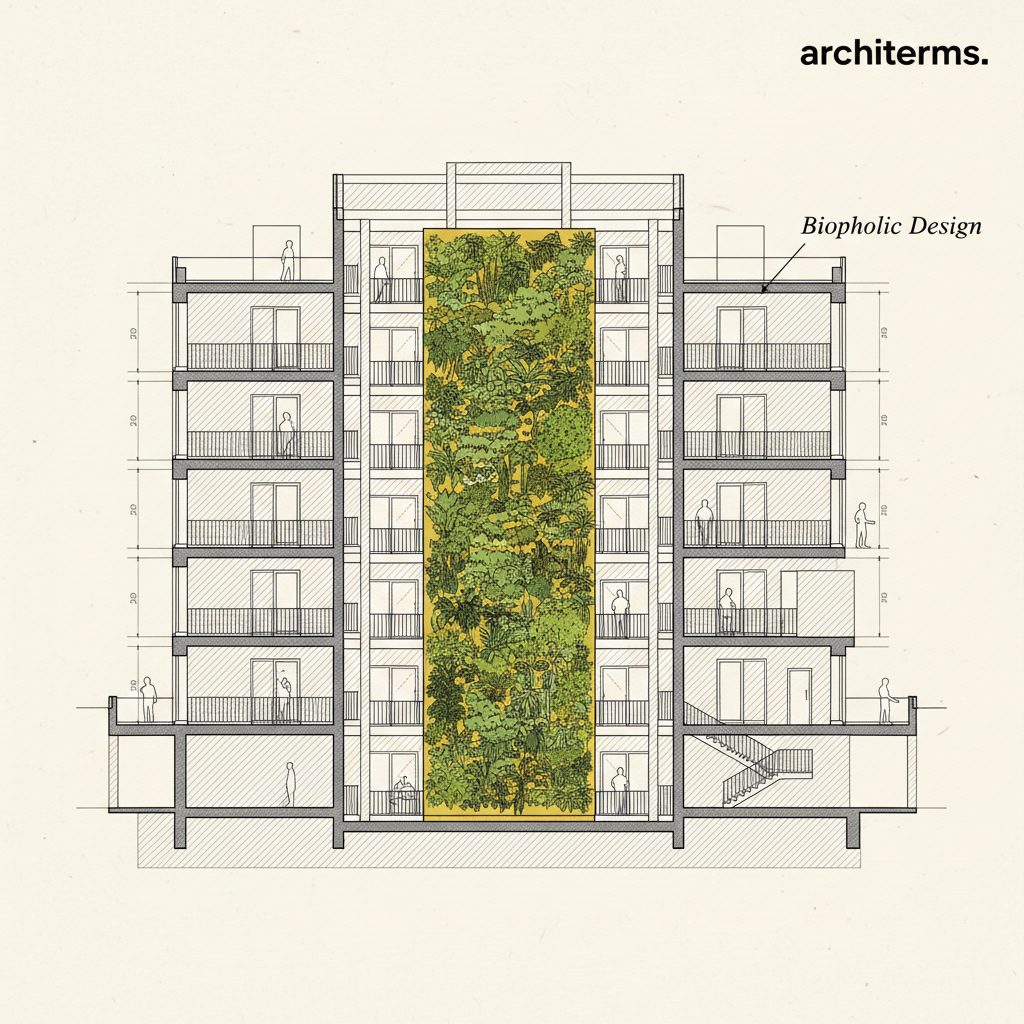
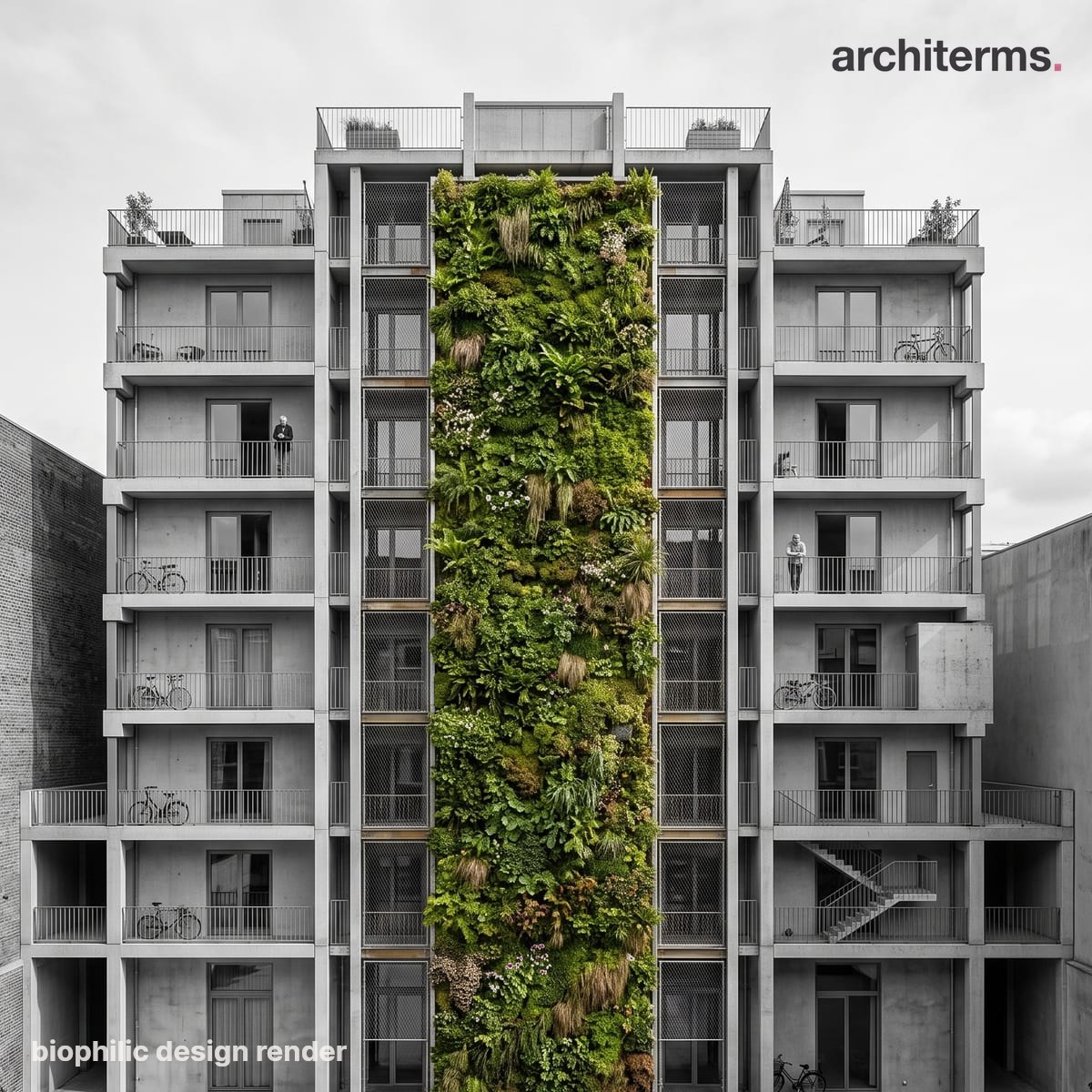
Biophilic design brings living plants, daylight, and natural materials indoors to answer the human pull toward nature. The green wall is not decoration alone: it cools the air, softens acoustics, and supports the well-being of the people working beside it.
Visualize your own Biophilic Design project with Reviz.Design
Definition
Definition Biophilic design is a strategy within architecture and interior design that intentionally integrates nature, natural systems, and natural analogues into the built environment to satisfy the human need for contact with the living world. The term combines "bio" (life) and "philia" (love or affinity), reflecting the biophilia hypothesis: the proposition that humans possess an evolved, partly genetic attraction to nature and natural processes. In practice, biophilic design encompasses direct experiences of nature (daylight, vegetation, water, fresh air), indirect experiences (natural materials, organic forms, naturalistic colors and imagery), and spatial conditions that evoke nature (prospect, refuge, mystery, and risk). It is most often categorized as part of sustainable and wellness-focused design because of its emphasis on environmental quality and human health.
Biophilic Design History The intellectual roots of biophilic design lie in the concept of biophilia, popularized by biologist Edward O. Wilson in his 1984 book of the same name, building on earlier use of the term by psychoanalyst Erich Fromm. Wilson argued that humanity's affinity for nature is rooted in evolutionary history. The translation of this hypothesis into a design framework gained momentum in the 1990s and 2000s through the work of researchers such as Stephen Kellert, who, with colleagues, articulated the dimensions and attributes that make a space biophilic. While the formal terminology is recent, the underlying impulse is ancient. Vernacular and traditional architecture across cultures frequently centered on nature: the courtyard houses of the Mediterranean and the Middle East organized rooms around planted, water-filled atriums; Japanese gardens and tea houses framed carefully composed views of moss, stone, and water; and the hanging gardens attributed to ancient Babylon illustrate a long-standing desire to bring greenery into dense settlements. The Romantic movement and the later Arts and Crafts movement also emphasized natural materials and organic ornament. Biophilic design, then, can be understood as the modern, research-supported formalization of design instincts that humans have expressed for millennia.
Biophilic Design in Architecture In contemporary architecture, biophilic design appears at every scale, from the detailing of a single room to the planning of entire districts. Common strategies include maximizing daylight through generous fenestration and a deliberate daylighting strategy, introducing living walls and green roofs, integrating interior planting and water features, and selecting tactile natural materials such as timber, stone, and clay. Designers also use natural geometries—fractal patterns, branching forms, and the curves found in plants and shells—to create visually nourishing surfaces. Notable built examples illustrate the range. Amazon's Spheres in Seattle enclose thousands of plant species within glazed domes as a workplace immersed in greenery. Singapore's WOHA-designed buildings, including hotels and the Parkroyal Collection, weave terraces, sky gardens, and cascading vegetation into high-rise structures. Bosco Verticale (Vertical Forest) in Milan, by Stefano Boeri, integrates hundreds of trees and shrubs onto residential balconies. At the urban scale, biophilic principles inform park networks, daylight-filled transit halls, and the careful framing of views toward water and landscape. Biophilic design frequently overlaps with passive design techniques, since natural ventilation, shading, and orientation toward sun and breeze serve both ecological performance and the human experience of nature. The approach is also commonly embedded within green building certification systems such as LEED and the WELL Building Standard, which reward access to daylight, views, and indoor greenery for their measurable effects on occupant comfort and health.
Common Confusion Biophilic design is often confused with simply "adding plants" to a space or with sustainable design as a whole, but it is narrower and more specific than the first and distinct from the second. Placing a few potted plants in a lobby is decoration; biophilic design is a systematic effort to satisfy human psychological and physiological needs through repeated, meaningful contact with natural elements, spatial qualities, and patterns. A second point of confusion is between biophilic design and sustainability or green architecture. Sustainability primarily concerns reducing environmental impact—energy use, embodied carbon, water consumption, and waste. Biophilic design concerns the human experience of nature within a building. The two frequently reinforce each other, since features like operable windows and vegetated roofs deliver both ecological and experiential benefits, yet a building can be highly energy-efficient without being biophilic, and vice versa. A third confusion arises with organic architecture, associated with Frank Lloyd Wright and others, which seeks harmony between buildings and their sites and often uses natural forms; organic architecture is a stylistic and philosophical tradition, while biophilic design is an evidence-based framework grounded in environmental psychology and measurable wellness outcomes. Finally, biomimicry is sometimes used interchangeably with biophilic design, but they differ: biomimicry imitates nature's strategies and structures to solve technical problems, whereas biophilic design seeks to connect occupants emotionally and sensorially with nature. Understanding these distinctions helps designers apply the principles deliberately rather than treating natural references as superficial styling.
Frequently Asked Questions
What are the main principles of biophilic design?
The core principles include direct experiences of nature such as daylight, water, plants, and fresh air; indirect experiences through natural materials, colors, and organic forms; and spatial qualities like prospect, refuge, and mystery. Together these aim to satisfy humans' innate affinity for nature and improve well-being.
What is the difference between biophilic design and sustainable design?
Sustainable design focuses on reducing a building's environmental impact, including energy use, carbon, and water consumption. Biophilic design focuses on the human experience of nature within a space. The two often overlap but are not the same, since a building can be energy-efficient without being biophilic.
Does biophilic design actually improve health?
Research in environmental psychology suggests that access to daylight, views of nature, and indoor greenery can reduce stress, improve mood, and support concentration and recovery. These findings are why standards such as the WELL Building Standard reward biophilic features in offices, schools, and healthcare settings.