Stucco.
Stucco is a plaster applied wet to the outside of a building, where it cures into a hard, continuous, weather-resisting skin. In plain terms: it is an exterior render of lime or cement, spread in coats over masonry or over lath, that hardens into something close to an artificial stone.
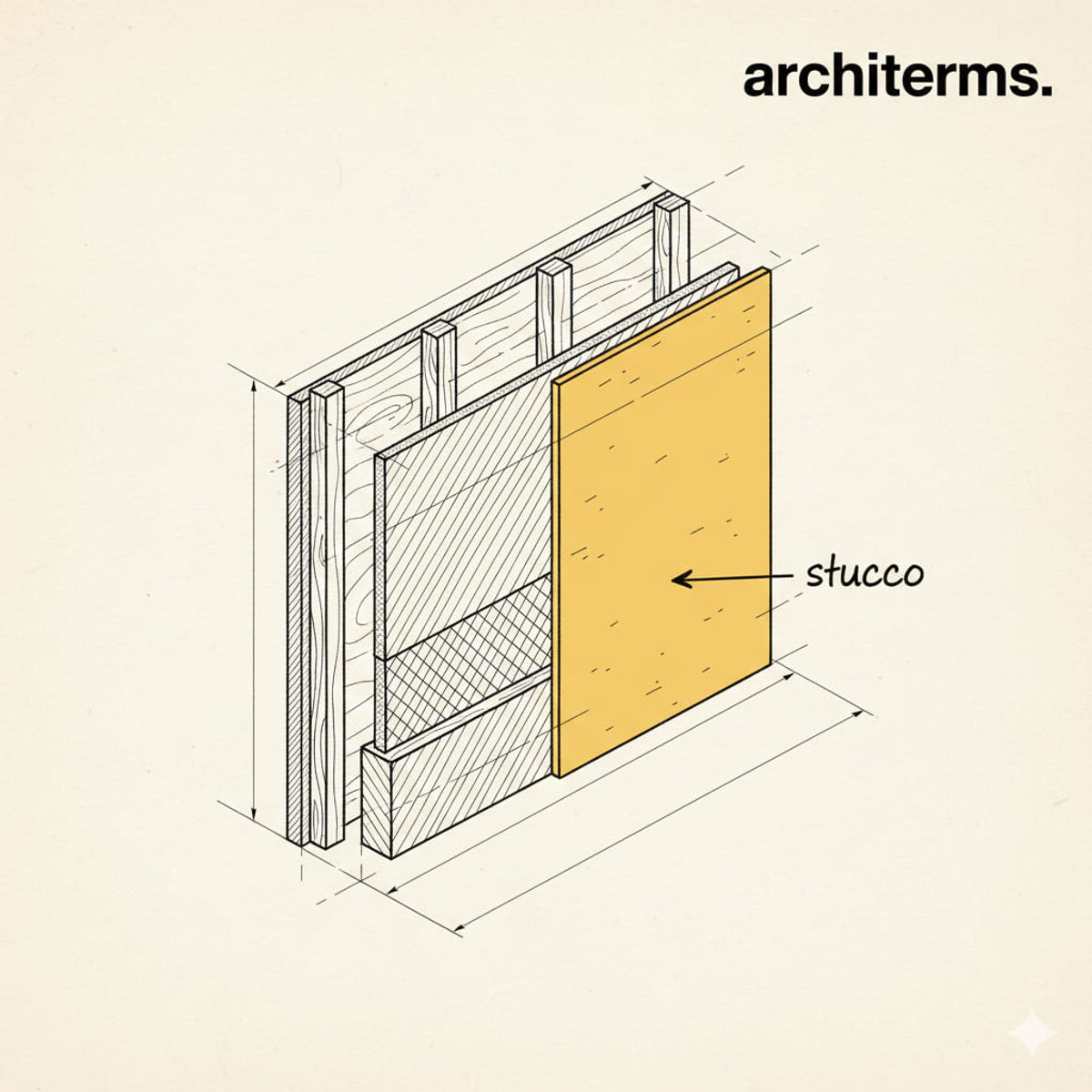
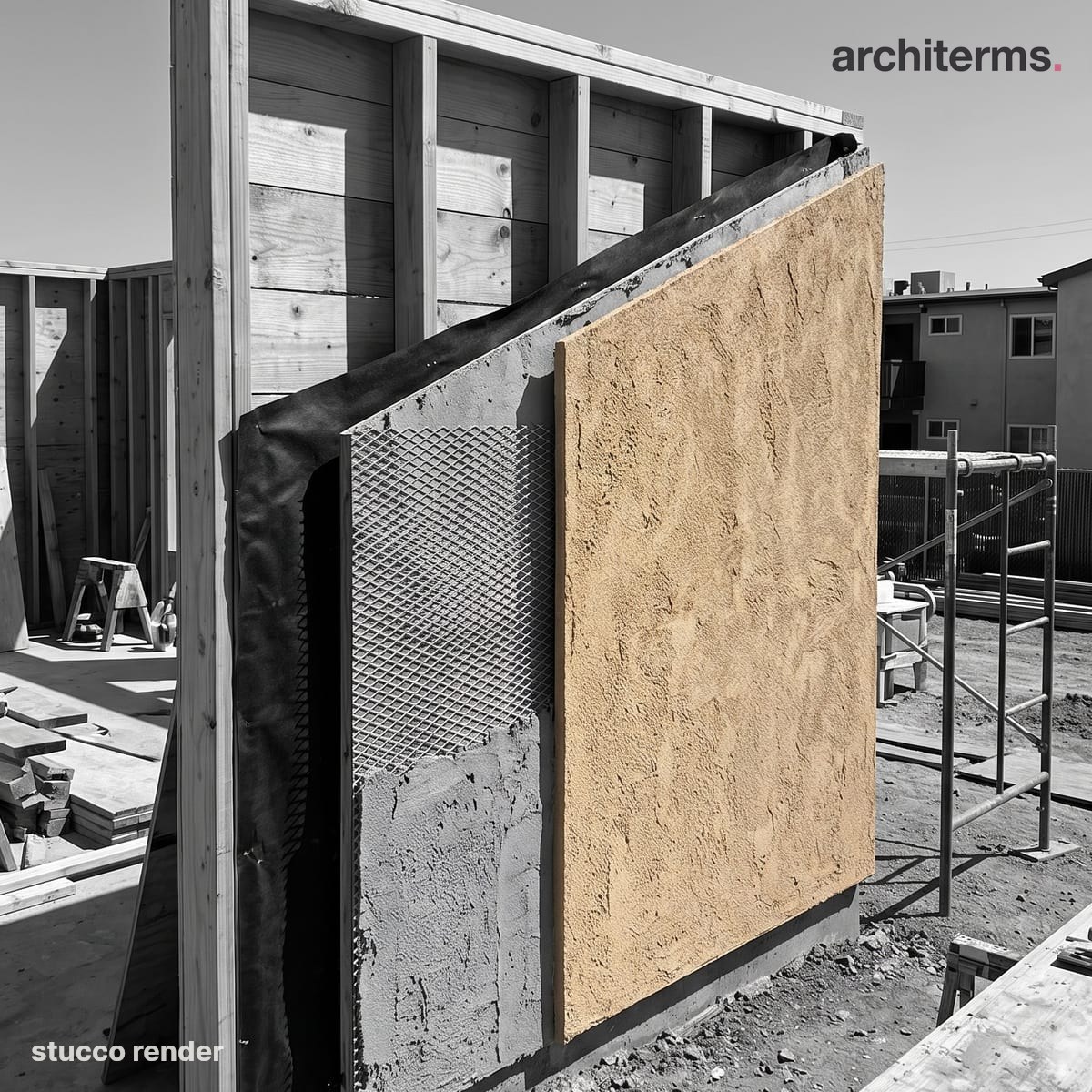
Stucco is built up in layers: a scratch and brown coat pressed into metal lath over a weather-resistant membrane, then a finish coat spread on top. As it cures it hardens into a continuous, stone-like skin that sheds water off the wall.
Rendered with Reviz.Design — AI visualization for architects and interior designers
Definition
Stucco is a plaster applied wet to the outside of a building, where it hardens into a continuous, weather-resisting skin. It is one of the oldest wall finishes still in everyday use: a binder, sand and water, mixed to a paste, spread in thin coats over masonry or over a lath fixed to a frame, and left to cure into something close to an artificial stone.
Because it goes on as a paste, stucco takes the shape of whatever it covers. It can be floated dead flat, combed into a texture, thrown on as a rough dash, or modelled into panels and mouldings. That plasticity is why the same material serves a whitewashed Mediterranean farmhouse and a streamlined Art Deco cinema, and why a rendered facade can read as either handmade or machine-smooth.
What varies most from one stucco to another is the binder. Traditional work is lime-based: soft, vapour-permeable and slow to set. Modern work is usually cement-based: harder, faster and much less forgiving of movement. The two weather so differently that treating an old lime render as if it were a modern cement one is the commonest cause of failure.
Stucco is an exterior render made from a binder, an aggregate and water, applied plastically in successive coats and cured into a hard, continuous surface. The binder is lime, Portland cement, or a blend of the two; the aggregate is usually a well-graded sand; and the water is what allows the mix to be worked with a trowel rather than laid as units.
Conventional work is built up in three coats. The scratch coat keys to the background and is combed while green so the next coat can grip. The brown coat brings the surface up to a true plane and does most of the levelling. The finish coat, only a few millimetres thick, carries the colour and the texture. Together they come to roughly 20 to 25 millimetres over masonry, and a little more over lath.
The background matters as much as the mix. Over brick, block or stone the render can bond directly, provided the surface is sound and suitably absorbent. Over a timber or steel frame it needs metal lath and, in modern practice, a drainage plane and a weather-resistant barrier behind that lath, so any water reaching the back of the render can escape. Confusingly, in Italian usage the same word also covers fine modelled interior plasterwork, which is why museum catalogues describe ceiling reliefs as stucco.
Stucco History
Lime render is ancient. Neolithic builders in the Levant coated walls and floors in lime plaster, and by the Roman period the technique was mature: Vitruvius describes a multi-coat lime and marble-dust render polished to a stone-like sheen, and Roman decorators modelled the same material into relief panels that survive at Pompeii and Herculaneum.
Renaissance and Baroque Italy revived that decorative tradition, and the stuccatori became a specialised trade, working lime and gypsum into figures, cartouches and ceiling frames. In parallel, plain lime render remained the ordinary wall finish across the Mediterranean and the Islamic world, valued because it could be made from local materials, reflected heat, and could be renewed each year with a fresh coat of limewash.
Spanish builders carried the technique to the Americas, where it merged with adobe construction. That hybrid was reinterpreted in the early twentieth century as the Mission and Spanish Colonial Revival styles, which made rendered walls a default finish across California, Florida and the American Southwest.
The material itself changed in the nineteenth century, when Portland cement became widely available. Cement-rich renders set fast, gained strength quickly and tolerated damp backgrounds, and by the middle of the twentieth century they had largely displaced lime in new work. Metal lath replaced riven timber lath, control joints were introduced to manage shrinkage, and from the 1970s synthetic systems arrived in which a thin polymer coat is applied over insulation board rather than over masonry. Conservation practice has since swung partly back: repair of historic lime render is now governed by detailed technical preservation guidance that warns against patching soft lime work with hard cement.
Stucco in Architecture
For a designer, stucco is less a product than a way of treating a wall as a single continuous surface:
- —One unbroken skin: Because a render has no joints, it reads as a monolithic plane. Openings can be cut anywhere without a coursing pattern to respect, and reveals, arrises and returns can be shaped rather than assembled.
- —Texture and light: The finish coat decides how the wall behaves in sunlight. A smooth trowelled finish reads as flat and shadowless; a sand float finish gives a fine, even grain; a dash or roughcast throws hard shadows and conceals both dirt and unevenness.
- —Colour: Lime renders are usually finished with limewash, which sinks in and weathers by chalking rather than peeling. Cement renders are either painted or made with pigmented finish coats, so that a chip does not expose a different colour underneath.
- —Movement: Render is strong in compression and weak in tension, so it cracks wherever its background moves. Designers control that with movement joints at storey heights and panel edges, by limiting panel areas, and by making sure the coating is never carried rigidly across a structural break. Where the wall is built as a cavity wall, the render belongs to the outer leaf alone and must not bridge the gap at openings.
- —Maintenance: A sound render lasts for generations, but only while water is kept out of the back of it. Blocked gutters, failed sealant at openings, and hard impermeable coatings applied over soft lime are the three routine causes of decay.
Common confusion
Stucco vs plaster: In English-language practice these words divide by location rather than by chemistry. Plaster is the internal finish, usually gypsum-based today; stucco is the external one, lime- or cement-based and formulated to take rain, frost and sun. The same lime mix could serve both, but a gypsum plaster placed outside will not survive a winter.
Stucco vs render: These are the same thing under different names. British and Australian practice says render; American practice says stucco. Specifications can therefore describe identical work in different vocabulary, and a drawing note reading cement render should be read as cement stucco.
Stucco vs EIFS: An exterior insulation and finish system looks similar from the street but is a different construction. It is a thin polymer-modified coat, often only a few millimetres thick, applied over a reinforcing mesh on rigid insulation board. Traditional work is thick, mineral, and bonded to a solid or lathed background. Tapping is the quickest check: a synthetic system sounds hollow and dents under thumb pressure, while true stucco sounds solid.
Stucco vs brick veneer: Both are non-structural facings carried by a backing wall, but one is applied wet and the other laid dry. The masonry facing arrives as units with mortar joints and a defined coursing; stucco arrives in a bucket and cures into a seamless plane. That is why a crack in a render counts as a defect, whereas a joint in brickwork is part of the design.
Frequently Asked Questions
What is stucco made of?
Stucco is a mix of a binder, an aggregate and water. The binder is lime, Portland cement, or a blend of the two, and the aggregate is normally a well-graded sand. Water makes the mix workable so it can be trowelled on in coats rather than laid as units, after which it cures into a hard mineral surface.
What is the difference between stucco and render?
There is no material difference; the words are regional. American practice calls the external coating stucco, while British and Australian practice calls it render. A specification reading cement render describes exactly the same work as one reading cement stucco, so the vocabulary matters only when reading drawings from another market.
How many coats does stucco need?
Traditional work uses three. The scratch coat keys to the background and is combed while still green, the brown coat levels the surface to a true plane, and the thin finish coat carries the colour and texture. Over masonry the three together come to roughly 20 to 25 millimetres, and slightly more over metal lath.
Why does stucco crack?
Render is strong in compression but weak in tension, so it cracks whenever the wall behind it moves. Shrinkage as the mix cures, thermal movement, settlement, and rigid coatings carried across a structural break are the usual causes. Movement joints and limited panel sizes are the standard defences.
Can cement stucco be used to repair a historic lime wall?
It is generally a mistake. Cement is harder and far less permeable than lime, so it traps moisture in the wall and forces water and salts out through the softer original material, which then decays around the patch. Conservation guidance recommends repairing lime render with a compatible lime mix.