Brutalism.
Brutalism is an architectural movement that emphasizes bold, massive concrete forms, honest material expression, and sculptural massing, typically featuring raw, unfinished surfaces and monumental geometric volumes. Emerging in the 1950s, it prioritizes structural clarity and social purpose over ornament, creating buildings that read as unified sculptural objects.
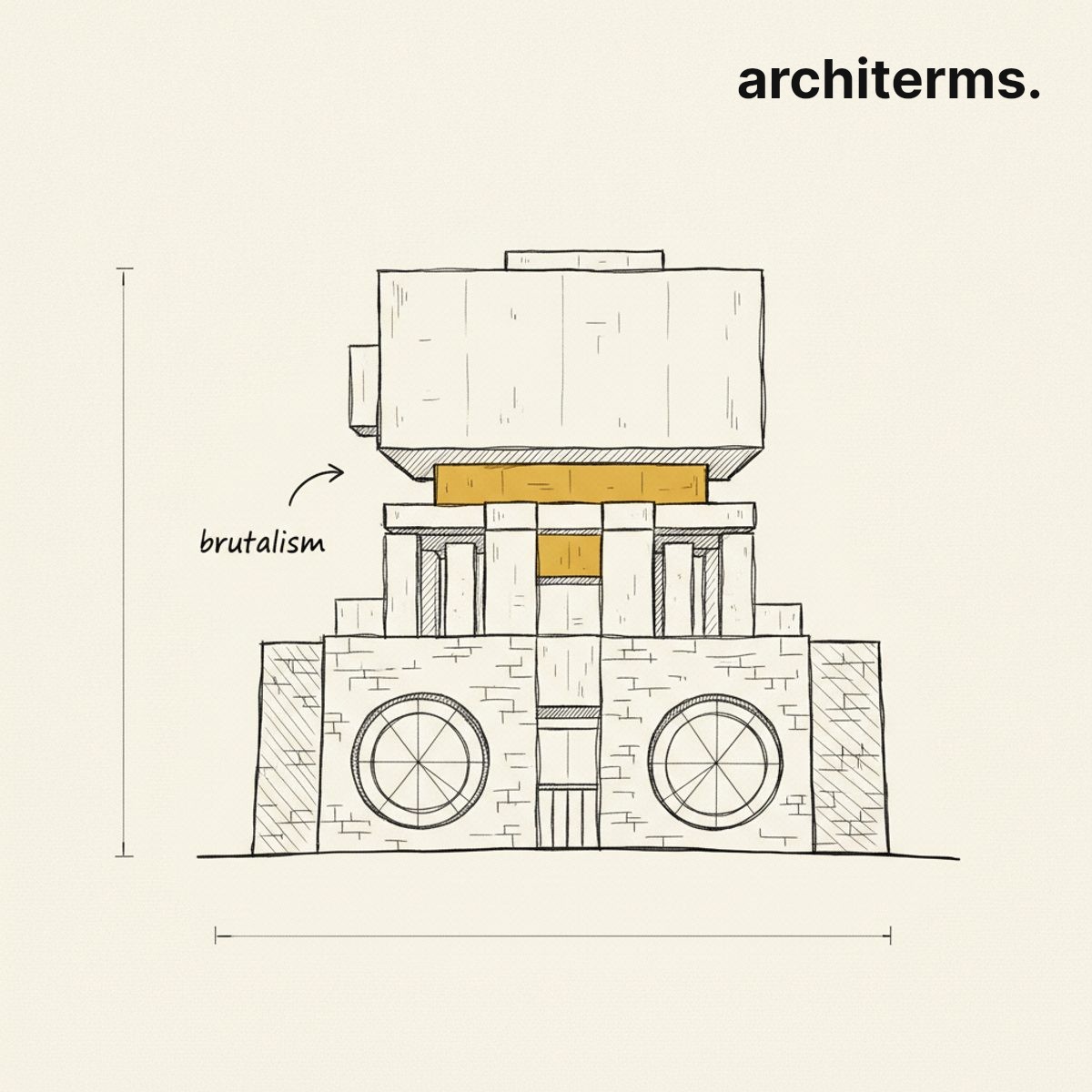
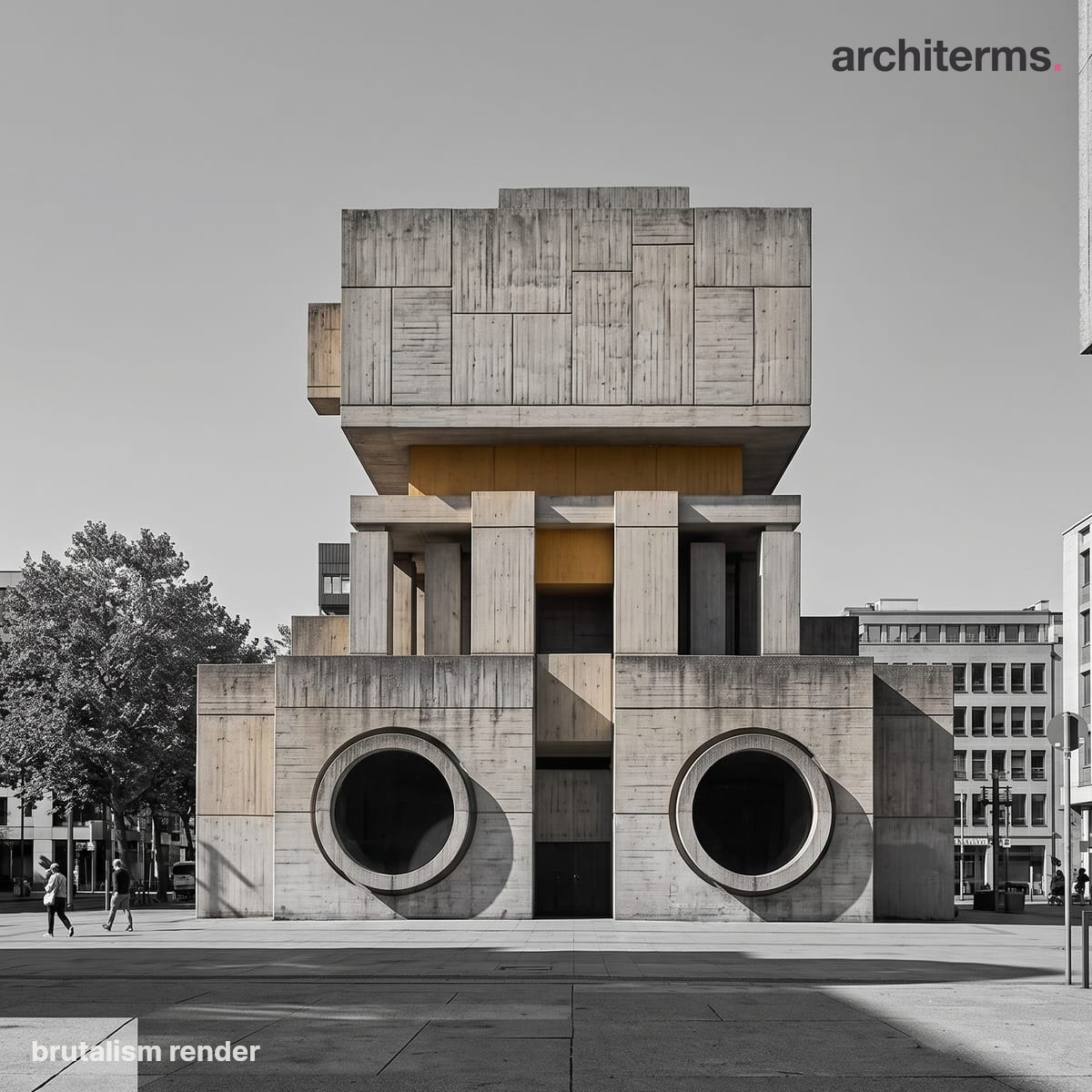
Brutalism leaves its concrete unfinished, so the board-marks of the formwork stay visible on the surface and the material declares itself. The heavy volumes are massed as a single sculptural object, structure and form reading as one rather than being hidden behind cladding or ornament.
Made with Reviz.Design — AI visualization for architects and interior designers
Definition
Brutalism is a distinctive architectural language built on the celebration of raw concrete, geometric form, and structural expression. *The movement emerged from modernist principles but departed from sleek International Style aesthetics by embracing heaviness, texture, and dramatic spatial drama. Rather than hiding structure or finishing surfaces to a polish, Brutalist architects revealed concrete as-cast, exaggerated massing into sculptural volumes, and designed buildings as monolithic objects that command their landscape—a radical shift that made Brutalism simultaneously celebrated as visionary and criticized as inhuman.*
The term "Brutalism" is derived from the French "béton brut," meaning raw concrete. Architecturally, Brutalism is defined by several core characteristics: (1) prominent use of load-bearing concrete (often in-situ cast), (2) bold, blocky massing organized around clear geometric forms, (3) frank expression of structure and joints as design elements, (4) sculptural, monumental presence that reads as unified object rather than a collection of parts, (5) minimal applied ornament or finish, and (6) often, a social or civic purpose. The concrete is typically left unfinished—board-marked, weathered, or with aggregate exposed—creating strong texture and material honesty. Brutalist buildings often feature dramatic cantilevers, deep recesses, and volumetric voids that emphasize mass and shadow.
Brutalism History
Brutalism emerged in the mid-1950s, crystallizing from several convergent influences. The post-World War II context called for rapid, economical building of housing, schools, and civic infrastructure. Concrete was abundant, moldable, and could be cast quickly on site. Simultaneously, the success of Le Corbusier's Unité d'Habitation (Marseille, 1952)—a massive, assertive concrete structure raised on pilotis—demonstrated that concrete could be monumental and sculptural, not merely utilitarian. In Britain, architects like Alison and Peter Smithson, James Stirling, and Denys Lasdun developed Brutalism as a critique of refined modernism: they believed that honest expression of materials and function, combined with bold social ambition, could create architecture of greater moral force than the glass and steel aesthetic of the International Style.
During the 1960s and 1970s, Brutalism became the dominant language for public institutions across North America and Europe. Universities, libraries, courts, government offices, and housing schemes adopted Brutalist forms because the style conveyed permanence, solidity, and democratic purpose. The Boston City Hall (1968, Kallmann McKinnell & Knowles) and the Barbican Estate (1965–1982, London) became iconic statements of Brutalist ambition—monumental, complex, uncompromising.
By the 1980s, however, taste shifted. Postmodernism critiqued modernism's austerity; developers favored lighter materials and warmer finishes; and maintenance issues (water leakage, concrete spalling, weathering) exposed vulnerabilities in brutalist construction. Brutalist buildings fell out of fashion, were neglected, demolished, or covered with cladding to hide their raw concrete. Only in the 2010s did a critical reappraisal begin—younger architects, photographers, and preservationists rediscovered Brutalism's intellectual rigor and sculptural power, leading to a contemporary renaissance in appreciation and, in some cases, restoration.
Brutalism in Architecture
Brutalist architecture takes several recurring formal approaches:
- —Massive concrete blocks and towers: stacked, cantilevered, or interlocked to create sculptural compositions. The Habitat 67 in Montreal (Moshe Safdie, 1967) stacks concrete modules into a cascading form; the Barbican stacks concrete boxes into a dense village-like precinct.
- —Fortress-like facade: deep recesses, narrow openings, or vertical ribbing created by board-marked concrete create strong shadow and texture. This strategy was common in libraries and government buildings designed to project stability and authority.
- —Raised on pilotis: the Corbusian gesture of lifting the building on concrete columns to expose ground level and create flowing public space below. Used extensively in housing and institutional blocks.
- —Volumetric voids and courtyards: rather than fenestrating walls, Brutalist architects often carved huge voids, recesses, and internal courtyards into the building mass, creating dramatic spatial drama. The Habitat 67 and the Barbican are organized around interconnected courts and passages.
- —Sculptural spatial sequences: long corridors, dramatic stairs, and megastructural organizers (spines, bridges, ramps) that guide movement through complex, often labyrinthine interior environments.
Material expression is central to Brutalist intent. Concrete is left as-cast, revealing board marks, aggregate, and joints as design features rather than flaws. Many Brutalist buildings feature aggregate exposure—washing or grinding the concrete surface to reveal the stone chips embedded within, adding color and texture. Brutalist architects also emphasized in-situ casting (pouring concrete on site in custom formwork) rather than prefabrication, because bespoke formwork allowed sculptural variation and site-specific design.
Key structural systems in Brutalism include the moment frame (allowing deep cantilevers and open plans) and shear walls that are themselves expressed as sculptural planes. Materials are often limited: concrete, steel (visible and expressed), occasionally brick or board-marked surfaces, and minimal applied finish. This austerity is intentional—the building's power comes from form and material honesty, not applied ornament.
Notable Brutalist examples span many building types:
- —Housing: Habitat 67 (Montreal); Barbican Estate (London); Park Hill (Sheffield); Pinnacle Point (Johannesburg).
- —Civic and institutional: Boston City Hall; Robson Square (Vancouver); the Hirshhorn Museum (Washington, DC); Salk Institute (La Jolla); Brutalist libraries and university buildings across North America and Europe (e.g., Yale Art and Architecture Building, Paul Rudolph, 1963).
- —Cultural: the Barbican Centre (London); the Hayward Gallery and Queen Elizabeth Hall (London); the Metropolitan Cathedral of Liverpool.
- —Government and law: the Palace of Justice in Chandigarh (Le Corbusier); courts and municipal offices across North America.
Brutalism was adopted globally—from the Soviet Union (where it aligned with state monumentalism) to Latin America, Africa, and Asia. In each context, local architects adapted Brutalist vocabulary to climate, materials, and cultural expectations, creating a surprisingly diverse family of works sharing core principles of honesty, monumentality, and social purpose.
Types of Brutalism
Brutalism is not monolithic. Several subtypes and regional variations emerged:
- —High-tech Brutalism: combines raw concrete with visible mechanical systems, exposed ductwork, and skeletal steel. Architecture of architects like Cedric Price and early High-Tech movement (e.g., the Pompidou Centre, though arguably Brutalism's heir rather than Brutalism proper).
- —Corbusian Brutalism: directly inspired by Le Corbusier's work, featuring pilotis, brise-soleils, sculptural massing, and social housing intention. Widespread in the 1960s-70s.
- —Smithsons' Brutalism: developed by Alison and Peter Smithson, emphasizing circulation, spatial organization, and human scale within monumental form. Their Robin Hood Gardens (London, 1972) exemplified integrated community design.
- —Metabolism-influenced Brutalism: in Japan, architects like Kenzo Tange and Kisho Kurokawa applied Brutalist concrete language to megastructure and growth principles, creating organic, evolving urban forms.
- —Brutalist Regionalism: architects worldwide adapted Brutalism to local climate and materials. In Scandinavia, Brutalist forms were softened with wood; in Africa and Latin America, Brutalism merged with vernacular building traditions.
Brutalism vs. Modernism
All Brutalist buildings are modernist in philosophy, but not all modernist buildings are Brutalist. Modernism is a broad movement emphasizing form following function, honest materials, and rejection of applied ornament. The International Style—the refined, minimalist variant of modernism featuring glass, steel, and sleek surfaces—coexisted with Brutalism but represented a different aesthetic and intention. Where the International Style aimed for elegance and transparency, Brutalism pursued monumentality and sculptural power. Where the International Style often hid structure behind glass, Brutalism celebrated it. Both rejected ornamentation, but Brutalism's embrace of raw, weathered texture is itself ornamental in effect, whereas the International Style sought pristine finishes.
Common confusion
Brutalism vs. Concrete Modernism: Not all concrete buildings are Brutalist. Many modernist buildings use concrete functionally but finish it smoothly, clad it, or detail it carefully. Brutalism specifically celebrates the concrete as an expressive, sculptural material and often leaves it rough or weathered.
Brutalism vs. Brutalist Revival: Contemporary architects (David Chipperfield, OMA, Atelier Peter Zumthor, and others) often use massive concrete forms inspired by Brutalism but with refined details, careful finishing, and less monumental intention. This is sometimes called "soft Brutalism" or post-Brutalism—it borrows Brutalist vocabulary without the full commitment to structural expression and social purpose.
Brutalism vs. Deconstructivism: Both movements reject classical proportion and symmetry. However, Deconstructivism (1980s–90s) fragmented and layered forms to suggest instability and complexity; Brutalism unified masses into coherent, even monumental, sculptural wholes. Deconstructivism was partly a reaction against Brutalism's perceived authoritarianism.
Brutalism vs. Metabolism: Metabolism, a Japanese movement of the 1960s–70s, shared Brutalism's love of bold concrete and megastructure but emphasized growth, change, and organic metaphor. Metabolist buildings are often more visibly complex and dynamic than Brutalist ones, which tend toward unified, static massing.
Why Brutalism Fell Out of Favor
By the 1980s, several factors diminished Brutalism's cultural cachet. (1) Practical issues: Concrete deteriorates without careful maintenance; water infiltration, corrosion of embedded steel, and spalling plague exposed concrete surfaces. Many Brutalist buildings were poorly maintained, and their weathered appearance came to read as deterioration rather than noble patina. (2) Aesthetic fatigue: after two decades of monumental gray concrete, architects and the public craved warmer materials, colors, and ornament. Postmodernism attacked modernism's austerity. (3) Urban reputation: large-scale Brutalist housing and civic projects, when poorly managed or economically abandoned, became associated with urban decline and social dysfunction—an unfair but powerful narrative. (4) Constructability and cost: by the 1980s, curtain-wall technology and precast systems offered faster, cheaper construction with less labor-intensive in-situ casting.
Contemporary Relevance
Since roughly 2010, Brutalism has experienced a critical and cultural renaissance. Factors include: (1) the work of preservation and documentation by photographers and historians (e.g., Brutalist Architecture, 2014; Concrete Dreams, 2015), (2) renewed interest in materiality and tectonics in contemporary architecture, (3) a growing appreciation for Brutalism's social and democratic ideals, and (4) recognition of Brutalism as historically significant modern heritage deserving protection and celebration rather than demolition.
Contemporary architects now engage Brutalism in several ways. Some directly restore and reuse iconic Brutalist buildings (e.g., the Barbican's ongoing conservation, the Salk Institute's maintenance). Others use Brutalist language in new work but refine detailing—what critics call "critical regionalism" or "material modernism." Still others critically quote Brutalist forms to challenge assumptions about progress and aesthetics, as in some works by David Chipperfield, Peter Zumthor, and the Japanese architects Tadao Ando and Shigeru Ban (whose work shares Brutalism's material honesty if not its monumentality).
The Architerms architecture glossary includes entries on many Brutalist concepts: cantilever, moment frame, load-bearing wall, pilotis, section drawings, and massing all describe tools and principles central to Brutalist design. Understanding Brutalism today requires grasping its roots in structural modernism, its social ambitions, and its material vocabulary.
Frequently Asked Questions
What is Brutalism in architecture?
Brutalism is an architectural movement that emphasizes bold, massive concrete forms, honest material expression, and sculptural massing. It emerged in the 1950s and features raw, unfinished concrete surfaces, bold geometric volumes, and a focus on structural clarity over applied ornament. Brutalist buildings often read as monolithic sculptural objects designed to convey permanence and social purpose.
What is the difference between Brutalism and International Style modernism?
Both are modernist movements rejecting ornament and emphasizing honest materials, but they differ aesthetically and philosophically. The International Style favors glass, steel, and sleek finishes with an aim toward elegance and transparency. Brutalism celebrates raw concrete, bold massing, and sculptural expression, prioritizing monumentality and material honesty over refinement. Where the International Style often hides structure, Brutalism exposes and celebrates it.
Where did Brutalism originate and why did it emerge?
Brutalism emerged in the 1950s, influenced by Le Corbusier's raw concrete Unité d'Habitation and post-World War II needs for rapid, economical construction. British architects like the Smithsons developed it as a critique of refined modernism, believing that honest material expression and bold social purpose could create architecture of greater moral force. Concrete was abundant, moldable, and ideally suited to both sculptural form and urgent housing and civic projects.
Why did Brutalism fall out of favor by the 1980s?
Brutalism declined due to practical, aesthetic, and social factors. Concrete deteriorates without maintenance, and water damage became commonplace, making buildings appear neglected rather than noble. Postmodernism attacked modernism's austerity, and the public craved warmer materials and colors. Large-scale Brutalist housing projects, when poorly managed, became associated with urban decay, damaging the movement's reputation despite the architecture's inherent quality.
Is Brutalism making a comeback in contemporary architecture?
Yes. Since around 2010, Brutalism has undergone a critical and cultural renaissance. Preservation efforts, photography books, and historical scholarship have rehabilitated its reputation. Contemporary architects engage Brutalist principles through restoration of iconic buildings, refined new works using bold concrete forms, and renewed appreciation for its social ideals and material honesty. Younger architects see Brutalism as historically significant modern heritage and a source of design intelligence.