Symmetry.
Symmetry is the balanced, mirrored arrangement of architectural elements around a central axis or point. In plain terms: it's when one side of a building reflects the other, creating order, calm, and a sense of formality.
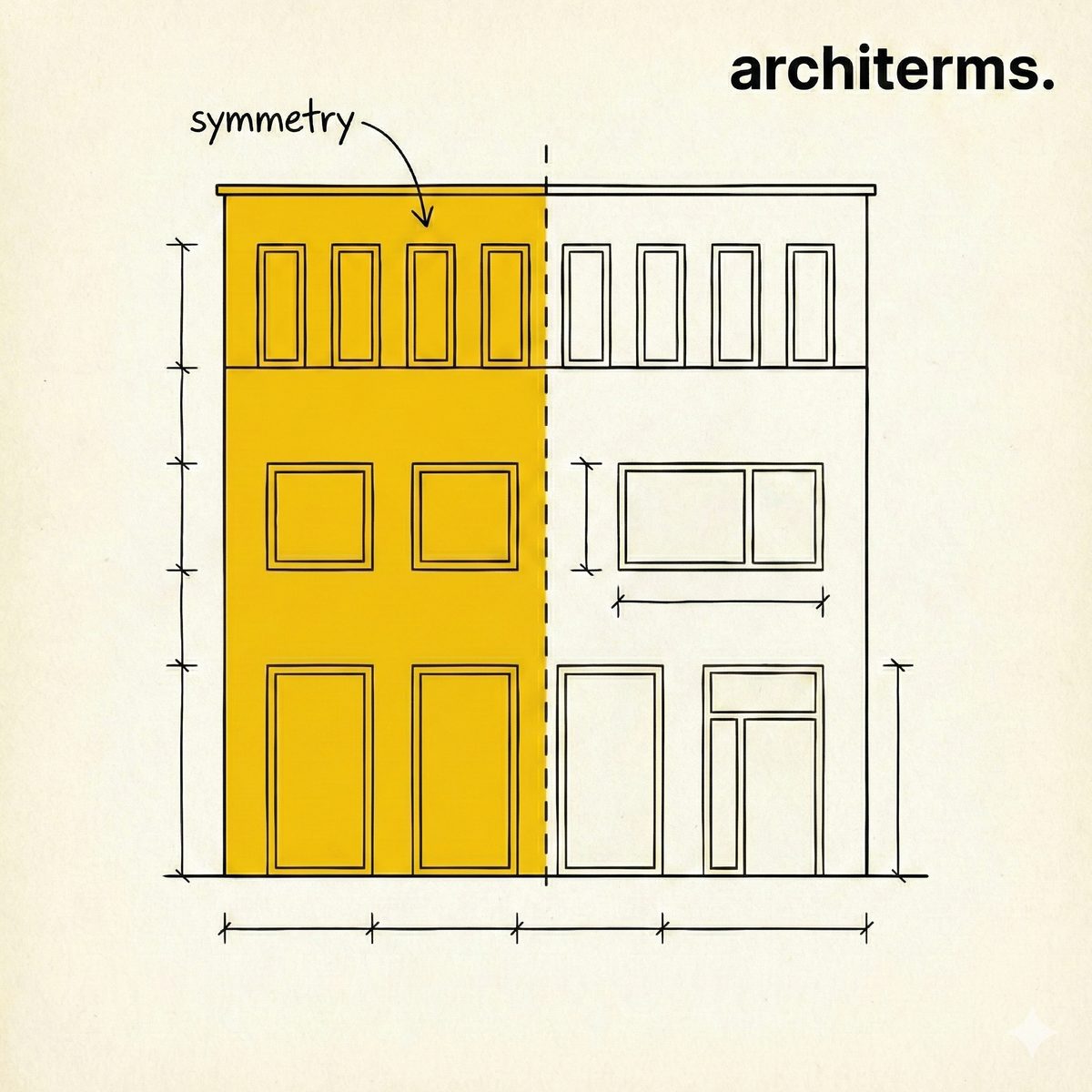
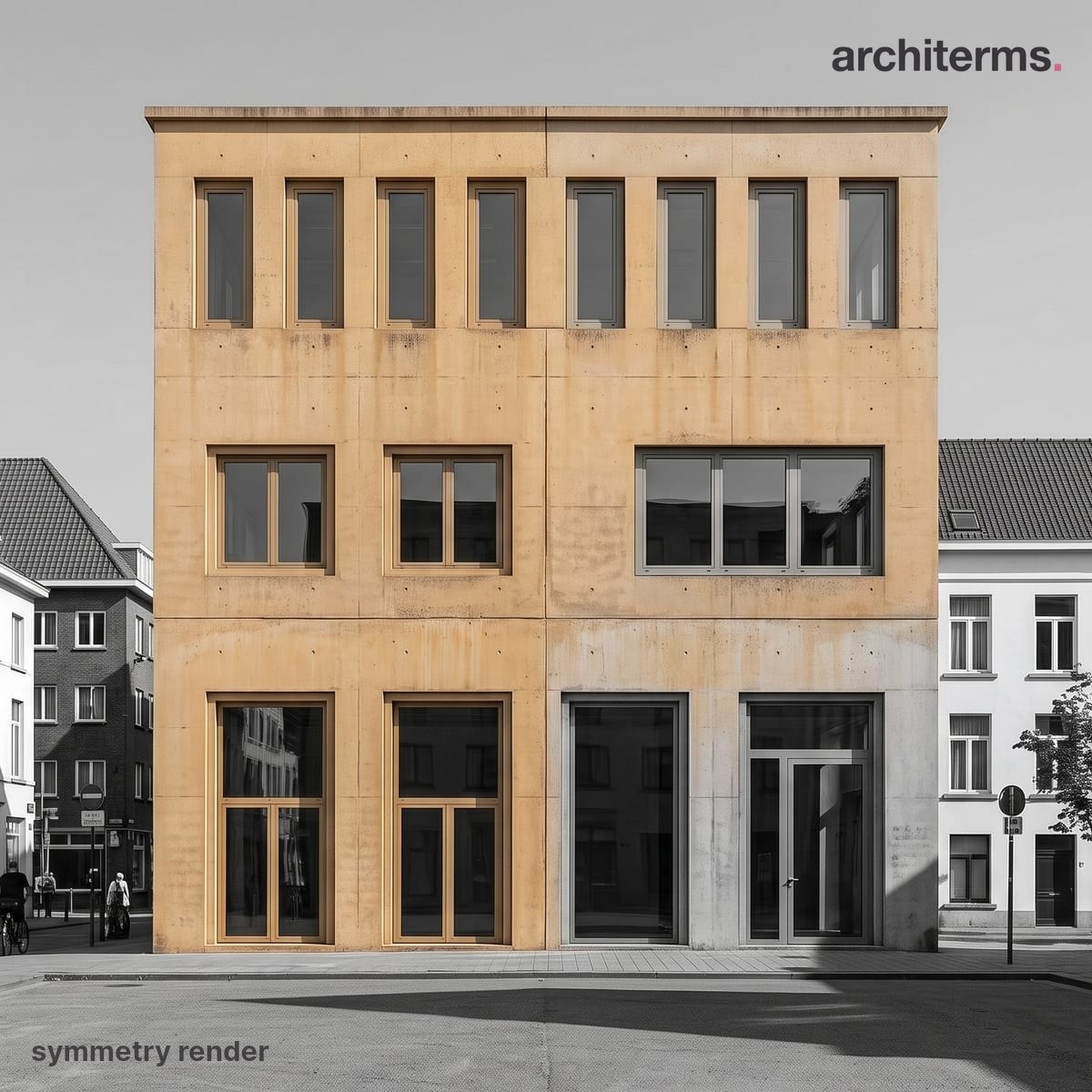
Symmetry orders a facade around a central axis: here the eight narrow top-floor windows sit in matched ranks of four either side of the centre joint. Lower down the mirror relaxes, which is why the frontage reads as formal without turning rigid.
Rendered with Reviz.Design — AI visualization for architects and interior designers
Definition
Symmetry is the most immediately recognizable ordering principle in architecture: the balanced arrangement of parts so that one side mirrors the other across an axis. A symmetrical facade — with a central door and matching windows stepping out evenly on each side — reads instantly as ordered, formal, and stable. For thousands of years symmetry has been the default language of important buildings — temples, churches, palaces, and civic monuments — because it signals dignity and control.
The most common kind is bilateral or mirror symmetry, where a central axis divides the building into two equal halves. But architecture also uses rotational symmetry, around a point, as in a dome or a centralized plan, and translational symmetry, repetition along a line, which shades into rhythm. Symmetry is closely tied to the other ordering principles — proportion, scale, and balance — and modern architects often play against it deliberately, using asymmetry for tension and movement.
Symmetry is the correspondence of size, shape, and position of elements on opposite sides of a dividing line, plane, or point. In buildings it usually means bilateral symmetry about a central axis, where the left and right halves are mirror images. Symmetry creates visual balance and hierarchy, typically emphasizing a central entrance or feature, and it is one of the primary tools for giving a composition formal order.
Symmetry History
Symmetry runs through almost the whole history of monumental building. Egyptian temples marched symmetrically along a processional axis; Greek and Roman temples set matching colonnades around a central line; Renaissance architects prized perfectly symmetrical, centralized plans as an image of cosmic order. The Beaux-Arts tradition made axial symmetry the backbone of grand civic design. The decisive break came with modernism, when architects deliberately abandoned strict symmetry to express function and movement, making asymmetry a design choice in its own right.
Symmetry in Architecture
Symmetry is a powerful and direct tool of composition:
- —Signals formality and hierarchy: it centers the entrance and lends dignity to civic and religious buildings.
- —Comes in several kinds: bilateral (mirror), rotational (centralized), and translational (repetition along a line).
- —Is not the only route to balance: a composition can be visually balanced without being mirrored — asymmetrical balance.
- —Invites reaction: modern and contemporary architects use deliberate asymmetry to create dynamism and surprise.
Common confusion
- —Symmetry vs. balance: symmetry is one WAY to achieve balance — by mirroring. Balance can also be asymmetrical, distributing visual weight without a mirror image.
- —Symmetry vs. proportion: symmetry is about arrangement around an axis; proportion is about the ratio of sizes. A building can be symmetrical but poorly proportioned, or beautifully proportioned but asymmetrical.
- —Symmetry vs. rhythm: rhythm is repetition along a line; symmetry is mirroring across an axis, though repetition is itself a kind of translational symmetry.
- —Bilateral vs. radial symmetry: bilateral symmetry mirrors across a line; radial (rotational) symmetry repeats around a central point, as in a rotunda or dome.
Frequently Asked Questions
What is symmetry in architecture?
Symmetry is the balanced arrangement of elements so that one side of a building mirrors the other across a central axis or point. It creates visual order and formality, usually emphasizing a central entrance, and it is one of the main ordering principles of architectural composition.
What are the types of symmetry in architecture?
The main types are bilateral (or mirror) symmetry, where two halves reflect across a central axis; rotational (or radial) symmetry, where elements repeat around a central point, as in a dome or rotunda; and translational symmetry, where a unit repeats along a line, which overlaps with rhythm.
What is the difference between symmetry and balance?
Symmetry is one way to achieve balance, by mirroring elements across an axis. Balance is the broader idea of visual equilibrium, which can also be asymmetrical — distributing different elements so they feel evenly weighted without being mirror images.
Why is symmetry used in classical architecture?
Symmetry signals order, stability, and dignity, which is why temples, churches, palaces, and civic buildings have long used it. A symmetrical facade centers attention on the entrance and presents the building as formal and authoritative, qualities classical architecture deliberately sought.
Is asymmetry bad in architecture?
No. Asymmetry is a legitimate and powerful design choice, widely used in modern and contemporary architecture to express function, create movement, and add visual interest. A well-designed asymmetrical building is still balanced — it just achieves that balance without mirroring.