Swale.
A swale is a shallow, broad, gently sloping channel, usually planted with grass or other low vegetation, that carries rainwater slowly across a site while filtering it and letting part of it soak into the ground. In plain terms: it is a wide green dip in the land that drains water without a pipe.
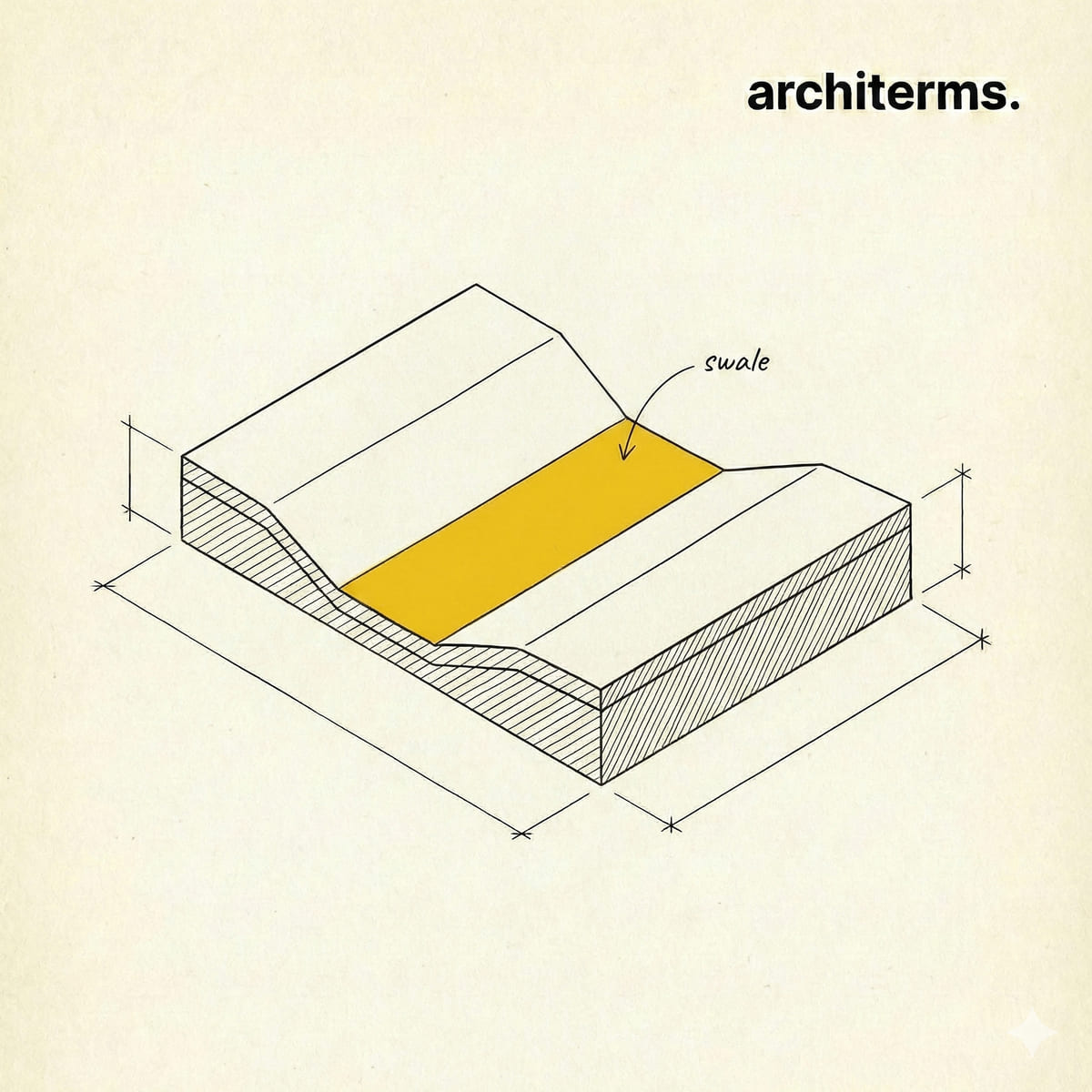
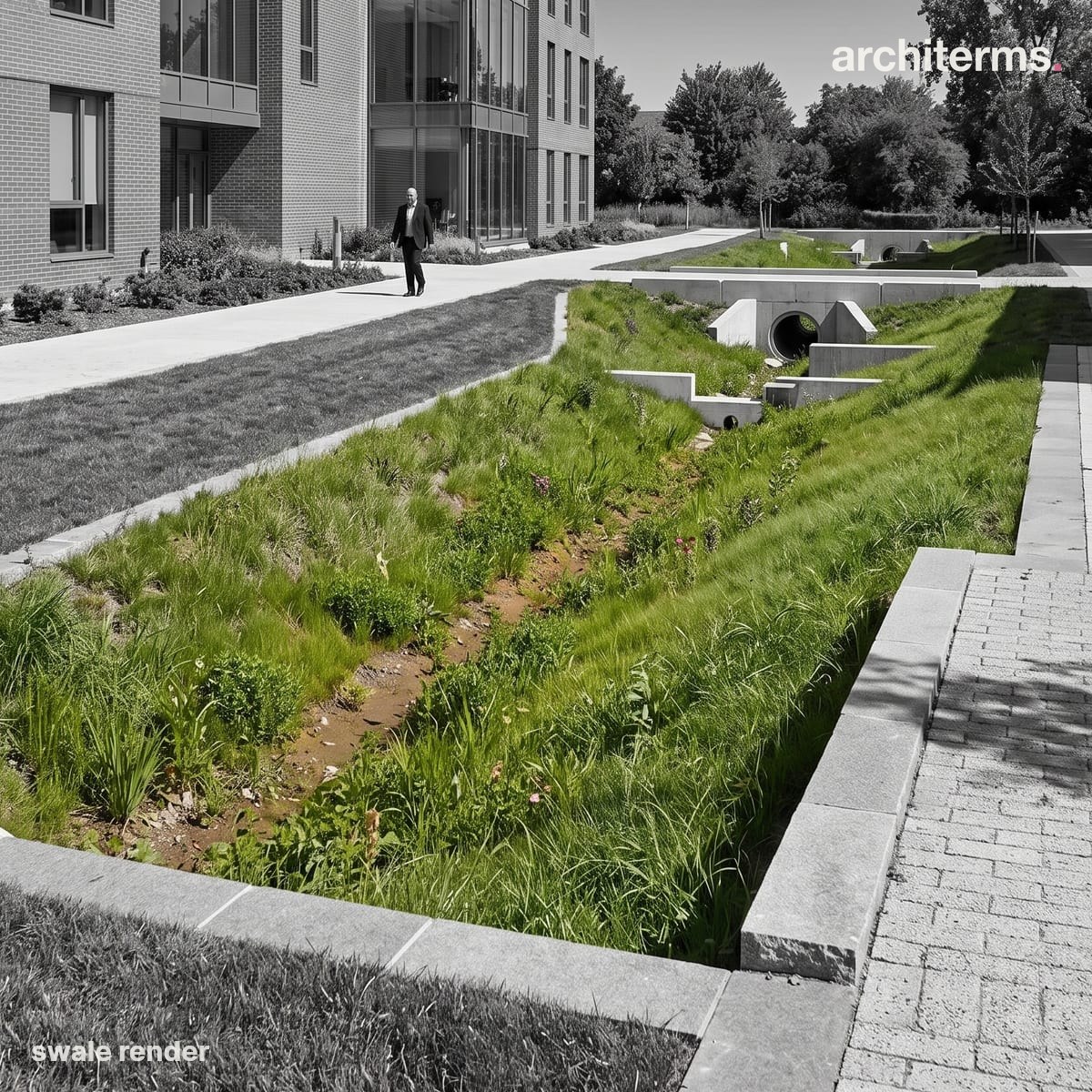
A swale is a shallow, planted depression that guides rainwater across a site: the vegetated sides slow the flow and filter it while some soaks away, and the low earth channel at its base carries the rest along. Concrete culverts link the channel from one side of a path crossing to the other.
Visualized with Reviz.Design — AI rendering for architects and interior designers
Definition
A swale is a shallow, broad, gently sloping channel formed in the ground and usually planted with grass, sedges or other low vegetation. Instead of collecting rainwater in a pipe and flushing it off the site as fast as possible, a swale carries it slowly along the ground, letting sediment settle out and letting some of the water soak into the soil on the way.
Because it is shaped rather than built, a swale reads as part of the landform rather than as a piece of drainage equipment. Its profile is typically a wide, flat-bottomed trapezoid or a shallow saucer, with side slopes gentle enough to mow, walk over and plant. From a distance it can look like nothing more than a slight dip in a lawn, a green verge beside a road, or a low seam running along the edge of a car park.
That modesty is the point. A swale does two jobs at once — it moves water and it treats it — and it does both without the visual weight of kerbs, gullies and manhole covers. For landscape architects it has become one of the basic moves of sustainable site design.
A swale is a linear, vegetated depression designed to convey, slow, filter and infiltrate stormwater. It is defined by three things: a gentle longitudinal fall that keeps water moving without scouring, a wide shallow cross-section that spreads the flow into a thin sheet, and a vegetated bed that provides roughness, root structure and biological treatment.
Hydraulically, the planting is the working part. Grass blades and stems slow the water, so velocities stay low and suspended solids, oils and the pollutants attached to them drop out or are filtered into the soil. Because the flow is slow, a swale needs more length and width than a pipe of equivalent capacity — a trade the designer accepts in exchange for treatment, amenity and a reduced downstream peak.
Several named variants exist. A grassed or drainage swale is the plain mown version used along roads and around car parks. A dry swale has free-draining soil, and often an underdrain, so that it empties between storms. A wet swale sits in poorly drained ground, holds water and is planted with marsh species. In permaculture the word is used differently again, for a level trench dug along the contour with a berm on the downhill side, built purely to catch and infiltrate water rather than to move it anywhere.
On a site plan the swale appears as a soft run of closely spaced contours with spot levels along its invert, annotated with a longitudinal gradient and an outfall point. Common practice keeps the side slopes no steeper than about 3:1 so that the channel can be mown and crossed safely, and keeps the fall along the channel gentle — often in the region of one to five per cent — with check dams introduced where the ground drops away more sharply.
Swale History
The word is older than the engineering. In English dialect a swale was simply a shallow, moist hollow in the ground, a low and shady place, and the term is usually traced back to a Norse root meaning cool or shady. Geographers still use it in that natural sense: the damp troughs between beach ridges are dune swales, and the shallow depressions that thread across grassland are prairie swales. The designed version is an imitation of that landform.
As drainage practice, the swale grew out of agriculture. Farmers had long shaped shallow grassed waterways along the natural drainage lines of a field so that storm water could leave without cutting gullies, and the soil conservation programmes of the 1930s in the United States promoted grassed waterways widely as a defence against erosion. Highway engineering adopted the same idea, and the open, grass-lined verge became standard along rural roads because it was cheap to build, easy to maintain and largely self-repairing.
Through much of the twentieth century, however, urban drainage moved in the opposite direction, toward buried pipes sized to remove rain from a site as quickly as possible. Interest revived in the closing decades of the century, when hydrologists and engineers began to treat surface runoff as both a resource and a pollutant rather than a nuisance to be flushed downstream. Sustainable drainage systems in Britain, low impact development in North America and water sensitive urban design in Australia all placed the vegetated channel near the front of the toolkit, and municipal green street programmes turned it into a visible piece of civic landscape.
Swale in Architecture
For architects and landscape architects a swale is a design element as much as a drainage device:
- —Shaping the ground: It is the clearest expression of grading as design. A swale gives a flat site a legible direction of fall, ties the building's finished floor level to the levels around it, and turns the invisible logic of drainage into a visible line in the landscape.
- —The start of a treatment train: Roof water, terrace drains and car park gullies commonly discharge into a swale, which passes the flow on to a detention basin, a filter strip, a soakaway or a watercourse. Each stage removes a little more sediment and a little more volume.
- —Edges and thresholds: Because it is linear, a swale naturally occupies the leftover strip between a building and a road, a footpath and a car park, or a boundary and a field. Where levels change sharply along its length, a retaining wall or a terraced bank can hold one side while the channel keeps its gentle profile.
- —Amenity and habitat: A planted channel reads as a ribbon of meadow or wetland through an otherwise hard site, supports pollinators and amphibians, and gives a building's setting a seasonal character that a pipe cannot.
- —Maintenance: Performance depends on upkeep. Grass must be mown to a reasonable height, sediment removed from the head of the channel, and the soil protected from compaction by vehicles and stored materials. A neglected swale silts up, ponds where it should drain and quickly loses its treatment value.
Common confusion
Swale vs ditch: A ditch is cut to move water away as quickly as possible. It is usually narrow and steep-sided, often V-shaped, may be unlined or hard-lined, and is judged almost entirely on capacity. A swale is deliberately wide, shallow and slow, and is judged on how much sediment and volume it removes as well as on what it can carry. A ditch drains; a swale drains and treats.
Swale vs bioswale: A bioswale is an engineered version of the same channel. Beneath the planting sits a specified filter medium — typically a sand and compost blend over gravel, often with a perforated underdrain — so that water passes down through the bed as well as along it. A plain grassed swale relies on the existing soil. If the section drawing shows layers of engineered media, it is a bioswale; if it shows topsoil and turf, it is a swale.
Swale vs rain garden: Here the difference is geometry and intent. A swale is linear and conveys: water enters at one end or along a side and leaves at the other. A rain garden is a basin, a bowl-shaped depression that holds a volume of water and lets it soak away over the following hours, with no role in carrying flow onward. Ask whether the water is meant to travel along it or to sit in it.
The quick test on a drawing is to look for fall, section and outlet. A steep V-section with an outfall and no planting notes is a ditch; a gentle vegetated fall with an outfall is a swale; layered media beneath that fall makes it a bioswale; and a level, ponded hollow with no through route is a rain garden.
Frequently Asked Questions
What is a swale in landscaping?
A swale is a shallow, broad, gently sloping channel planted with grass or other vegetation that carries rainwater slowly across a site. It filters out sediment as the water passes and lets part of the flow soak into the soil, so it both drains and treats runoff instead of simply piping it away.
What is the difference between a swale and a ditch?
A ditch is built to remove water fast: narrow, steep-sided, often V-shaped, and judged on capacity alone. A swale is deliberately wide, shallow and vegetated so that water moves slowly, drops its sediment and partly infiltrates. In practice a ditch only drains, while a swale drains and cleans at the same time.
Is a swale the same as a bioswale?
No. A bioswale is an engineered swale with a specified filter medium beneath the planting, usually a sand and compost mix over gravel and often a perforated underdrain, so water filters downward as well as flowing along. A plain grassed swale relies on the existing topsoil and offers less treatment.
How steep should a swale be?
Swales are kept gentle so that water does not scour the bed. Common practice is side slopes no steeper than about 3:1 so the channel can be mown and crossed safely, and a fall along the channel of roughly one to five per cent. On steeper ground, check dams are added to step the flow down.
What plants are used in a swale?
Mown turf grasses are the traditional choice because they are dense, tolerant of occasional flooding and easy to maintain. Meadow mixes, sedges and rushes are used where a richer habitat is wanted, and moisture-loving marsh species suit wet swales that hold water between storms.