Gabion.
A gabion is a cage or basket of wire mesh filled with stone or rubble, stacked to build retaining walls, embankments, and landscape features. In plain terms: it's a rock-filled wire box used as a heavy, free-draining building block.
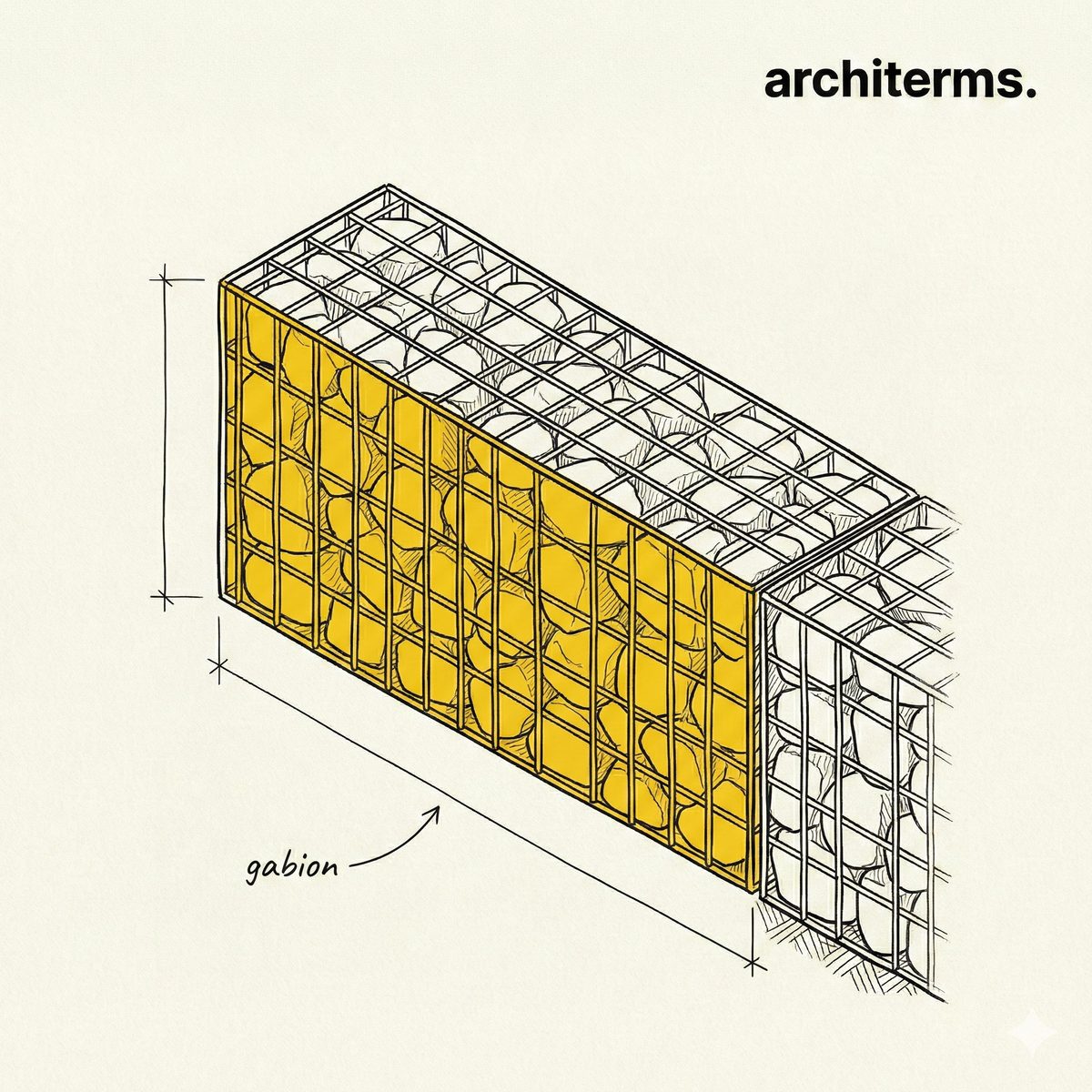
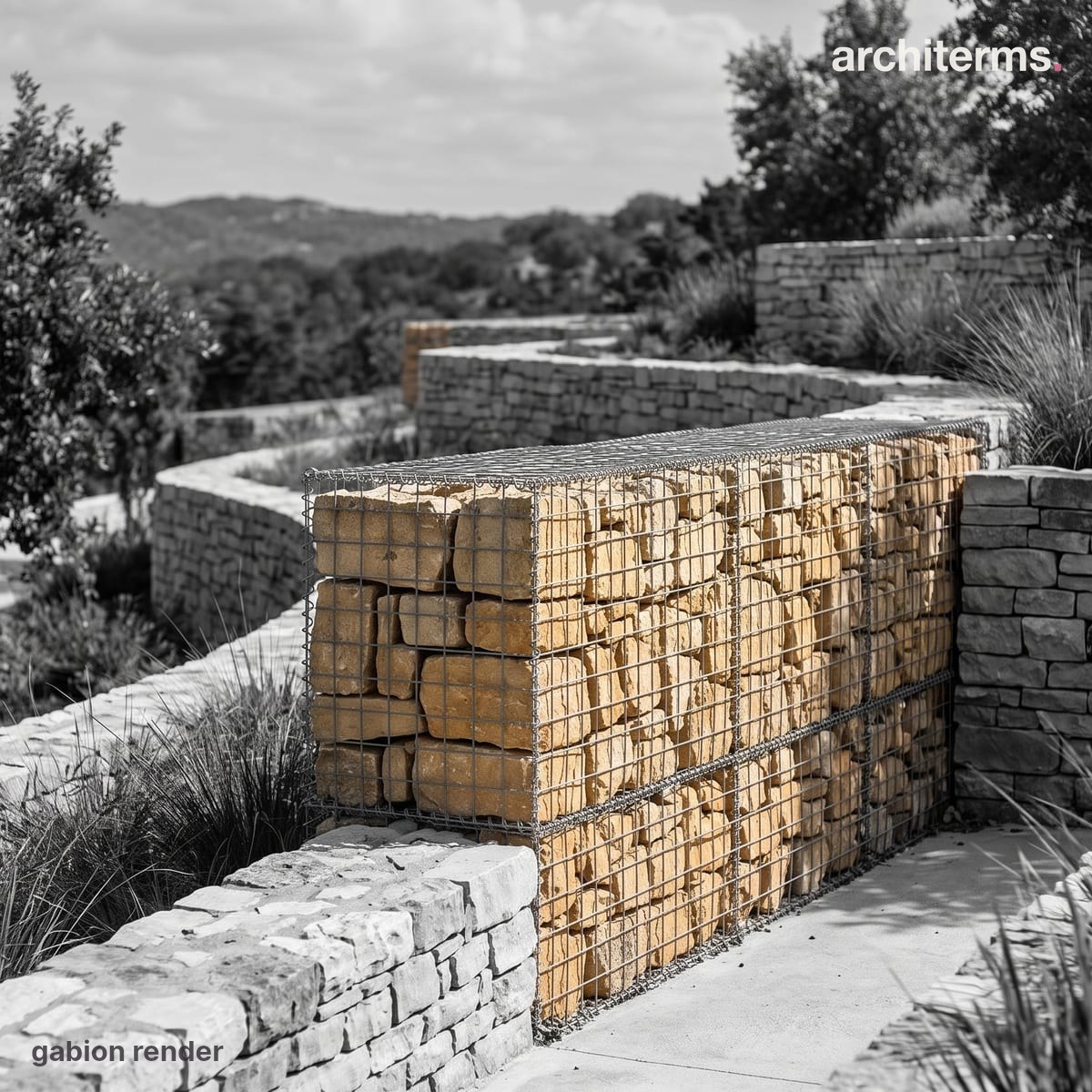
A gabion is a welded wire cage filled with loose stone and stacked as a building block. The mesh holds the rubble in place while gaps between the stones let water drain freely, making it a heavy, self-draining unit for retaining walls and embankments.
Visualized with Reviz.Design — AI rendering for architects and interior designers
Definition
A gabion is a wire-mesh cage packed with stone, used as a large, modular building block for retaining walls, erosion control, and landscape structures. Each unit is simple — wire mesh containers filled by hand or machine with rock — but stacked and tied together they form heavy, free-draining walls that hold back soil and resist water. The name comes from the Italian gabbione, meaning a big cage.
Gabions work by mass and friction rather than rigid strength: the filled baskets are heavy enough to resist the push of the earth behind them, while the gaps between the stones let water drain straight through. That drainage is a major advantage over solid walls, which have to be designed carefully to relieve water pressure. Flexible, permeable, and quick to build, the gabion sits comfortably between civil engineering and landscape architecture.
A gabion is a galvanized or polymer-coated steel wire mesh basket filled with rock or rubble and assembled with others to form gravity retaining walls, revetments, channel linings, and landscape elements. It resists earth pressure through its own weight and the interlock of the fill, and its open structure drains freely. Gabions are also used as decorative, free-draining facade, fence, and seat elements.
Gabion History
The gabion began as a military device: woven baskets filled with earth or stone, set up to absorb fire and shore up fortifications, used from the Renaissance through the 19th century. The modern version arrived with mass-produced galvanized wire mesh, which turned the basket into a durable, engineered product for rivers, roads, and railways. Manufacturers such as Maccaferri standardized the system in the late 1800s, and over the last few decades architects and landscape designers have adopted the gabion's raw stone texture as a finish in its own right.
Gabion in Architecture
The gabion's appeal is that it solves an engineering problem and gives a material expression at the same time:
- —Retains earth by mass: a gabion wall is a gravity retaining wall, an alternative to reinforced concrete that needs no formwork.
- —Drains freely: the open fill relieves the water pressure that builds behind solid walls, often removing the need for separate drainage.
- —Controls erosion: gabion mattresses and revetments armor riverbanks, slopes, and channels against scour.
- —Becomes architecture: exposed gabion walls, screens, and seats bring a rugged stone texture to buildings and landscapes, sometimes used as a ventilated facade layer.
- —Stays flexible and green: because it can flex with ground movement and trap soil, a gabion can settle without cracking and can be planted over time.
Common confusion
- —Gabion vs. retaining wall: a gabion is one way to build a gravity retaining wall; not every retaining wall is a gabion.
- —Gabion vs. riprap: riprap is loose dumped rock; a gabion holds the rock inside a wire cage so it stays in place and can be stacked into a vertical wall.
- —Gabion vs. mass concrete wall: a gabion is permeable and flexible and drains itself; a concrete wall is rigid and must be given separate drainage and movement provisions.
- —Gabion vs. crib wall: a crib wall is an interlocking frame of beams filled with soil or stone; a gabion is a wire basket filled with stone.
Frequently Asked Questions
What is a gabion?
A gabion is a wire-mesh cage or basket filled with stone or rubble, used as a heavy, modular building block. Stacked and tied together, gabions form free-draining retaining walls, erosion-control structures, and landscape features that hold back soil through their own weight.
How do gabion walls work?
A gabion wall is a gravity structure: the filled baskets are heavy enough that their weight and the friction between the stones resist the pressure of the soil behind them. Because the stone fill is open, water drains straight through, which relieves the water pressure that would otherwise build up behind a solid wall.
What is the difference between a gabion and riprap?
Riprap is loose rock dumped onto a slope or bank to resist erosion. A gabion confines similar rock inside a wire mesh cage, so the stone cannot wash away or roll out and can be stacked vertically into a structured, near-vertical wall.
How long do gabions last?
Durability depends mainly on the wire coating. Heavily galvanized or polymer-coated mesh can last many decades, even in wet or coastal conditions, while the stone fill itself is effectively permanent. The limiting factor is corrosion of the wire, so the coating is specified to suit the environment.
Can gabions be used as a building facade?
Yes. Beyond retaining walls, gabions are used as freestanding garden walls, fences, seats, and ventilated facade screens, where the exposed stone texture becomes the finished surface. Used this way they are still engineered for their own weight and wind loads.