Retaining Wall.
A retaining wall is a structure built to hold back soil or rock and resist the lateral pressure of the earth behind it, supporting ground at two different levels. In plain terms: it is the wall that keeps a slope, terrace, or embankment from sliding or collapsing.
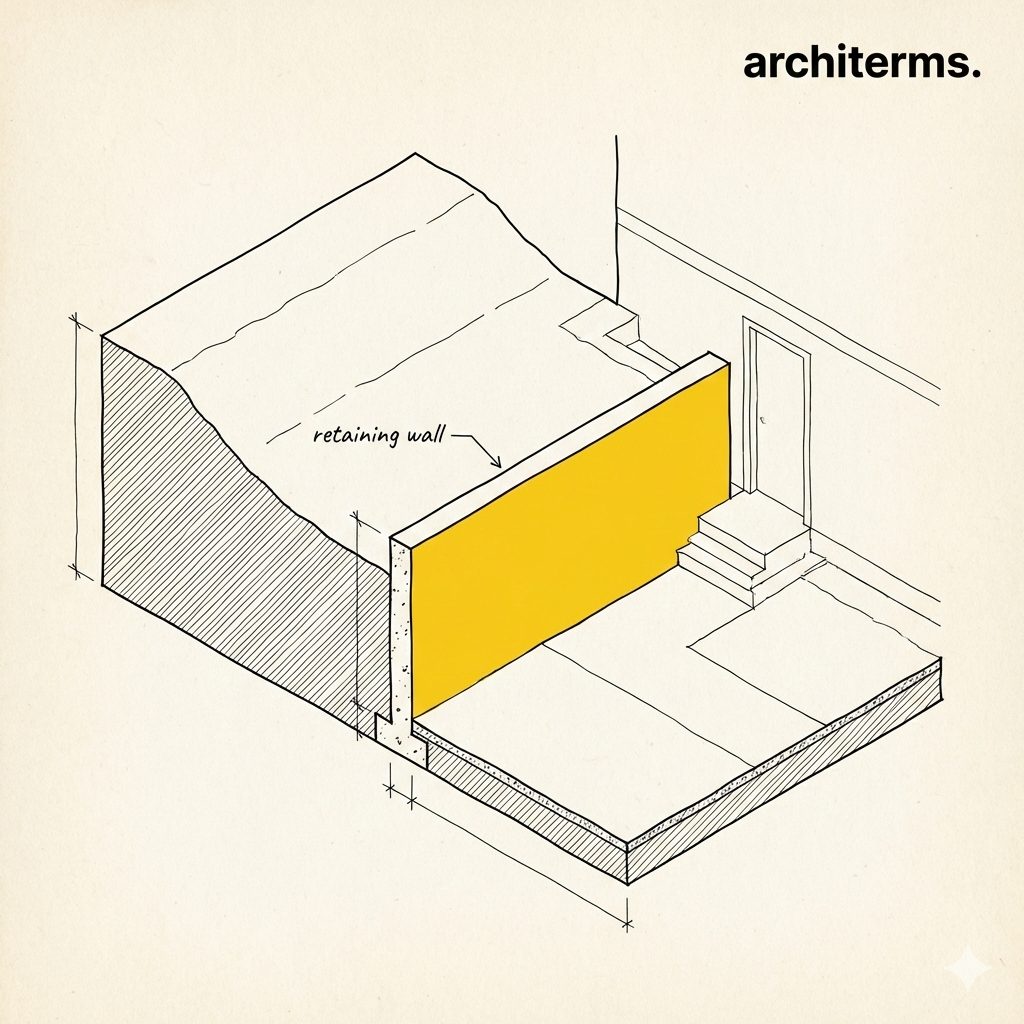
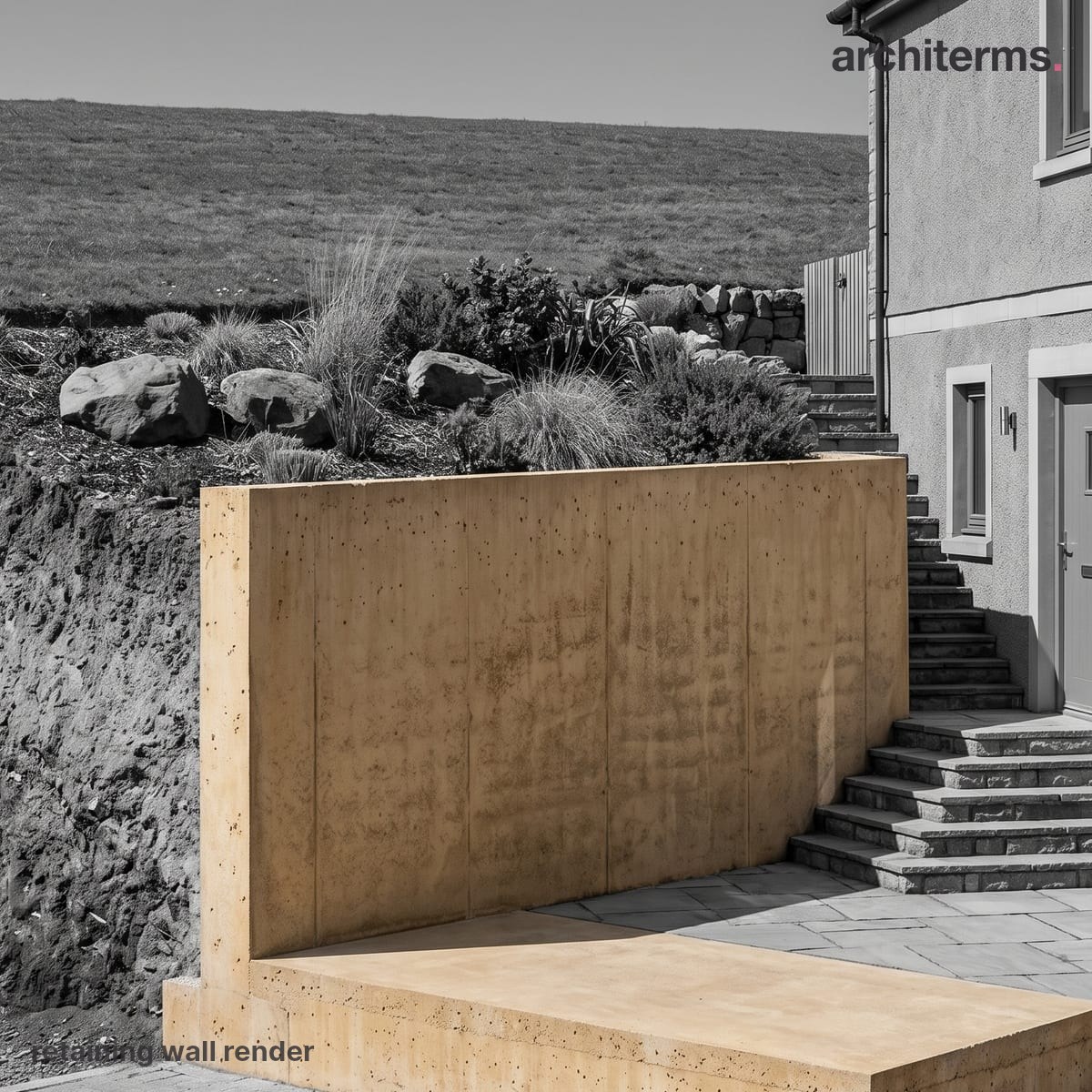
A retaining wall holds back the higher ground behind it, keeping the planted bank from slumping onto the terrace below. Its solid mass resists the sideways push of the retained soil and lets two levels sit side by side, linked here by the adjacent steps.
Made with Reviz.Design — AI visualization for architects and interior designers
Definition
A retaining wall is a structure whose single job is to hold back earth. Wherever the ground needs to change level abruptly—at a terraced garden, a road cut, a basement, or a waterfront—soil on the higher side pushes sideways against anything in its way. A retaining wall resists that sideways push, called lateral earth pressure, and keeps the higher ground from slumping, sliding, or washing into the lower level.
Retaining walls look simple, but they carry some of the most demanding loads in construction. The pressure from the retained soil grows with the height of the wall and increases dramatically when the soil is saturated with water. For that reason a good retaining wall is as much about drainage and a stable base as it is about the visible face: the parts you cannot see—the footing, the backfill, and the weep holes—are what keep it standing.
A retaining wall is a rigid structure built to restrain soil or rock to a slope steeper than it would naturally hold, resisting the lateral earth pressure of the material behind it and supporting ground at two different elevations. It must resist three modes of failure: sliding forward along its base, overturning about its toe, and bearing failure where it presses into the soil beneath. Retaining walls are typically built from reinforced concrete, masonry, stone, or interlocking blocks, and they rely on their own weight, a wide footing, embedded reinforcement, or anchors—together with drainage behind the wall—to stay stable.
Retaining Wall History
Retaining walls are among the oldest engineered structures. Agricultural terraces held by dry-stone retaining walls shaped hillsides across the ancient Mediterranean, the Andes, and Asia, turning steep slopes into farmable land. Roman engineers built massive gravity retaining walls for roads, harbours, and building substructures, relying on sheer mass to resist the earth. For centuries retaining walls were essentially gravity structures—thick and heavy enough that their own weight would not be pushed over. The arrival of reinforced concrete in the late 19th and 20th centuries allowed far thinner cantilever retaining walls, which use a wide base slab and embedded rebar so that the weight of the retained soil itself helps hold the wall down. Modern engineering added sheet-pile walls, anchored walls, and mechanically stabilised earth, greatly extending the heights that can be retained.
Retaining Wall in Architecture
Beyond pure engineering, retaining walls do real architectural work:
- —Making sloped sites usable: They create level terraces, courtyards, and building platforms on hillside sites that would otherwise be unbuildable.
- —Basements and below-grade space: A basement wall is a retaining wall, holding back the surrounding soil so habitable rooms can sit below ground level.
- —Landscape and place-making: Retaining walls double as seating, planters, steps, and boundaries, shaping gardens and public spaces while doing structural work.
- —Infrastructure: Roads, railways, bridges, and waterfronts depend on retaining walls to hold cuts and embankments in place.
The main types reflect how each wall resists the earth: gravity walls rely on mass; cantilever walls use a reinforced-concrete stem and base; counterfort and buttressed walls add ribs for taller spans; and sheet-pile or anchored walls are driven or tied back into the ground. Whatever the type, drainage is essential—weep holes and granular backfill relieve water pressure that would otherwise overwhelm the wall.
Common confusion
Retaining wall vs. load-bearing wall: A load-bearing wall carries vertical loads from the structure above (floors and roofs) down to the foundation. A retaining wall resists horizontal pressure from soil behind it. One handles weight from above; the other handles a sideways push.
Retaining wall vs. foundation wall: A foundation wall transfers a building's weight to the ground and may also retain soil; a retaining wall's primary purpose is to hold back earth, whether or not a building sits on it.
Gravity vs. cantilever retaining wall: A gravity wall resists the soil with its own mass and needs no reinforcement; a cantilever wall is a thinner reinforced-concrete wall shaped like an inverted T, using the weight of soil on its heel to resist overturning.
Retaining wall vs. breast wall: A breast wall supports and protects a natural slope of firm ground or rock against erosion, while a true retaining wall holds back loose, made-up, or backfilled earth that would otherwise collapse.
Frequently Asked Questions
What is a retaining wall?
A retaining wall is a structure built to hold back soil or rock and support ground at two different levels. It resists the lateral (sideways) pressure of the earth behind it, preventing a slope, embankment, or terrace from sliding, slumping, or eroding into the lower area.
How does a retaining wall work?
A retaining wall works by resisting the lateral earth pressure of the soil behind it through a combination of its own weight, a wide footing, embedded reinforcement, or anchors. It must not slide forward, overturn, or sink into the ground beneath. Drainage behind the wall is essential, because water trapped in the soil greatly increases the pressure pushing on the wall.
What are the main types of retaining wall?
The main types are gravity walls, which resist the soil with sheer mass; cantilever walls, thin reinforced-concrete walls shaped like an inverted T that use the weight of the retained soil to stay stable; counterfort or buttressed walls, which add ribs for greater height; and sheet-pile or anchored walls, which are driven into or tied back into the ground.
Why do retaining walls need drainage?
When soil behind a wall becomes saturated, water adds hydrostatic pressure on top of the earth pressure, which can be enough to push the wall over. Weep holes, perforated drains, and granular backfill let this water escape, relieving the pressure. Poor drainage is one of the most common causes of retaining-wall failure.
What is the difference between a retaining wall and a load-bearing wall?
A load-bearing wall carries vertical loads—the weight of floors and roofs—down to the foundation. A retaining wall instead resists the horizontal pressure of soil held behind it. One deals with downward weight from the structure above; the other deals with a sideways push from the earth.