Rotunda.
A rotunda is a circular room or building, usually crowned by a dome and often ringed by columns. In plain terms: a room with no corners and a dome over it, which is why it feels ceremonial before anyone tells you what it is for.
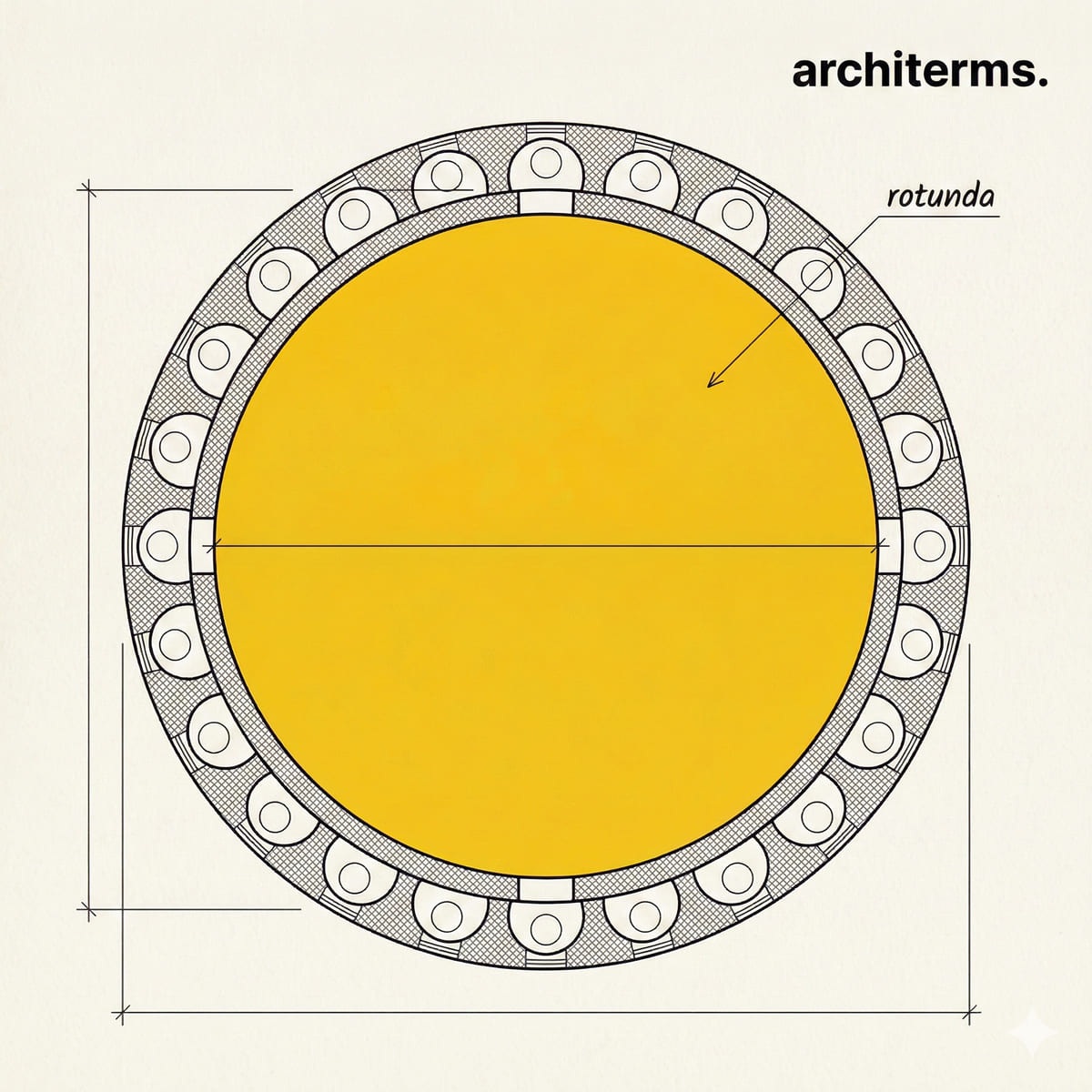
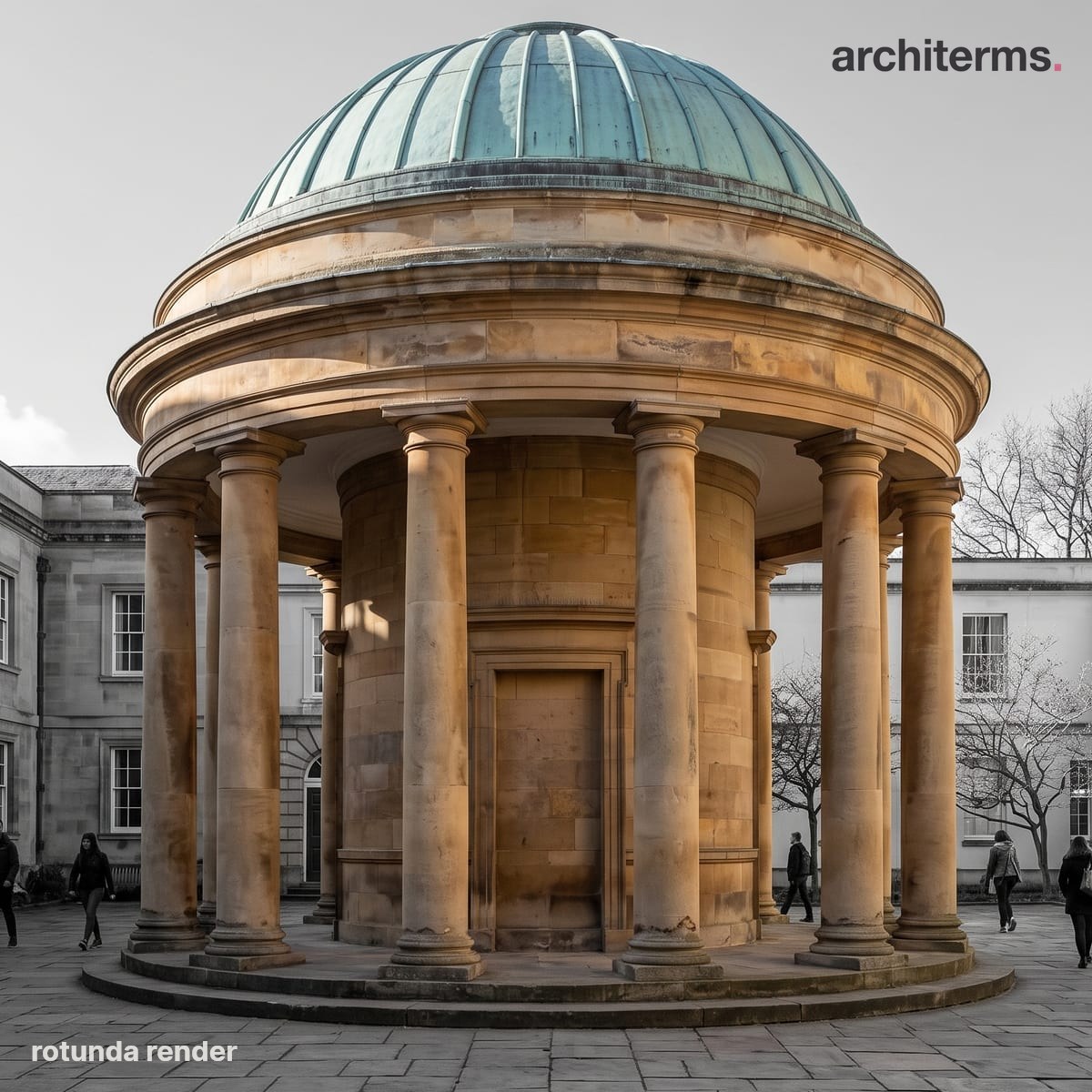
A rotunda is a circular structure crowned by a dome, here a colonnaded drum ringed by free-standing columns on a stepped stone base. With no corners to anchor a direction, the plan reads as ceremonial from every angle.
Visualized with Reviz.Design — AI rendering for architects and interior designers
Definition
A rotunda is a room, or a whole building, that is circular in plan and normally covered by a dome. It is one of the few architectural types that carries meaning almost independently of what it houses: a capitol, a museum entrance hall, a library reading room and a mausoleum can all be rotundas, and in every case the form says the same thing — this is the centre, and it is important.
The reason is geometric. A circular plan has no direction and no hierarchy: every position on the perimeter is equivalent, and the only privileged point is the middle. A dome intensifies that by drawing every line of the ceiling to a single apex. Stand in a rotunda and the building tells you where you are standing, which is why the form is used at the point where a plan pivots — the junction of wings, the head of an axis, the entry to a collection.
A rotunda is a building or a principal room, circular in plan, generally roofed by a dome and frequently surrounded internally or externally by a ring of columns. Light usually enters from above, through an oculus at the crown or through a drum of windows below the springing, because a circular wall has few good positions for ordinary windows and top light preserves the geometry. Structurally the dome exerts outward thrust at its base, so the enclosing wall must be thick, buttressed, or tied by a tension ring — which is why the classic rotunda has heavy walls relieved by niches rather than a light, open perimeter.
Rotunda History
The type is Roman in its developed form. Round temples and tholoi existed in Greek architecture, but it was Roman concrete that made a large domed circular space buildable. The Pantheon in Rome, completed around 125 CE, remains the definitive example and the largest unreinforced concrete dome ever built: a perfect hemisphere on a cylinder, lit only by a nine-metre oculus, with coffering that lightens the shell as it rises.
Late antiquity adopted the form for martyria and mausolea, where a centralised plan suited a building organised around a single tomb, and Byzantine and early Christian architecture developed the domed centralised church from the same root. The Renaissance rediscovered the Pantheon as a model of ideal geometry — Brunelleschi, Bramante's Tempietto, and above all Palladio, whose Villa Rotonda placed a domed circular hall at the centre of four identical porticoed faces.
Neoclassicism then made the rotunda a civic instrument. Jefferson's Rotunda at the University of Virginia, the United States Capitol, and countless nineteenth-century museums, libraries and exchanges used it to give a public institution a symbolic centre. Iron and glass extended the type — great domed reading rooms and exhibition halls — and modern practice still reaches for it whenever a building needs an unmistakable heart.
Rotunda in Architecture
- —Marks the centre: it is used where a plan needs a pivot, so it usually sits at a crossing of axes and resolves several approaches at once.
- —Distributes movement: because every direction from the middle is equal, a rotunda is an efficient distributor — enter, orient, and choose a wing.
- —Is lit from above: an oculus or a windowed drum keeps the wall unbroken and produces the even, sourceless light the form is known for.
- —Is defined by its dome: the crowning Cupola, and any lantern above it, are what turn a round room into a rotunda rather than a circular hall.
- —Announces itself outside: where the rotunda meets the street it is typically fronted by a Portico, so the visitor reads a familiar rectangular entrance before arriving in a room with no corners.
Common confusion
- —Rotunda vs. dome: the dome is the roof; the rotunda is the room. A dome can cover a square bay via pendentives, and a rotunda can in principle be flat-roofed. They are usually found together, which is why the words get swapped.
- —Rotunda vs. Cupola: a cupola is a small dome-like structure, often a lantern sitting on a larger roof. It may crown a rotunda, but it is not one.
- —Rotunda vs. tholos: tholos is the Greek term for a circular building, usually a temple or tomb, and typically colonnaded rather than domed. It is the ancestor of the rotunda, not a synonym.
- —Rotunda vs. drum: the drum is the cylindrical wall that carries the dome, often pierced with windows. It is a component of a rotunda, and the word is sometimes loosely used for the whole.
Frequently Asked Questions
What is a rotunda in architecture?
A rotunda is a circular room or building, usually covered by a dome and often ringed by columns. Because a circular plan has no direction and a dome focuses on a single centre, the form is used where a building needs an unmistakable symbolic and spatial heart.
What is the difference between a rotunda and a dome?
A rotunda is the room, defined by its circular plan. A dome is the roof over it. Domes frequently cover square or polygonal spaces via pendentives or squinches, and a rotunda could in theory be covered another way, so the two words are not interchangeable.
What is the most famous rotunda?
The Pantheon in Rome, completed around 125 CE. Its hemispherical concrete dome spans about 43 metres, is still the largest unreinforced concrete dome ever built, and is lit solely by a circular oculus at its crown.
How is a rotunda lit?
Usually from above. A circular wall offers few good positions for conventional windows without disrupting the geometry, so light comes through an oculus at the apex of the dome or through a drum of windows below the dome springing, giving an even, apparently sourceless light.
Why are so many government buildings rotundas?
Because the form reads as centre and as ceremony without needing explanation, and because it distributes circulation equally to every wing. Neoclassical civic architecture inherited it from the Pantheon by way of the Renaissance, and it became the standard way to mark a public institution.