Wainscoting.
Wainscoting is the panelling applied to the lower part of an interior wall, usually capped by a moulded rail and standing on a plinth board. In plain terms: it is a hard-wearing, decorative skin for the half of the wall that people actually touch.
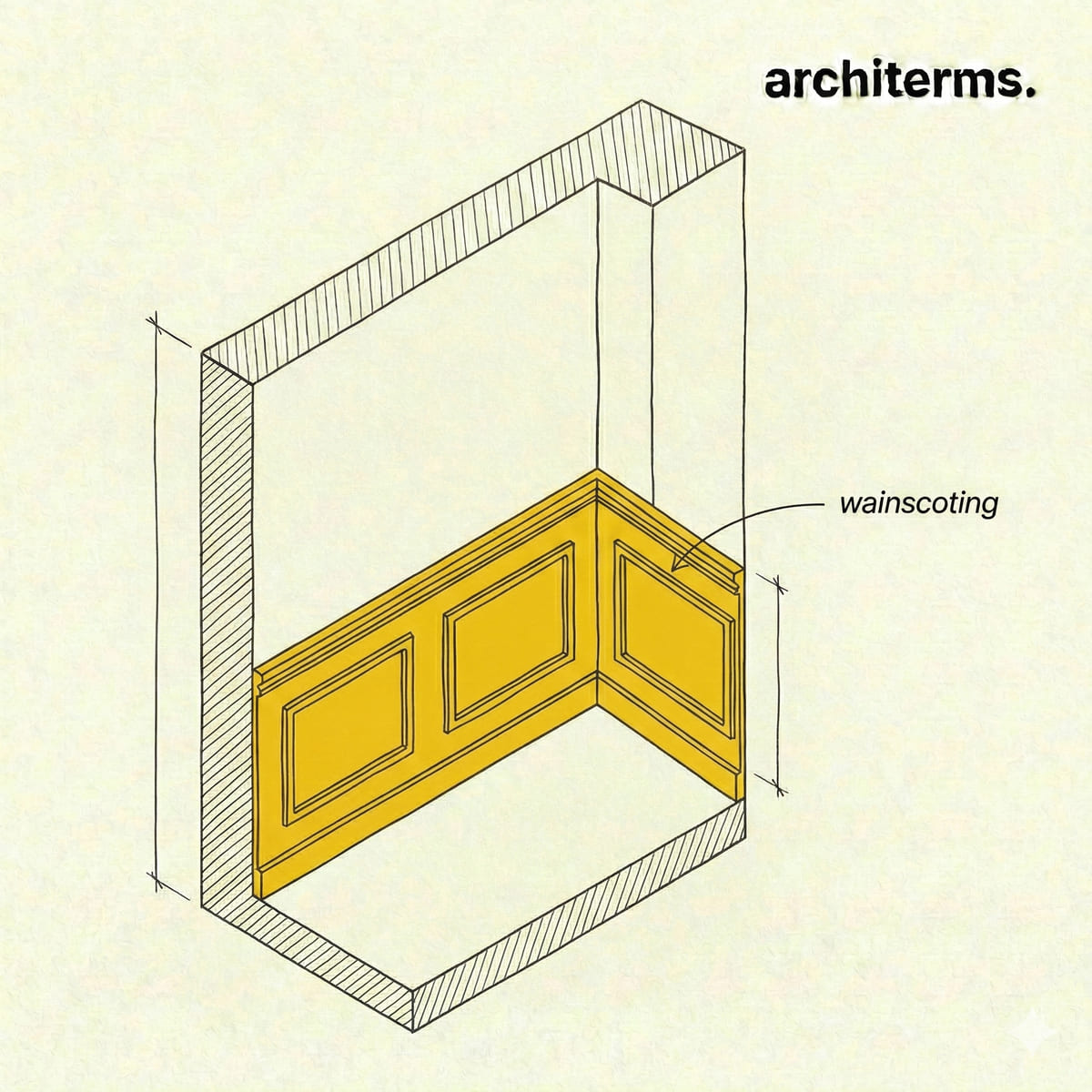
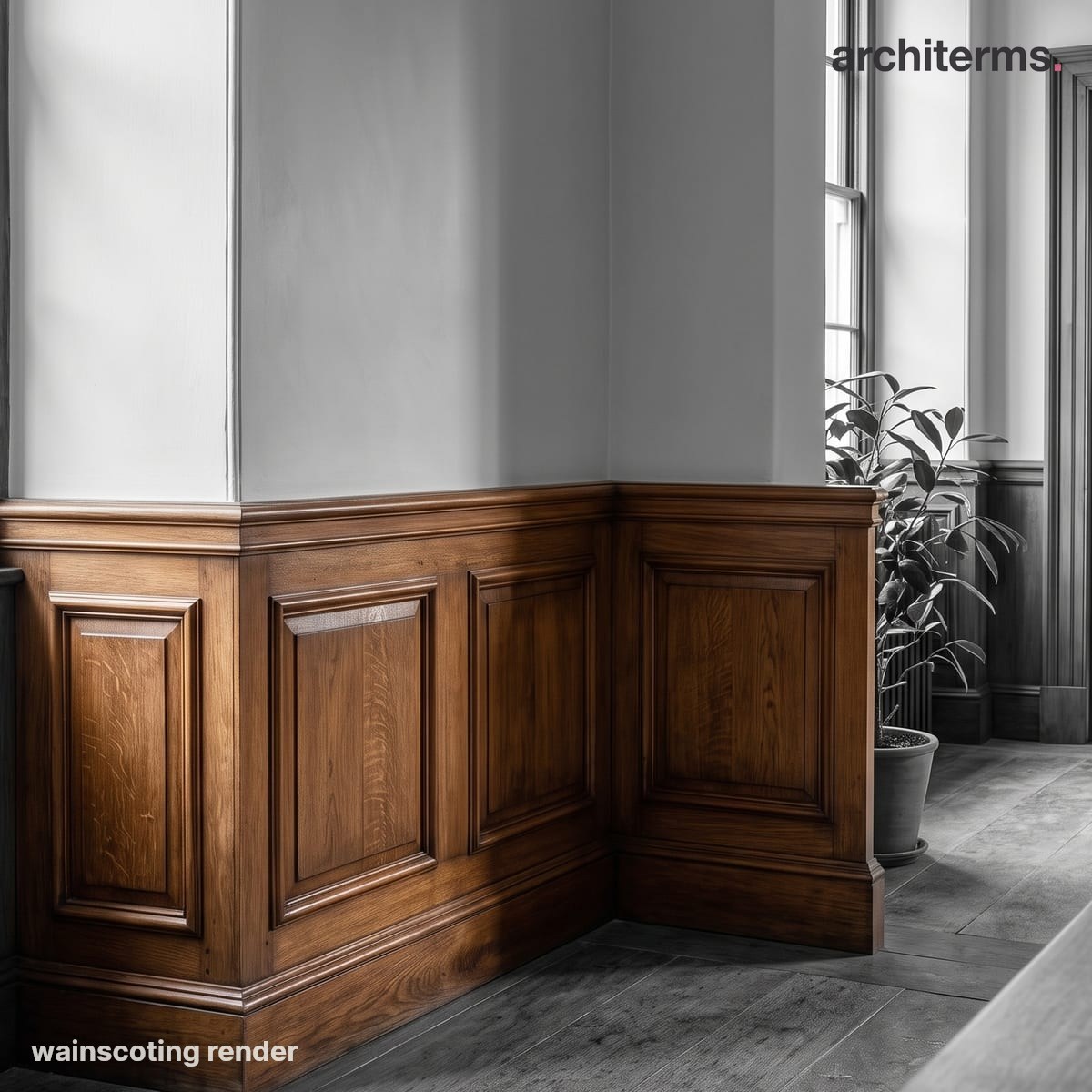
Wainscoting clads the lower part of the wall in framed panels, capped by a moulded top rail and set on a plinth at the floor. It protects the zone most likely to be knocked or scuffed while giving the room a defined, decorative dado.
Visualized with Reviz.Design — AI rendering for architects and interior designers
Definition
Wainscoting is the treatment of the lower portion of an interior wall as a distinct panelled surface, separated from the plaster or paint above it by a horizontal capping rail. Below that rail the wall is usually timber — stiles, rails and infill panels — and below the panels a plinth or skirting meets the floor. The result is a wall read in two horizontal bands rather than one continuous plane.
It began as a purely practical device and stayed useful long after its original reason disappeared. The lower wall is the part that chairs scrape, mops splash, boots kick and damp reaches first, so cladding it in something replaceable and washable protected the expensive finish above. In cold masonry buildings the timber lining also took the chill off the surface a person leans against. Everything decorative about wainscoting — the raised fields, the bolection moulds, the fluted stiles — grew on top of that plain protective purpose.
Wainscoting is timber (or timber-imitating) panelling fixed to the lower section of an interior wall, typically between 800 mm and 1200 mm high, terminated at the top by a moulded chair rail or dado rail and at the bottom by a skirting or plinth. It is built as a frame-and-panel system: vertical stiles and horizontal rails enclose panels that float in grooves, an arrangement that allows the timber to expand and contract across the grain without splitting the frame. Modern versions include board-and-batten, beadboard, and flat-panel or shaker-style variants, and are frequently executed in MDF for painted work.
Wainscoting History
The word descends from the Middle Dutch term for a high-quality riven oak board imported from the Baltic through the Low Countries — wainscot was originally the material, not the wall treatment. Medieval and Tudor interiors lined walls with it in small square panels, partly for warmth in unheated stone rooms and partly because a linenfold or carved panel was a portable display of wealth.
The classical revival reorganised the wall. Renaissance theory read the interior as a column in section — plinth, shaft, entablature — and the dado became the base of that composition, with the chair rail as its cap. Georgian interiors formalised the result: raised-and-fielded panels in the dado, plain plaster above, cornice at the top. The Victorians extended panelling higher and often heavier, while the Arts and Crafts movement returned to expressed joinery and honest oak. Twentieth-century mass housing dropped it, kept only the skirting, and left the chair rail as a vestige.
Two things brought it back. Sheet materials — plywood, and later MDF — made frame-and-panel effects achievable without a joiner, and the reappraisal of traditional interiors made the horizontal division fashionable again. Timber standards bodies such as the American Wood Council still publish the moisture and movement guidance that governs how solid panelling has to be detailed.
Wainscoting in Architecture
- —Protects the wall people touch: the dado zone takes the wear, and a damaged board can be replaced without redecorating the whole room.
- —Divides the wall proportionally: a rail at roughly one-third of the wall height gives the room a datum, and picture-hanging, furniture and door architraves all read against it.
- —Adds depth without depth: 20 mm of applied frame casts enough shadow to make a flat plastered wall legible as a composition.
- —Adapts to the substrate: it can be fixed to battens over masonry, or directly to a Stud frame, and it hides irregularity in the wall behind it.
- —Coexists with modern linings: contemporary work commonly runs panelling below and Drywall above, which is why the capping rail also serves as the tidy stop between two different finishes.
- —Suits partitions: a lightweight Partition Wall gains apparent solidity when its lower half is panelled, a cheap way to make a stud division feel built rather than assembled.
Common confusion
- —Wainscoting vs. panelling: panelling is any framed timber wall lining, including full-height work. Wainscoting is specifically the lower-wall version. All wainscoting is panelling; full-height panelling is not wainscoting.
- —Wainscoting vs. dado: the dado is the lower zone of the wall as a compositional idea, borrowed from the pedestal of a classical order. Wainscoting is the physical panelling that may occupy it. A dado can be painted, papered, or tiled instead.
- —Wainscoting vs. beadboard: beadboard is one pattern — narrow vertical boards with a bead at each joint. It is a kind of wainscoting, not a synonym for it.
- —Wainscoting vs. Molding: the chair rail, panel moulds and skirting are moldings; the wainscoting is the whole assembly including the panels between them.
- —Wainscoting vs. chair rail alone: a chair rail applied to bare plaster gives the horizontal division without the panelling. It is a common economy, and it is not wainscoting.
Frequently Asked Questions
What is wainscoting?
Wainscoting is panelling applied to the lower part of an interior wall, usually between 800 mm and 1200 mm high, capped by a chair rail and standing on a skirting board. It protects the most-used part of the wall and divides the wall into two visual bands.
How high should wainscoting be?
The traditional rule places the cap rail at roughly one-third of the wall height, which gives about 900 mm in a standard 2.7 m room. Taller ceilings can carry panelling to a metre or more, and going much above half the wall height reads as full panelling rather than a dado.
What is the difference between wainscoting and a dado?
The dado is the lower zone of the wall as a design idea, taken from the pedestal of a classical order. Wainscoting is the physical timber panelling that can fill that zone. A dado may equally be papered, painted or tiled, in which case there is no wainscoting.
What material is modern wainscoting made from?
Painted work is now most often MDF, which is stable, has no grain to telegraph through paint and machines cleanly. Stain-grade work uses solid hardwood or veneered plywood, and in damp rooms PVC and polyurethane panels avoid the movement and rot problems of timber.
Is wainscoting still used in contemporary interiors?
Yes, though usually simplified. Flat shaker-style panels and board-and-batten layouts give the horizontal division and the shadow lines without the classical mouldings, which is why they read as current rather than period work.