Crown Molding.
Crown molding is the shaped band of trim that runs around the top of a room, bridging the angle where the wall stops and the ceiling begins. In plain terms: it is the classical cornice brought indoors and cut down to domestic scale.
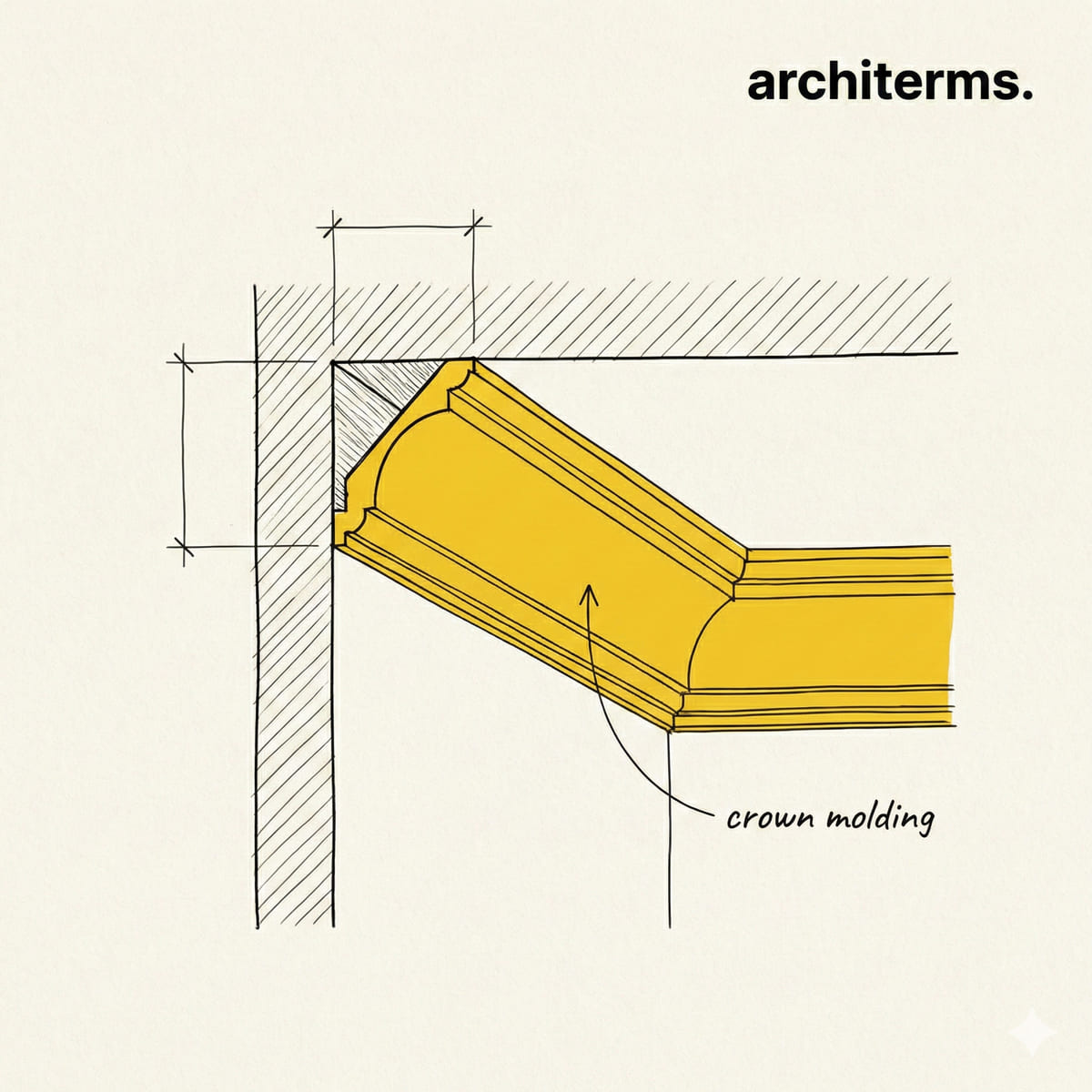
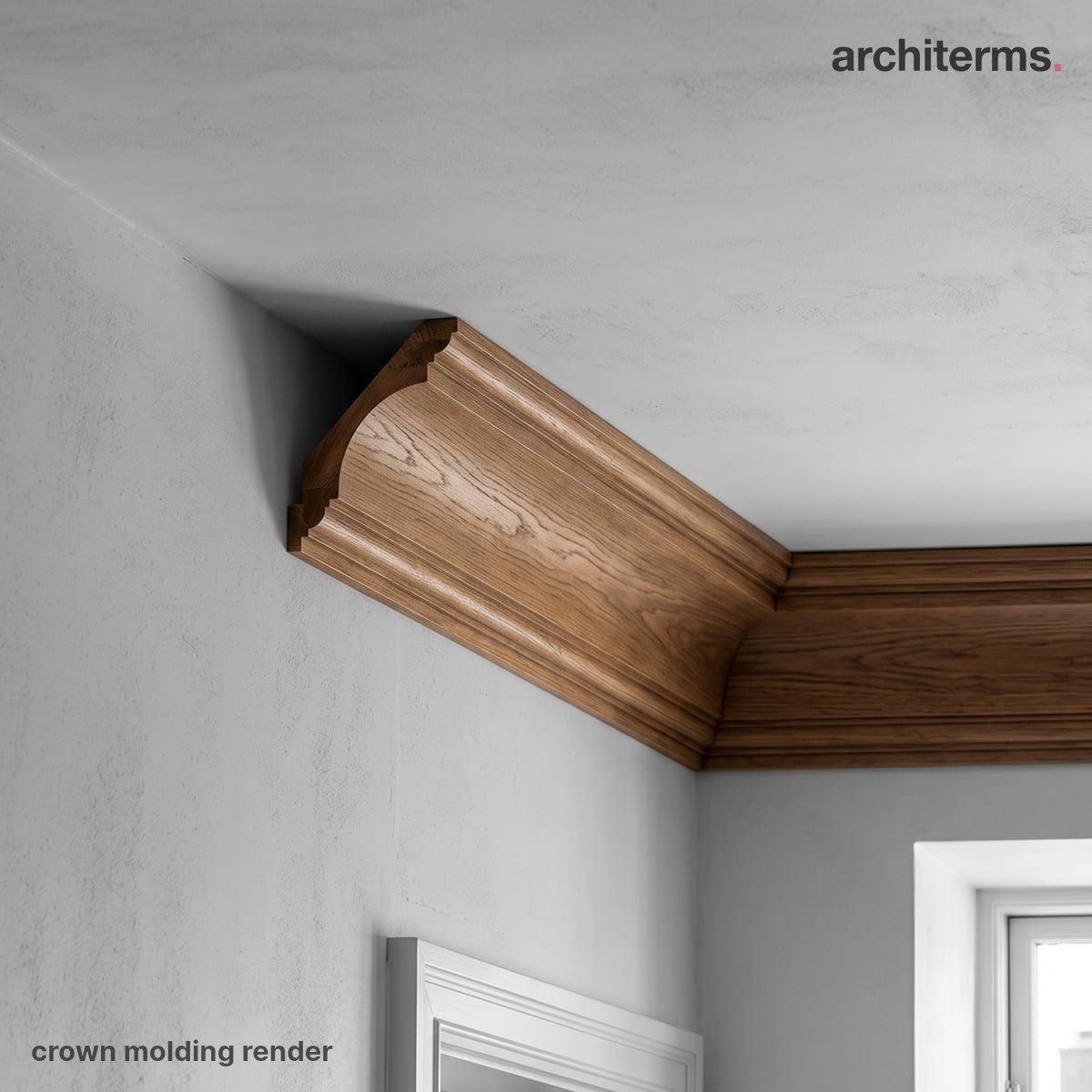
Crown molding is a shaped band of trim set into the angle where the wall meets the ceiling. Sprung across that corner at an angle, its stepped profile hides the joint and gives the room the finished cap of a classical cornice at domestic scale.
Created with Reviz.Design — AI rendering for architects and interior designers
Definition
Crown molding is the run of profiled trim that closes the joint between wall and ceiling. It is fixed at an angle across the corner — "sprung" is the trade word — so that its decorated face turns towards the room rather than lying flat against either surface. Most rooms that read as finished rather than merely painted have one.
Its job is half practical and half optical. The wall-to-ceiling junction is where two trades meet and where hairline cracks appear as a building dries and settles, so a molding covering that line hides a seam that is very hard to keep perfect. Optically, the profile catches light along its whole length: a sequence of curves and flats reads as a soft gradient instead of a hard corner, which gives the eye somewhere to stop and makes the same room feel taller and better resolved.
A crown molding is a decorative molding installed at the intersection of wall and ceiling, sprung across the angle so its face is presented to the room. It is defined by its profile — the shape of its cross-section — which is assembled from the classical vocabulary of curves: the cyma recta and cyma reversa (double curves), the convex ovolo, the concave cavetto, and the flat fillets that separate them. A crown may be a single milled length or a built-up assembly of several members stacked to gain depth, and it is made in timber, plaster, MDF, or moulded polyurethane depending on budget and period.
Crown Molding History
The profile is older than the room it decorates. The cornice of classical Greek temples was the projecting top member of the entablature, throwing rainwater clear of the wall and casting a deep shadow that terminated the building against the sky. Roman builders carried the vocabulary indoors and into masonry rooms; Renaissance architects, measuring the ruins, codified the profiles into the orders and taught them as a system of proportion rather than a set of shapes.
That system reached domestic interiors through pattern books. Georgian and Federal builders in Britain and North America took plates of cornice profiles and reproduced them in timber and in run-in-place lime plaster, where a craftsman dragged a shaped metal template along wet plaster to form the run. The Victorian period industrialised it: fibrous plaster casting and, later, the mechanised molding plane made deep enriched cornices cheap enough for terraced housing. Modernism then rejected the whole family — a shadow gap or a plain plastered arris expressed the junction instead of dressing it — and crown molding became a marker of traditional work. Today both readings coexist, and lightweight moulded polymer profiles have made the historic sections available at a fraction of their original cost.
Crown Molding in Architecture
- —Finishes the top of the wall: it performs indoors the role the Cornice performs on a facade, terminating a surface with a projecting, shadow-casting edge.
- —Hides a difficult junction: plasterboard, timber framing and ceiling joists all move at different rates, and a sprung molding conceals the crack that movement opens.
- —Scales with ceiling height: a 60 mm profile in a 2.4 m room and a 300 mm built-up assembly in a 4 m room are the same idea at different scales — an oversized crown in a low room is the commonest error.
- —Carries enrichment: the deeper sections have room for a Dentil band, egg-and-dart, or modillions, which is where a crown stops being trim and becomes ornament.
- —Conceals services: a deep crown or a coffered return can hide indirect lighting, curtain track or a duct, in the same way a Soffit boxes out services below a ceiling.
Common confusion
- —Crown molding vs. Cornice: they describe the same gesture in different places. Cornice is the general term — classical, exterior, and interior — while crown molding specifically names the interior wall-to-ceiling run, and is the usual North American usage.
- —Crown molding vs. Molding: molding is the whole family of shaped trim, including skirting, architrave, chair rail and picture rail. Crown molding is the member at the top of the wall, so every crown molding is a molding but almost no molding is a crown.
- —Crown molding vs. coving: a cove is a single concave quarter-circle, plain and simple. A crown molding usually combines several curves into a compound profile. All coving is a form of crown molding; not all crown molding is coving.
- —Crown molding vs. Soffit: a soffit is the underside of a built element — a boxed-out horizontal plane — while a crown is trim applied across a corner. A soffit encloses volume, a crown decorates an edge.
- —Crown molding vs. picture rail: both run horizontally around a room, but a picture rail sits lower on the wall and is structural in intent — it carries hooks — while a crown is purely a terminating element.
Frequently Asked Questions
What is crown molding?
Crown molding is decorative trim installed where the wall meets the ceiling, fixed at an angle across the corner so its shaped face turns towards the room. It hides the junction between two surfaces and gives the room a finished, terminated edge.
What is the difference between crown molding and a cornice?
They are the same gesture named differently. Cornice is the broader architectural term, used for the projecting top member of a classical entablature and for exterior work; crown molding specifically names the interior run where wall meets ceiling, and is the standard term in North American practice.
How big should crown molding be for my ceiling height?
Profile depth should scale with the room. A rough working rule is roughly 25 to 50 mm of molding height for every 300 mm of ceiling height, so a 2.4 m ceiling suits a modest 60 to 100 mm profile while a 4 m room can carry a built-up assembly of 250 mm or more without looking heavy.
What materials is crown molding made from?
Traditionally timber and run-in-place lime plaster, later fibrous plaster casting. Modern work uses finger-jointed softwood, MDF for painted finishes, and moulded polyurethane or polystyrene, which is light, dimensionally stable in wet rooms, and cheap enough to reproduce deep historic profiles.
Does crown molding make a room look taller?
Usually yes, if it is correctly proportioned. The profile gives the eye a defined stopping point and its shadow line reads as a soft transition rather than a hard corner, which lengthens the wall visually. An oversized profile does the opposite and visually drops the ceiling.