Groin Vault.
A groin vault is a vault formed by the intersection of two barrel vaults at right angles, creating a groin vault ceiling with four curved surfaces meeting at groin lines. In groin vault architecture, this structural system allows for larger spans and more flexible floor plans than a single barrel vault.
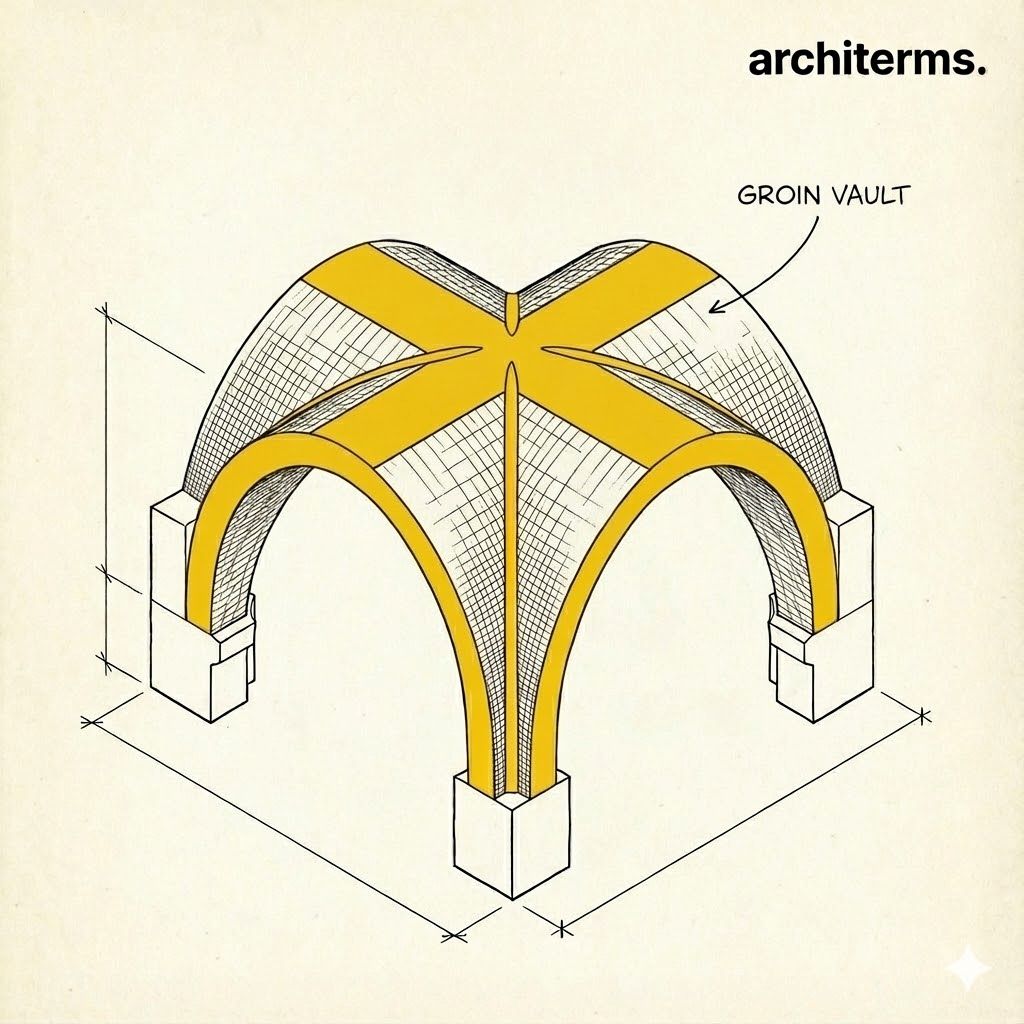
Definition (Groin vault meaning / Groin vault architecture)
A groin vault (also called a cross vault) is created when two barrel vaults intersect at a right angle. The intersection creates four curved surfaces that meet along diagonal lines called groins (or groin lines). This groin vault architecture system is one of the most important developments in masonry construction because it allows builders to cover rectangular and square spaces more efficiently than a single barrel vault.
The groin vault meaning in architecture refers to both the geometric form and the structural system. Structurally, a groin vault distributes loads more evenly than a barrel vault, directing forces along the groin lines to the supporting walls or columns at the corners. This makes it possible to create larger, more open spaces with fewer supporting walls.
Groin vault ceiling refers to the overhead surface created by this vaulting system. The groin vault ceiling is characterized by its distinctive curved surfaces and the groin lines where they intersect, creating a visually dynamic overhead plane that defines the space below.
Groin vault architecture history
Groin vault architecture has a long history, dating back to ancient Roman construction:
Roman origins: The Romans developed the groin vault as an improvement over barrel vaults. Early examples can be seen in Roman baths, basilicas, and large public buildings where the need for larger, more flexible spaces drove innovation.
Medieval development: Groin vaults became central to Romanesque and Gothic architecture. In Romanesque buildings, groin vaults were used in crypts, naves, and aisles. Gothic architects refined the form, creating ribbed groin vaults that were lighter and more elegant.
Renaissance and beyond: The groin vault remained important through the Renaissance and Baroque periods, appearing in churches, palaces, and civic buildings. Today, groin vaults are still used in both historic preservation and contemporary architecture.
Groin vault examples
Famous groin vault examples include:
Roman architecture: The Baths of Caracalla and the Basilica of Maxentius in Rome demonstrate early groin vault construction.
Romanesque architecture: Many Romanesque churches feature groin-vaulted crypts and side aisles, such as the crypt of Canterbury Cathedral.
Gothic architecture: Gothic cathedrals often use ribbed groin vaults in their naves and transepts, creating the characteristic soaring interior spaces.
Modern examples: Contemporary buildings sometimes use groin vaults for their structural efficiency and visual interest, especially in large public spaces like train stations, museums, and libraries.
Groin vault vs barrel vault
Understanding groin vault vs barrel vault is essential for understanding vault construction:
Barrel vault:
- —A single continuous arch extended in one direction
- —Creates a tunnel-like space
- —Requires continuous support along both sides
- —Limited to rectangular spaces aligned with the vault direction
- —Simpler construction but less flexible
Groin vault:
- —Formed by intersecting two barrel vaults at right angles
- —Creates four curved surfaces meeting at groin lines
- —Loads are concentrated at the corners, allowing for more open side walls
- —Can cover square or rectangular spaces in any orientation
- —More complex construction but more flexible and efficient
Groin vault sketch and geometry
A groin vault sketch typically shows:
- —Two intersecting barrel vaults at right angles
- —The four curved surfaces (called "cells" or "bays")
- —The groin lines where surfaces meet
- —The supporting walls or columns at the corners
- —The load paths directing forces to the supports
The geometry of a groin vault is defined by:
- —The span and height of each intersecting barrel vault
- —The angle of intersection (typically 90 degrees, but can vary)
- —The radius of curvature of each vault
- —The position and shape of the groin lines
Aesthetic appeal: The curved surfaces and groin lines of groin vaults create visually interesting spaces that many contemporary architects value. The form can add character and scale to large public spaces.
Modern applications: Groin vault architecture appears in:
- —Train stations and transportation hubs
- —Museums and cultural centers
- —Libraries and educational buildings
- —Commercial and retail spaces
- —Residential architecture seeking distinctive character
Contemporary materials: Modern groin vaults can be constructed from:
- —Reinforced concrete (cast-in-place or precast)
- —Steel framing with various cladding materials
- —Timber (glulam or engineered wood)
- —Composite materials
Traditional masonry: In historic construction, groin vaults were built from stone or brick, with each course carefully shaped to follow the curved surfaces and meet at the groin lines. The construction required skilled masons and careful centering (temporary supports) during construction.
Modern construction: Contemporary groin vaults can be:
- —Cast in place using concrete forms
- —Precast and assembled on site
- —Built from steel or timber framing with various finishes
- —Created using digital fabrication techniques
Key considerations: Groin vault construction must account for:
- —Load distribution to corner supports
- —Lateral stability and thrust
- —Waterproofing and drainage (for exterior applications)
- —Integration with other building systems (MEP, lighting, etc.)
Common confusion
Groin vault vs. rib vault: A rib vault is a groin vault with ribs added along the groin lines. Ribs provide additional structural support and visual definition. All rib vaults are groin vaults, but not all groin vaults have ribs.
Groin vault vs. dome: A dome is a curved surface that can cover circular or polygonal spaces. A groin vault is specifically formed by intersecting barrel vaults and creates a different geometry. Domes distribute loads in all directions; groin vaults concentrate loads at corners.
Groin vault vs. cross vault: These terms are essentially synonymous. "Groin vault" is the more common term, while "cross vault" describes the intersecting geometry.
Groin vault vs. quadripartite vault: A quadripartite vault is a specific type of groin vault divided into four parts by ribs. It's a ribbed groin vault with a particular rib pattern.