Contextualism.
Contextualism is an architectural design philosophy that emphasizes responding to the specific physical, cultural, historical, and environmental characteristics of a site and its surroundings. Rather than imposing a predetermined style, contextualist architects integrate new buildings into their landscape, neighborhood, or urban fabric in a way that respects and enhances the existing context.
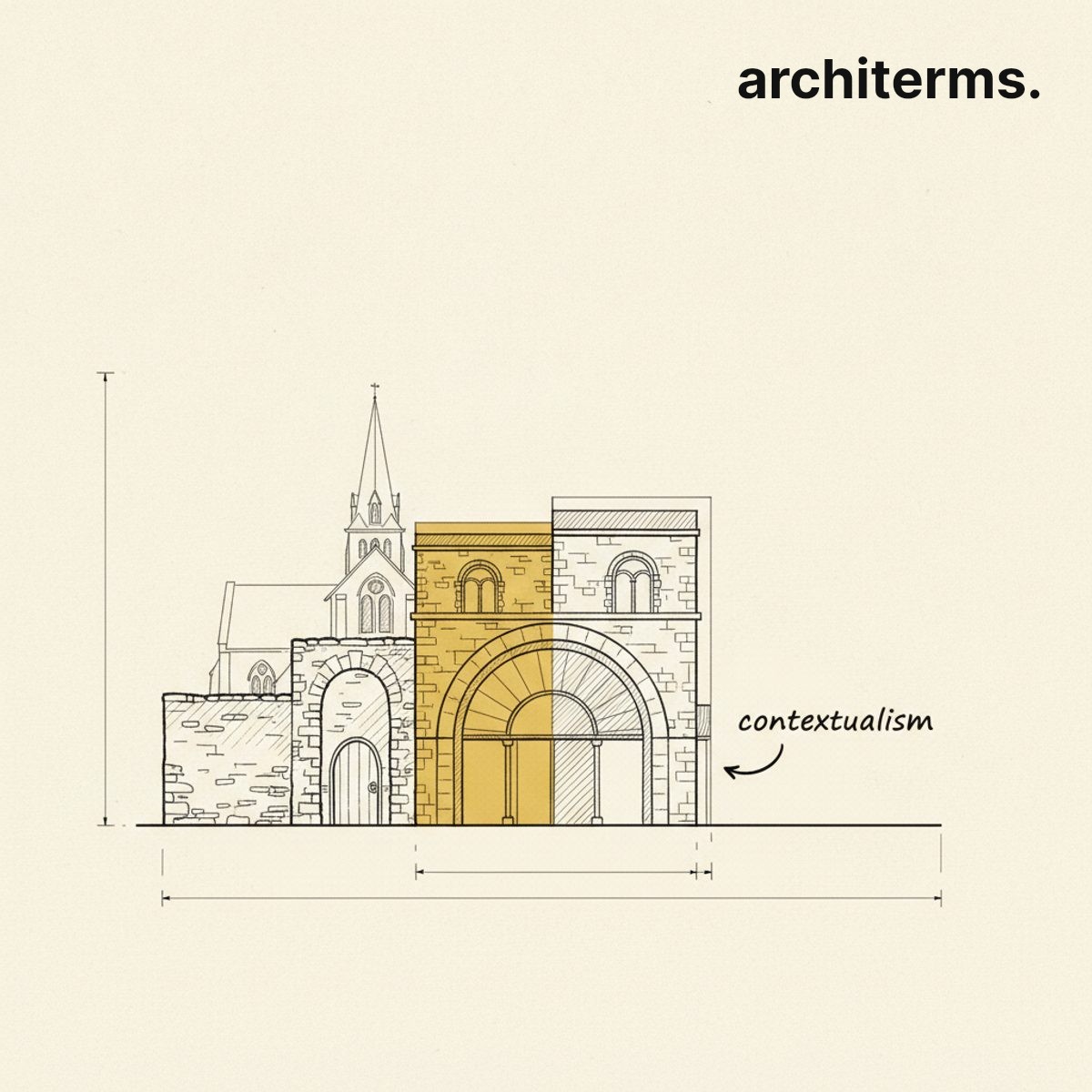
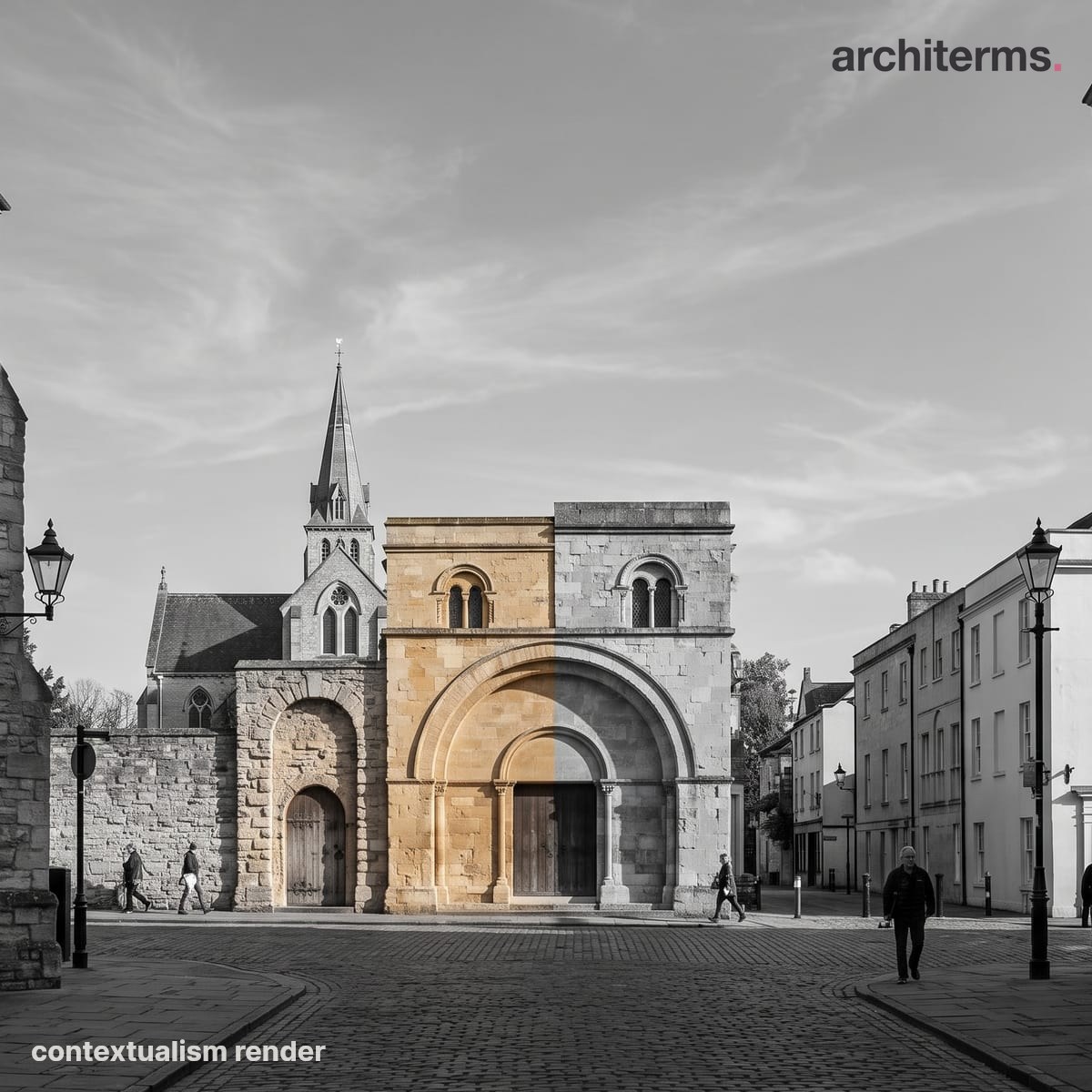
Contextualism reads a site before designing for it: here the new building borrows the cornice height, bay spacing and material of the terrace it joins, so it settles into the street rather than interrupting it.
Visualized with Reviz.Design — AI rendering for architects and interior designers
Definition
Contextualism represents a fundamental shift in how architects think about the relationship between a building and its environment. It rejects the modernist notion that a good design is universally applicable, instead arguing that every site has unique qualities—topography, climate, heritage, community identity, building tradition—that should shape the design strategy. A contextualist building feels at home in its place; it reads as both a contemporary work and a respectful inhabitant of its surroundings.
Contextualism in architecture refers to a design approach in which decisions about form, material, scale, fenestration, color, and composition are informed by careful study of the existing environment. This can mean matching the height and rhythm of a historic streetscape, adopting local materials or vernacular construction methods, respecting sight lines and public gathering spaces, or responding to microclimatic conditions like wind, sun exposure, and drainage patterns. The term encompasses both the philosophical commitment to place-based design and the practical methodologies—site analysis, community engagement, historical research, and spatial mapping—that make that commitment tangible.
Contextualism is not simply historicism or pastiche; a contextualist building can be unmistakably contemporary in expression while still being deeply responsive to its setting. It is also not a rigid rulebook: contextualism allows for innovation, contrast, and creative reinterpretation, as long as those choices are grounded in understanding of the place.
Contextualism History
The seeds of contextualism were sown in the late 1960s and early 1970s as a reaction against the perceived alienation of high modernism. While modernists like Le Corbusier and the International Style practitioners believed good design transcended geography and culture, critics including Jane Jacobs (in "The Death and Life of Great American Cities," 1961) and later architects and urban theorists began arguing that the loss of fine-grained urbanism, local identity, and human-scaled public space was a design failure, not an inevitability.
In the 1980s, contextualism became a formal movement within postmodern and neotraditional architecture circles. Architects including Robert Venturi, Denise Scott Brown, and others began deliberately engaging with vernacular precedent, historic fabric, and the social meaning of place. Quinlan Terry and the New Urbanism movement championed context-sensitive urbanism and building codes that encouraged compatibility with neighborhood character. European architects including Aldo Rossi and the Ticino school emphasized the relationship between new buildings and the historical city, arguing that architecture must be rooted in the genius loci—the spirit or character of place.
By the 1990s and 2000s, contextualism had matured from a polemical stance into a mainstream methodology. Urban design guidelines, historic district overlays, and form-based codes all encode contextualist thinking into regulatory frameworks. Environmental and climate considerations have added a scientific dimension: contextualism now includes biophilic design, thermal mass strategies tuned to local conditions, and site-responsive building orientation and material choices.
Contextualism in Architecture
In practice, contextualism operates at multiple scales and through multiple strategies:
Urban and neighborhood scale: A new building respects the established rhythm of a streetscape by matching cornice heights, setback lines, bay widths, and fenestration patterns to surrounding structures. If the neighborhood is Victorian terraced housing, a new residential infill building might echo those proportions and material palettes. If the context is a modernist precinct from the 1960s, the new building might reference the language of that era while advancing it.
Historic and heritage sensitivity: In areas with significant architectural heritage, contextualism means studying the historic fabric—materials, details, construction techniques, symbolic meanings—and either adapting existing buildings (adaptive reuse) or inserting new work that does not compete with or diminish the patrimony. This often requires restraint and a light touch, as seen in contemporary infill projects in European medieval centers.
Material and tectonic response: Rather than applying a universal cladding or finish, contextualist design may adopt local stone, brick traditions, timber construction methods, or render finishes that resonate with regional building culture. The architect might specify handmade brick if that is what the neighborhood is built of, or rammed earth if that is the vernacular tradition.
Topographic and climatic integration: A building responds to slope, drainage, sun angles, prevailing winds, and seasonal conditions specific to its site. On a hillside, a contextualist design might step with the topography rather than flatten it; in a hot, arid climate, it might employ deep overhangs, courtyards, or thermal mass to passively cool the interior, following patterns seen in traditional architecture of that region.
Cultural and social context: Contextualism acknowledges that a place has a social identity and history. New buildings can honor that identity through program, public realm contribution, community co-design, and the inclusion or restoration of valued public spaces. This is closely aligned with placemaking and community-engaged design practices.
Infill and void: Where a neighborhood has missing teeth (vacant lots, parking lots, or underutilized sites), contextualism guides the selection of appropriate scale, massing, and land-use intensity to stitch the fabric back together. A void may call for a building that completes a street edge, closes a view, or frames a public plaza—all decisions driven by reading the context.
Notable examples:
The Sainsbury Wing of the National Gallery in London (Robert Venturi & Denise Scott Brown, 1991) is a landmark contextualist project—a contemporary building that sits alongside the Victorian gallery and responds to its color, proportion, and fenestration while maintaining a clear modern identity.
The urban infill projects of architect Álvaro Siza in Porto, Portugal demonstrate how contemporary design can integrate seamlessly with existing neighborhoods through careful material choice, height, and fenestration alignment without resorting to pastiche.
Hammarby Sjöstad in Stockholm exemplifies contextualism at the district scale, where new development responds to maritime and industrial heritage while introducing contemporary sustainability strategies and public waterfront access.
Adaptive reuse projects—converting warehouses to lofts, mills to offices—are inherently contextualist because they preserve existing structures and reuse or reinterpret their materials, forms, and spatial character.
Contextualism vs. Historicism
A common misconception is that contextualism means copying the past. Historicism, by contrast, is the deliberate reproduction of historical styles—Gothic Revival, Greek Revival, Colonial reproduction—regardless of setting. Contextualism can reference history, but it does so critically and selectively, in service of creating a coherent relationship to place. A contextualist building in a medieval town square might be made of traditional stone but have a thoroughly modern fenestration pattern and silhouette; the goal is harmony, not duplication.
Contextualism vs. Universalism
Modernism and the International Style are often positioned as the opposite of contextualism. The modernist position was that rational design principles, industrial materials, and efficient forms transcend place and culture. Contextualism inverts this: it argues that attention to the specific is not parochial but rather a way to create buildings that are more human, more sustainable, and more meaningful to their communities. Today, many architects blend both: they employ contemporary materials and construction logic (honest modernist values) while carefully integrating those choices into the context of place.
Contextualism vs. Kitsch
Contextualism can slide into pastiche or theming if not done carefully—a new suburban development dressed up in fake New England colonial details, or a shopping mall designed to mimic a historical town square. True contextualism requires depth: genuine engagement with historical research, community values, site analysis, and material authenticity, not superficial stylistic gestures.
Types of Contextualism
Strict contextualism: Dominant in historic districts and conservation areas, where new work must be largely compatible with existing heritage—similar heights, materials, and proportions. This approach prioritizes continuity and preservation.
Critical contextualism: A term coined by theorist Kenneth Frampton, this approach respects context but also asserts the architect's contemporary vision. The building is rooted in place but not bound by it; it can introduce contrast, new materials, or formal innovation as long as choices are justified by deep contextual reading.
Parametric or performance-based contextualism: Emerging from digital design tools, this approach uses algorithms to optimize building form, orientation, and envelope in response to site conditions—solar gain, wind, views, pedestrian flow—treating context as data to be computationally analyzed.
Contextualism in Code and Practice
Form-based codes and design guidelines that emerged from New Urbanism and contextualist theory now govern development in many cities. These codes specify setbacks, building heights, street-facing active uses, and material palettes as regulatory standards rather than suggestions. This has professionalized contextualist thinking but also sometimes bureaucratized it, turning responsive design into compliance with a template.
Contextualism and Sustainability
Contextualism aligns naturally with sustainable design principles. Responding to local climate and topography reduces mechanical conditioning loads; using regional materials cuts embodied carbon in transport; adapting existing buildings preserves embodied energy; and respecting pedestrian-scale neighborhoods supports walkability and reduced vehicle dependence. Biophilic design and thermal mass strategies are contextualist when they respond to specific ecological and climatic conditions of a site.
Contextualism and Typology
Architects often study building typology—the recurring patterns and types within a place's architectural tradition (row houses, courtyard buildings, pavilion structures)—as a way to understand context. Understanding the vernacular tradition, how buildings in a region have historically solved the problems of shelter, climate, and social organization, often informs contextualist design strategy.
Common confusion
Contextualism vs. conservatism: Contextualism is sometimes mistakenly understood as a conservative approach that resists change and protects the status quo. In fact, contextualism can be a tool for strategic change—densification, adaptive reuse, infill development—provided those changes are site-responsive and respectful of community values. Many progressive projects are highly contextualist.
Contextualism vs. regionalism: Regional design emphasizes broad geographical and cultural traditions (Mediterranean architecture, Scandinavian timber building). Contextualism zooms in closer, to the specific neighborhood, street, or site. However, the two are related; regional vernacular is often an important reference point in contextualist analysis.
Contextualism vs. proportion and rhythm: These are design principles that can be used in contextualist work but are not synonymous with contextualism. A building can have pleasing proportion and rhythm but not respond to site context; conversely, a contextualist building must often respect the proportional and rhythmic logic of its surroundings.
Frequently Asked Questions
What is contextualism in architecture?
Contextualism is a design philosophy that emphasizes creating buildings in response to the specific characteristics of their site, surroundings, and community—including landscape, climate, heritage, cultural identity, and existing urban fabric. Rather than applying a universal style, contextualist architects analyze the place and integrate new work in a way that enhances both the building and its environment. It emerged as a reaction against modernism's belief that good design transcends geography and location.
What is the difference between contextualism and historicism?
Historicism is the deliberate reproduction of historical styles (like Greek Revival or Victorian) regardless of setting. Contextualism, by contrast, may reference history but does so selectively and critically in service of creating harmony with place. A contextualist building can be entirely contemporary in expression while being deeply responsive to its surroundings. Contextualism is about fit and meaning; historicism is about style and reproduction.
Where did contextualism originate in architectural theory?
Contextualism emerged in the late 1960s and early 1970s as a critique of high modernism's detachment from place and community. It was formalized in the 1980s through architects like Robert Venturi, Denise Scott Brown, and the New Urbanism movement, which argued that architecture must be rooted in the spirit and character of place. By the 1990s, contextualism had become embedded in urban design codes, historic district guidelines, and mainstream architectural practice.
How does contextualism relate to sustainability?
Contextualism and sustainability are naturally aligned. Responding to local climate and topography reduces building energy use; using regional materials cuts embodied carbon; preserving existing structures through adaptive reuse saves embodied energy; and creating pedestrian-scaled neighborhoods reduces car dependence. Biophilic design, passive thermal strategies, and site-responsive building orientation are all contextualist approaches that also advance environmental performance.
What is critical contextualism?
Critical contextualism is an approach that respects and engages with the context of place but also asserts the architect's contemporary vision and critical perspective. Coined by theorist Kenneth Frampton, this method roots a building in its site while allowing for contrast, innovation, and formal boldness—provided those choices are justified by deep contextual understanding. It avoids both slavish imitation and complete disregard for context.