Vapor Barrier.
A vapor barrier is a low-permeability membrane placed on the warm side of an insulated assembly to stop indoor moisture diffusing into the construction and condensing inside it. In plain terms: it keeps humid air out of the wall.
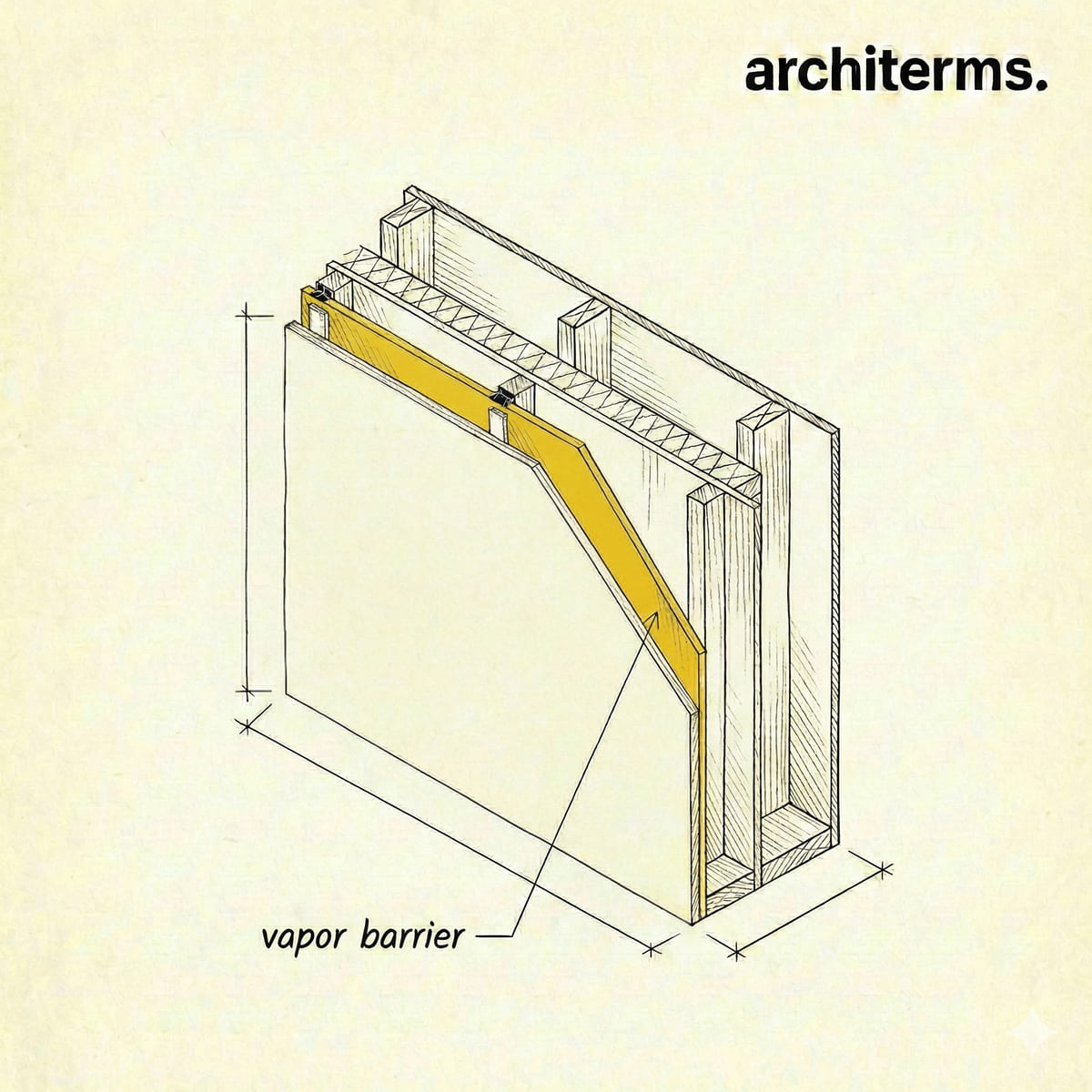
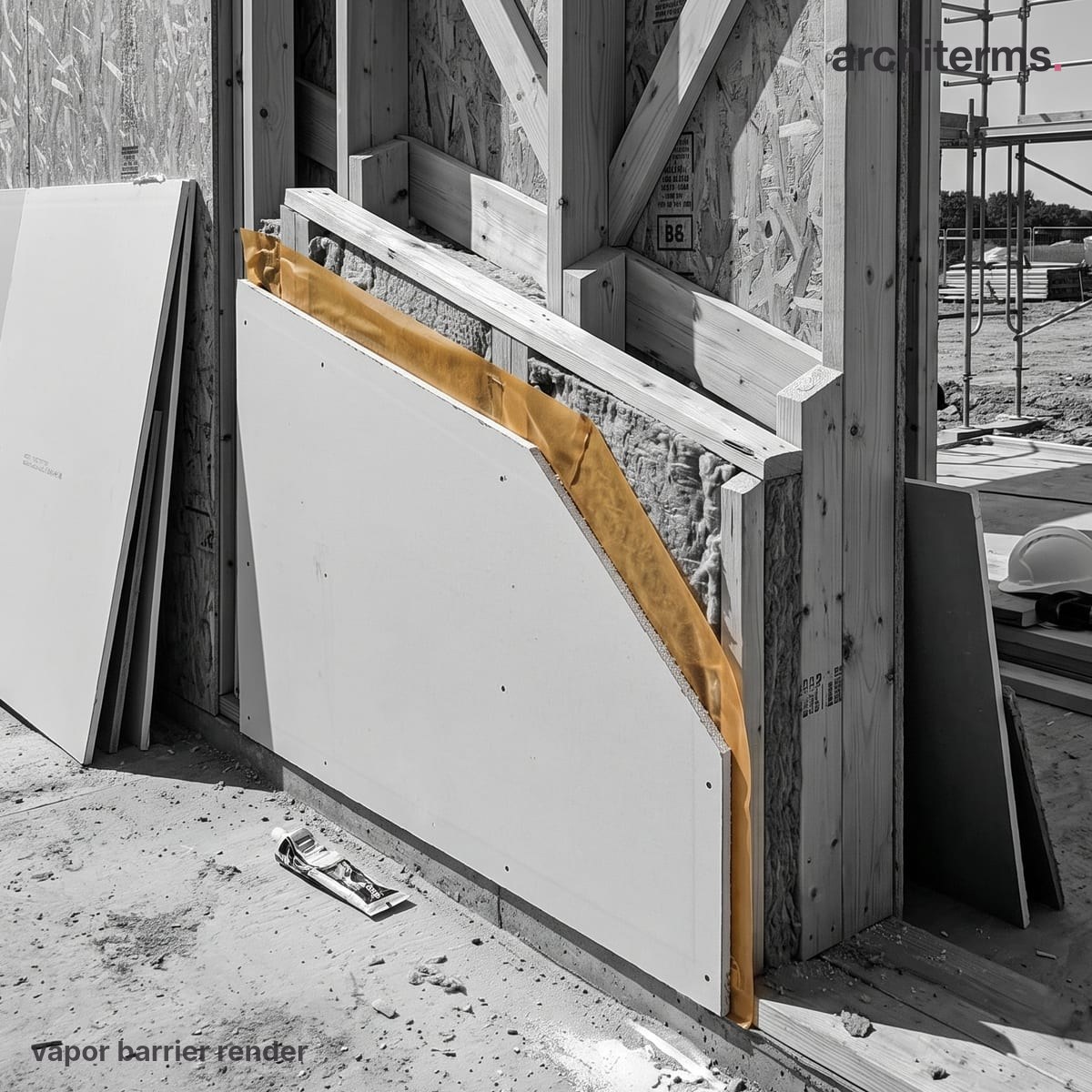
The vapor barrier is the thin membrane set on the warm, interior side of the assembly, just behind the drywall and in front of the insulation. It slows the diffusion of moist indoor air into the wall, where that moisture would otherwise condense against the cooler outer layers.
Made with Reviz.Design — AI visualization for architects and interior designers
Definition
A vapor barrier is a sheet of material with very low permeability to water vapour, fixed on the warm-in-winter face of a wall, roof or floor to prevent moist interior air from diffusing into the insulation behind. It is one of the least glamorous components in a building and one of the easiest to get catastrophically wrong, because it works by controlling a process nobody can see.
The physics is straightforward. Warm indoor air holds a great deal of water vapour; the outer part of an insulated assembly is cold. If vapour moves into the construction and reaches a surface below its dew point, it condenses there — inside the insulation, against the sheathing, out of sight. Wet insulation loses most of its thermal value, wet timber rots, and steel corrodes. The barrier's job is to keep the vapour on the warm side, where the air is warm enough to hold it.
A vapor barrier is a material with a vapour permeance low enough to substantially block moisture diffusion, installed on the high-humidity side of a thermally insulated assembly. North American practice classifies materials by permeance: Class I (0.1 perm or less, such as polyethylene sheet and sheet metal) is a true vapour barrier; Class II (0.1 to 1.0 perm, such as kraft-faced batts) is a vapour retarder; Class III (1.0 to 10 perms, such as latex paint on plasterboard) retards only weakly. European practice uses the equivalent air-layer thickness, the sd-value, in metres. Because the correct choice depends on climate, the modern preference in many assemblies is a variable-permeability smart membrane that tightens in winter and opens in summer to let trapped moisture escape.
Vapor Barrier History
Before insulation, buildings did not need one. Solid masonry walls were leaky, warm on both faces relative to the insulation case, and had enough thermal mass and air exchange that interstitial condensation was rarely the failure mode. The problem is a creation of the insulated cavity.
North American light-frame construction ran into it first. As mineral wool and then fibreglass batts filled stud cavities from the 1930s onward, the cold side of the cavity became genuinely cold, and asphalt-impregnated kraft facing appeared on batts as the standard control layer. Polyethylene sheet took over after the Second World War because it was cheap, continuous and effectively impermeable.
Then came the correction. Buildings in cooling-dominated climates, air-conditioned so that the inside was the cold side for much of the year, began failing with polyethylene installed on what turned out to be the wrong face — the barrier trapped moisture driven inward from outside. Research through the 1990s reframed the whole subject as moisture control rather than moisture blocking, introducing the idea that assemblies must be able to dry in at least one direction. Smart vapour retarders, whose permeance rises with ambient humidity, are the practical result, and current guidance ties the choice of class and position to climate zone rather than treating polyethylene as universal.
Vapor Barrier in Architecture
- —Sits on the warm side: in a heating-dominated climate that means the interior face of the insulation; in a cooling-dominated climate the logic reverses, and in mixed climates a variable-permeability membrane avoids having to choose.
- —Is not the air barrier, though it can be: vapour diffusion moves far less water than air leakage does, so an unsealed vapour barrier riddled with service penetrations may still allow the failure it was meant to prevent.
- —Must be continuous to work: it is taped at laps, sealed at penetrations, and ideally kept clear of the service zone, which is why a battened void in front of the membrane is standard in careful timber-frame work.
- —Interacts with the wall type: a Cavity Wall manages liquid water in the cavity and vents it, which is a different mechanism from vapour control; an external rainscreen Cladding build-up sheds bulk water and lets the wall behind dry outward.
- —Is fixed to the frame: in light-frame construction it is stapled across the face of each Stud before the internal lining goes on, which makes the lining the thing that protects it.
- —Complements, never replaces, flashing: Flashing and the weather-resistive barrier keep liquid water out from outside. The vapour barrier deals only with diffusion from inside.
Common confusion
- —Vapor barrier vs. vapor retarder: a true barrier is Class I, at or below 0.1 perm. A retarder slows diffusion without stopping it. Most assemblies are better served by a retarder, because a wall that cannot dry in either direction has no margin for the leaks and construction moisture it will inevitably contain.
- —Vapor barrier vs. air barrier: the vapour barrier controls diffusion through materials; the air barrier controls bulk air movement through gaps. Air leakage typically carries an order of magnitude more moisture into a wall than diffusion does, so the air barrier is usually the more important layer.
- —Vapor barrier vs. weather-resistive barrier: the housewrap on the outside face is there to shed liquid water while remaining vapour-open, so the wall can dry outward. Installing something impermeable in that position turns a drying path into a moisture trap.
- —Vapor barrier vs. damp-proof membrane: a DPM under a ground slab blocks liquid water and ground gas rising by capillarity. A vapour barrier addresses airborne moisture diffusing through an insulated envelope. Different water, different mechanism.
- —Inside vs. outside: the single most common and most damaging error is installing polyethylene on the wrong face for the climate. In a hot, humid, air-conditioned building it faces outward, and an interior polyethylene sheet will collect condensation instead of preventing it.
Frequently Asked Questions
What is a vapor barrier?
A vapor barrier is a low-permeability membrane installed on the warm side of an insulated wall, roof or floor. It stops humid indoor air diffusing into the construction where it would reach a cold surface, condense inside the insulation and cause rot, corrosion and heat loss.
Which side of the insulation does a vapor barrier go on?
The warm-in-winter side. In heating-dominated climates that is the interior face; in cooling-dominated climates, where the building is air-conditioned and the inside is the cold side, the logic reverses. Mixed climates are best served by a variable-permeability smart membrane.
What is the difference between a vapor barrier and a vapor retarder?
Permeance. A true vapor barrier is Class I, at or below 0.1 perm, and effectively stops diffusion. A vapor retarder slows it — Class II is 0.1 to 1.0 perm, Class III is 1.0 to 10 perms. Many assemblies perform better with a retarder because the wall retains some ability to dry out.
Is a vapor barrier the same as an air barrier?
No. A vapor barrier controls moisture diffusing through materials; an air barrier controls air moving through gaps and penetrations. Air leakage carries far more water into a wall than diffusion does, so a vapor barrier full of unsealed holes will not prevent condensation.
Can a vapor barrier cause damage?
Yes, if it is on the wrong face for the climate or if it seals a wall that also cannot dry outward. It then traps moisture that entered from leaks, rain or construction, and the assembly stays wet. This is why current guidance ties barrier class and position to climate zone.