Bollard.
A bollard is a short, sturdy post set into the ground to stop vehicles entering a space while allowing people to walk through freely. Because bollards work in rows, the gap between them is the dimension that does the job. They range from purely decorative posts to impact rated barriers whose strength comes from a deep foundation rather than from the post itself.
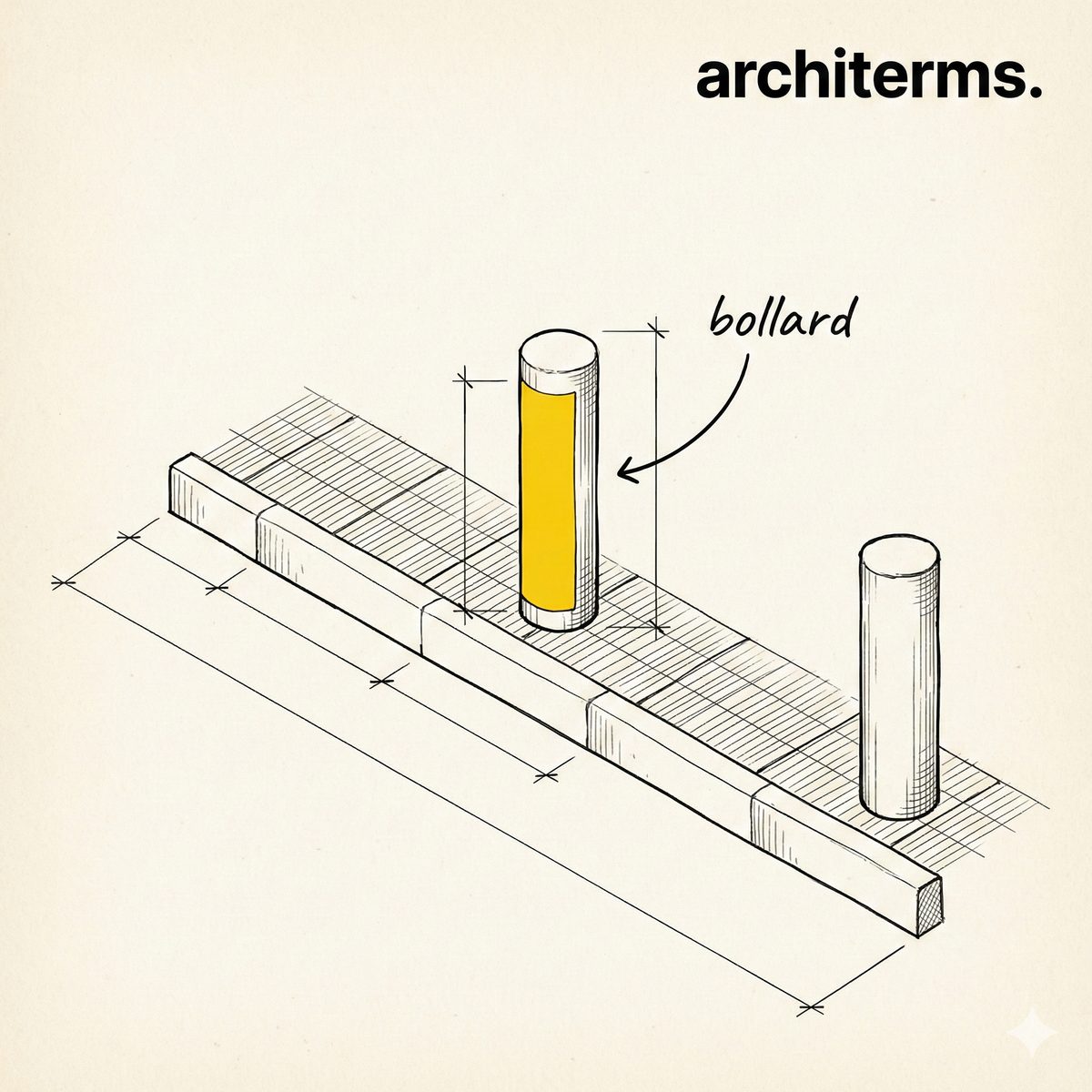
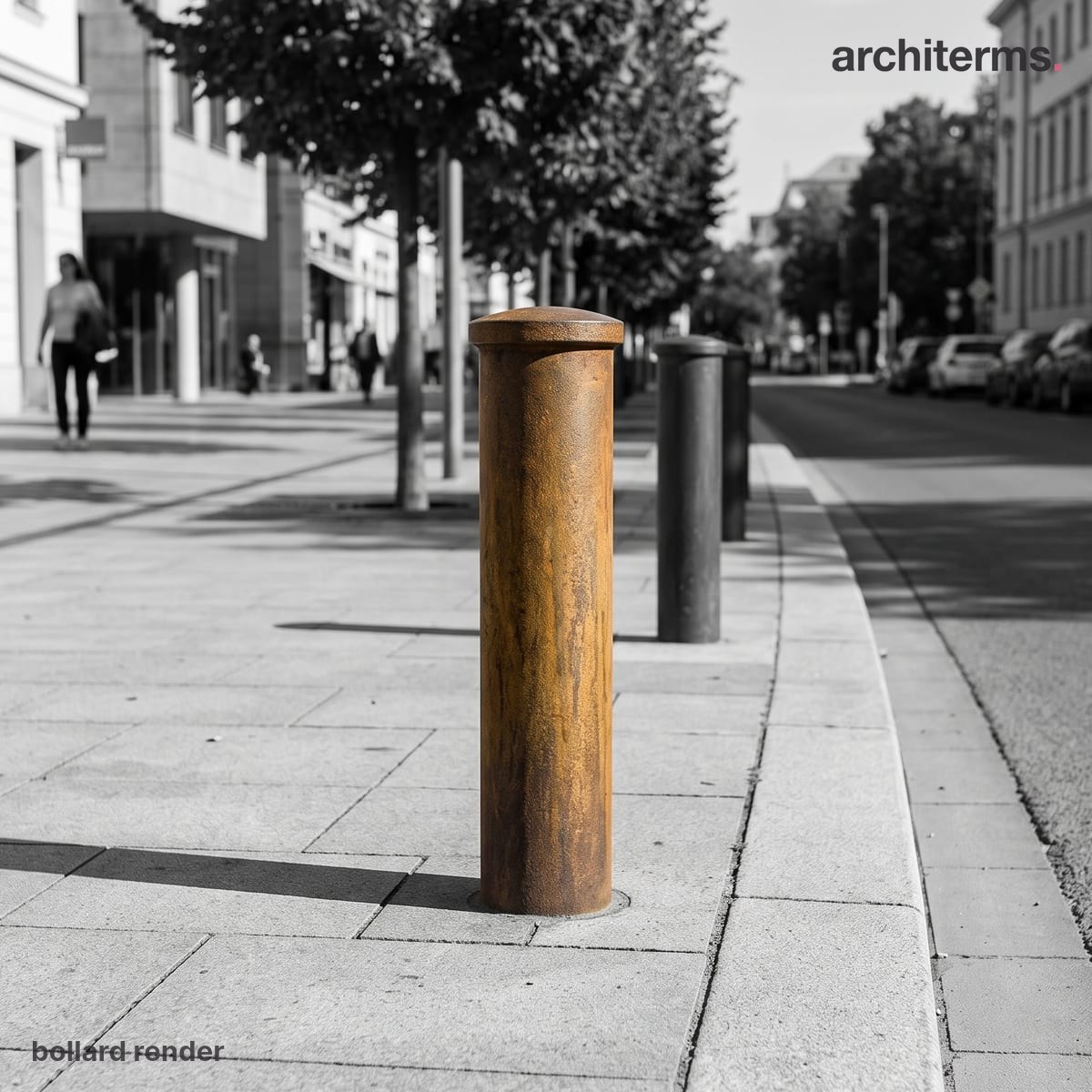
A bollard is a low, solid post fixed into the ground along the edge of a pedestrian space. Set in a line with gaps too narrow for a car but wide enough to walk through, it keeps vehicles off the footpath while leaving people free to pass.
Created with Reviz.Design — AI rendering for architects and interior designers
Definition
A bollard is a short, stout post set into the ground to keep vehicles out of a space while leaving people free to walk through it. The same word covers a granite stump on a medieval quay, a cast iron post outside a Georgian doorway, and a steel cylinder built to stop a truck. What changes is rarely the shape but the depth and strength of whatever sits below the paving.
Because a bollard obstructs a point rather than a line, it only does useful work in a row. The critical dimension is therefore the gap between one post and the next: wide enough for a wheelchair, a pram or a bicycle, and tight enough that the body of a car cannot pass. Most other decisions follow from that spacing and from whether the post must stop a vehicle or only tell a driver where not to go.
A bollard is a short vertical post, most often cylindrical and usually standing somewhere between about 900 and 1200 millimetres above the ground, installed singly or in a line to control vehicle movement, to protect a building frontage or a piece of equipment, and to mark the edge of an area that people may cross freely. In landscape and highway work it is the standard device for separating pedestrian from vehicle territory where a continuous barrier would be unwelcome, or where the surface is laid flush from building face to building face. Bollards may be permanently fixed, removed or lowered for occasional access, or lit from within. They may be simple visual markers or fully engineered impact barriers, and the difference between the two lies almost entirely underground.
Bollard History
The word reached the street from the harbour. A bollard was first a short thick post on a quay, a jetty or a ship's deck, around which mooring ropes were turned and made fast, and it still does that job at sea; the pulling power of a tug is quoted as its bollard pull. The origin of the word is not settled, but it is usually traced to bole, meaning the trunk of a tree, which suits the earliest examples, heavy timber posts sunk upright into a wharf.
The move inland followed the growth of wheeled traffic. Warehouse yards, market streets and city thoroughfares needed something to keep cart wheels off walls, doorways and footways, and redundant timber and stone posts were pressed into that service. From the nineteenth century the cast iron bollard became a standard foundry product, which is why so many historic streets carry bollards in matching patterns. A persistent London tradition holds that surplus cannon were set muzzle down in the pavement after the Napoleonic wars and reused as bollards; the account is hard to verify, and most surviving cannon shaped bollards appear to have been cast in that form on purpose, with a rounded cap suggesting a ball resting in the muzzle. Concrete and welded steel took over much of the market in the twentieth century, and the pedestrianisation of town centres from the 1960s onward turned the bollard into a planning instrument. More recently the need to protect crowded public places from vehicles has produced a family of impact rated bollards tested as security barriers.
Bollard in Architecture
Practice sorts bollards by how they behave rather than by how they look, and the families overlap:
- —Fixed bollards: set permanently in a concrete foundation or bolted to a base plate, defining an edge that never has to open.
- —Removable bollards: lifted out of a flush ground socket and usually locked in place, so a delivery vehicle, a market stall or a fire appliance can be let through and the post replaced afterwards.
- —Retractable bollards: telescoping into a sleeve below the paving, worked by hand or by a hydraulic, pneumatic or electric drive, which suits an access point opened several times a day.
- —Folding and collapsible bollards: hinged at the base so the post drops flat, a cheaper answer than a below ground sleeve where the paving cannot be deeply excavated.
- —Illuminated bollards: hollow posts carrying a low level light source, used along paths and parking edges to light the walking surface without throwing light upward.
- —Security bollards: engineered to absorb the energy of a moving vehicle rather than simply to be seen, tested against published vehicle barrier standards and specified by the mass and speed of the vehicle to be stopped.
Materials follow the same split between appearance and performance. Stone and cast iron dominate conservation work and historic streets, ductile iron and steel tube are standard for new installations, and concrete gives mass cheaply where an industrial look is acceptable. Timber suits parks and rural settings. Many catalogue bollards are a steel core with a decorative sleeve of stainless steel, cast aluminium or polymer slipped over it, so the visible finish and the structural element are separate and a damaged sleeve can be replaced without disturbing the foundation.
The foundation is the part that decides what a bollard can actually do. An amenity bollard may sit in a modest concrete pocket no larger than a fence post Footing, while an impact rated one usually needs a deep foundation or, where buried services forbid excavation, a shallow mounted type engineered with a reinforced slab that spreads the load. Two posts that look identical above ground can therefore behave completely differently, which is why a drawing showing only the visible post specifies very little.
Setting out matters as much as the item itself. Guidance differs between countries, but spacing along a footway is commonly around 1.2 to 1.5 metres between centres, which leaves a clear opening comfortable for an accessible pedestrian route while denying the gap to a car. Bollards are normally held back from a kerb face so a vehicle overhang cannot strike them, and a contrasting band near the top helps people with limited vision detect them. In a shared surface street the bollard is only one of several devices at work: the Setback of the building line supplies a margin that people can occupy safely, a change in the Paver pattern signals where vehicles are tolerated, and where the footway runs above a change in ground level the earth is held by a Retaining Wall or a Gabion, with bollards added along the top only to stop a vehicle reaching the edge.
Common confusion
A bollard is not a kerb. A kerb is a continuous linear edge that separates carriageway from footway, channels surface water towards gullies and gives a tactile line to follow, and a determined driver can simply mount it. A bollard interrupts a point and blocks that gap absolutely if it is built to, which is the usual answer where a level surface has no kerb at all. The two often work together, the kerb doing the drainage, the bollards the exclusion.
Nor is a bollard a guard rail. Pedestrian guard railing is a continuous fence that herds people towards a crossing point, whereas bollards leave pedestrian Circulation open in every direction and restrict vehicles only. Guard railing is now often removed on the grounds that it clutters the street and lengthens journeys on foot, while a line of bollards achieves the same exclusion with far less visual obstruction.
The most consequential confusion is between an amenity bollard and a security bollard. A heavy looking cast iron post may be no more than decoration bolted to a slab, while a slim stainless cylinder may be a tested barrier over a deep foundation. Appearance carries no reliable information about performance. Finally, the harbour meaning survives alongside the street one, and a mooring bollard, sometimes called a bitt, is shaped for a horizontal pull from a rope rather than an impact from a vehicle.
Frequently Asked Questions
What is a bollard used for?
A bollard is used to keep vehicles out of an area while letting people walk through it. Lines of bollards protect footways, squares, shopfronts and building entrances, guard equipment such as fuel pumps and cabinets, and mark the boundary of a pedestrian zone. In harbours the same word means a post used to secure mooring lines.
How far apart should bollards be spaced?
Spacing is set by what has to pass and what has to be excluded. Guidance varies by country, but bollards on a footway are commonly placed around 1.2 to 1.5 metres apart between centres, which leaves a clear opening comfortable for a wheelchair or a pram while being too narrow for a car. Security installations are spaced according to testing and to the vehicle they are meant to stop, so local standards should always be checked.
What are the different types of bollards?
The main families are fixed, removable, retractable, folding or collapsible, illuminated, and impact rated security bollards. Fixed posts are set permanently in a foundation, removable ones lift out of a ground socket, retractable ones sink into a sleeve below the paving, and folding ones hinge flat at the base. Illuminated bollards add a low level light source, and security bollards are engineered to arrest a moving vehicle.
What is the difference between a bollard and a kerb?
A kerb is a continuous raised edge that separates the carriageway from the footway and channels surface water, but a vehicle can drive over it. A bollard is a separate post that physically blocks a point along that line. Level shared surface streets often have no kerb at all, which is exactly where bollards do the work of keeping vehicles out.
What are security bollards made of?
Most impact rated bollards are a thick steel tube, often filled with concrete and reinforced internally, with a decorative sleeve of stainless steel or another material slipped over the top. Their resistance comes mainly from the foundation rather than the post, so they are installed either in a deep concrete foundation or, where buried services prevent digging, as a shallow mounted unit tied into a reinforced slab.