Pile Foundation.
A pile foundation is a deep foundation of long columns—piles—driven or cast into the ground to carry a building's loads down to strong soil or rock below weak surface layers. In plain terms: when the soil near the surface is too soft to build on, piles reach down like deep legs to firmer ground.
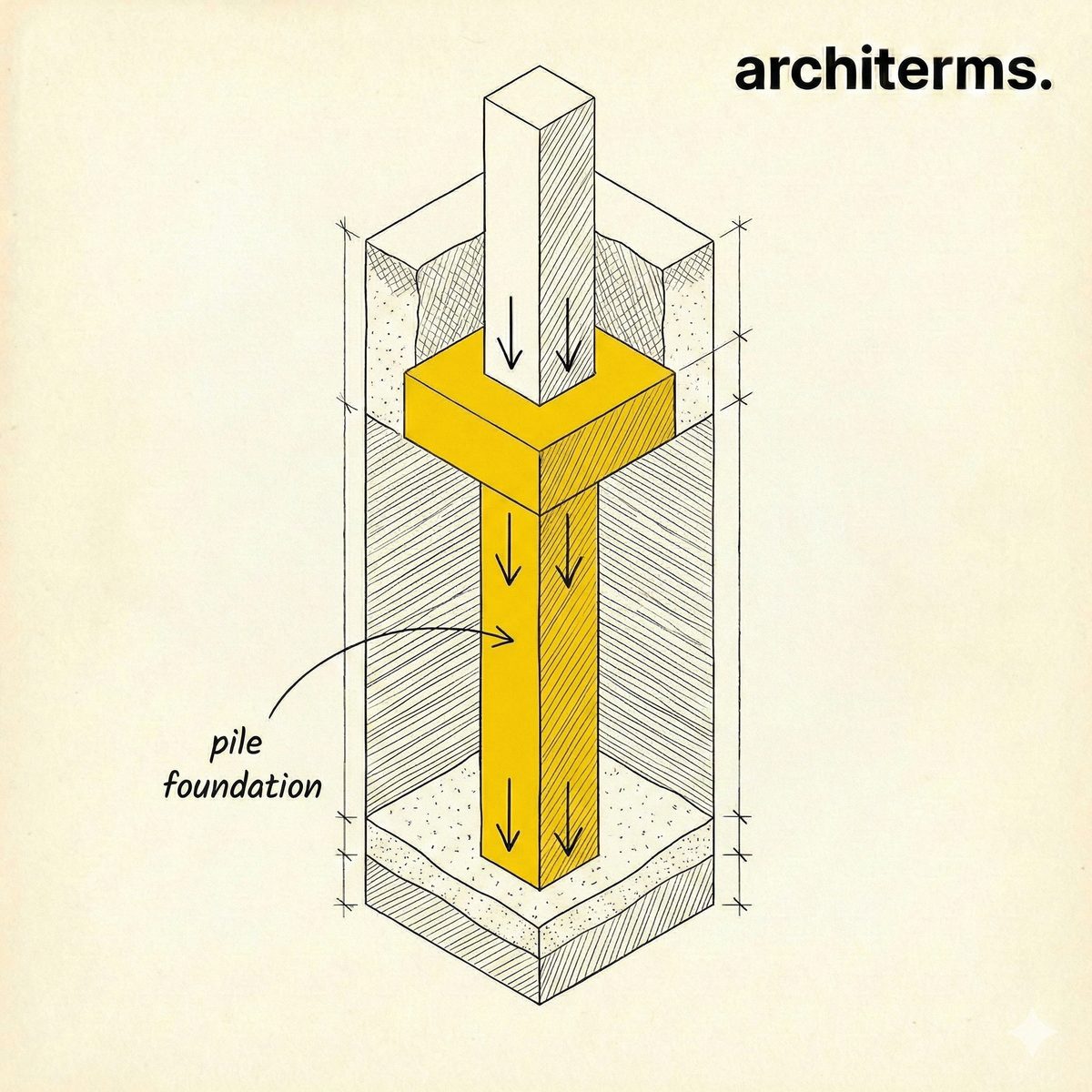
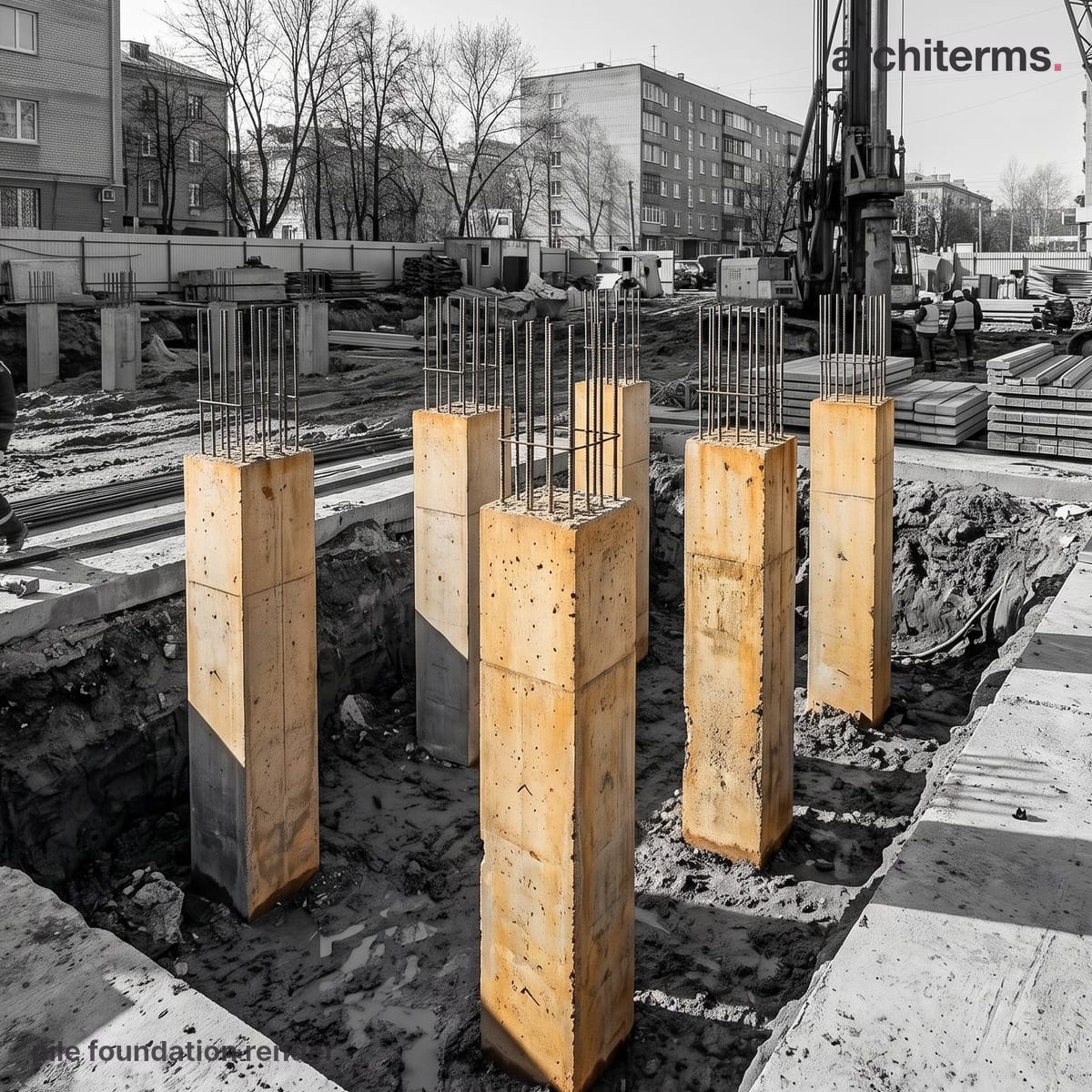
A pile foundation carries the building's loads through weak surface soil down to firmer ground below. Each pile is cast with reinforcing bars left exposed at the top, ready to tie into the cap or grade beam that will link the piles together.
Made with Reviz.Design — AI visualization for architects and interior designers
Definition
A pile foundation is used when the soil at the surface cannot safely support a structure. Instead of spreading loads on shallow footings, piles—slender columns of concrete, steel, or timber—extend deep into the ground to transfer the building's weight to stronger soil or bedrock far below, or to mobilize the grip of the surrounding soil along their length.
Piles are essential for heavy structures, tall buildings, bridges, and anything built on made ground, soft clay, or waterlogged sites. They are usually capped by a thick concrete slab, the pile cap, which ties a group of piles together and spreads the column or wall load among them.
A pile foundation is a type of deep foundation in which vertical or near-vertical structural members called piles transmit loads from a structure through weak, compressible soil to a deeper stratum of dense soil or rock. Piles carry load in two ways: end-bearing piles rest their tips on a firm layer and act like columns to it, while friction piles transfer load through skin friction between their sides and the surrounding soil. Piles are commonly grouped and joined at the top by a reinforced-concrete pile cap that distributes the superstructure's loads to the group.
Pile Foundation History
Driving timber piles into soft ground is ancient: lake dwellings, Roman bridges, and the buildings of Venice all stand on wooden piles. For centuries timber remained the main material, kept durable by being permanently below the water table. The 19th and 20th centuries introduced stronger and longer piles of concrete and steel, along with machinery to drive or bore them deep. Modern practice includes driven precast piles, cast-in-place bored piles, and screw piles, chosen to suit the soil, the loads, and the site—allowing skyscrapers and major bridges to be founded on ground that could never carry them on shallow footings.
Pile Foundation in Architecture
Pile foundations make difficult sites buildable:
- —Reaching firm ground: Where surface soils are soft, fill, or waterlogged, piles bypass them to find competent bearing strata deeper down.
- —Heavy and tall loads: Concentrated loads from tall buildings and bridges are carried by groups of piles working together beneath columns and walls.
- —End-bearing vs. friction: Depending on the ground, piles may rest on a hard layer, rely on friction along their shafts, or combine both.
- —Pile caps and ground beams: Caps tie pile groups together and receive the columns above, while ground beams span between caps to support walls.
Choosing the pile type, length, and arrangement is a geotechnical decision based on soil investigation, loads, and site constraints such as noise, vibration, and access.
Common confusion
Pile foundation vs. shallow foundation: A shallow foundation (such as a strip or pad footing) spreads load onto soil near the surface; a pile foundation is a deep foundation that carries load to strong soil far below. Piles are used when shallow soils are too weak.
End-bearing vs. friction pile: An end-bearing pile transfers load through its tip onto a firm layer like a column; a friction pile transfers load along its sides through friction with the surrounding soil. Many piles act partly by both mechanisms.
Pile vs. pile cap: A pile is the deep column itself; the pile cap is the thick reinforced-concrete block on top that joins a group of piles and spreads the structure's load among them.
Pile vs. caisson/pier: Piles are relatively slender and often installed in groups; a caisson or drilled pier is a larger-diameter deep foundation, sometimes a single shaft beneath a column. The distinction is mainly one of size and method.
Frequently Asked Questions
What is a pile foundation?
A pile foundation is a deep foundation made of long columns called piles that are driven or cast into the ground to carry a building's loads down to strong soil or rock below weak surface layers. It is used when the soil near the surface is too soft or unstable to support the structure on shallow footings.
When is a pile foundation used?
Pile foundations are used where surface soils are soft, loose, filled, or waterlogged, and where loads are heavy or concentrated, as under tall buildings and bridges. By reaching deeper, firmer ground, piles provide safe support that shallow foundations could not achieve on such sites.
What is the difference between end-bearing and friction piles?
An end-bearing pile carries load through its tip, which rests on a firm layer of soil or rock, acting like a column down to that stratum. A friction pile carries load through skin friction along its sides with the surrounding soil. Many real piles work by a combination of both.
What is the difference between a pile and a pile cap?
A pile is the deep structural column installed into the ground, while the pile cap is the thick reinforced-concrete block placed on top of a group of piles. The cap ties the piles together and spreads the load of the column or wall above evenly among them.
What materials are piles made of?
Piles are commonly made of reinforced concrete, steel, or timber. Concrete piles may be precast and driven or bored and cast in place; steel piles are used for great strength and length; and timber piles, the oldest type, are still used where they remain permanently below the water table.